Cryptocurrency Colocation Hosting: Bitcoin, Ethereum & Multi-Chain Infrastructure Guide
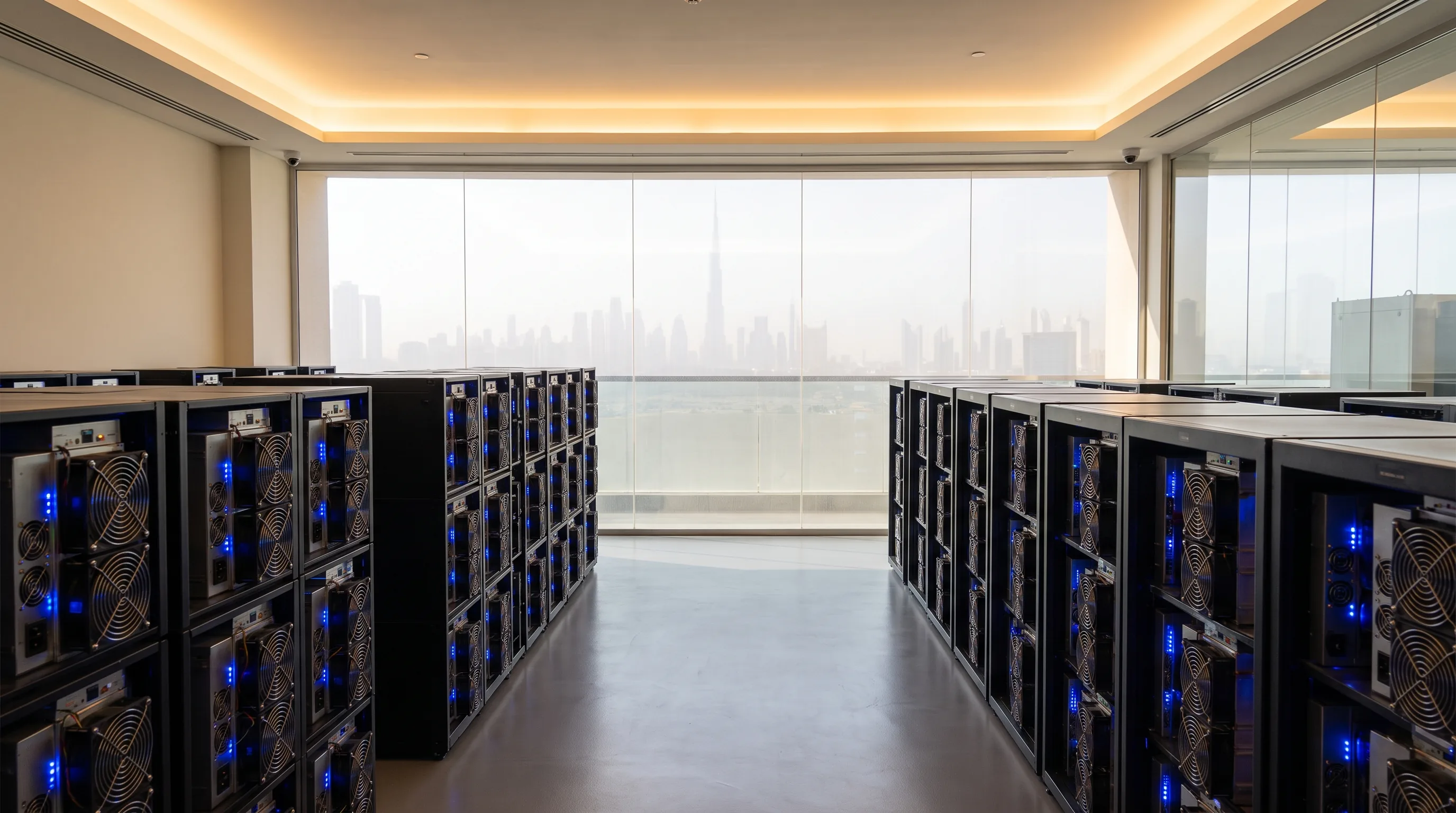
The cryptocurrency infrastructure landscape has fundamentally expanded beyond Bitcoin mining. While ASIC miners still account for the largest share of colocation demand by power consumption, Ethereum validator nodes, Solana validators, cross-chain bridge infrastructure, and decentralized storage nodes now represent a rapidly growing segment of the colocation market. Each asset class demands different hardware, different power profiles, different cooling strategies, and different contractual structures.
This guide covers the full spectrum of cryptocurrency colocation hosting in 2026: from megawatt-scale Bitcoin mining deployments to low-power, high-uptime validator infrastructure. It examines the technical requirements for each workload type, compares pricing models across regions, evaluates the UAE regulatory framework that makes it an increasingly attractive jurisdiction, and provides a decision framework for choosing between facility types, contract structures, and geographic locations.
What Cryptocurrency Colocation Actually Means
Cryptocurrency colocation is a hosting arrangement where a data center provides the physical infrastructure (space, power, cooling, network, and security) for customer-owned cryptocurrency hardware. The customer ships or installs their equipment at the facility and retains full ownership and operational control, while the provider handles everything from electrical distribution to ambient temperature management.
This model differs from cloud mining or managed mining services in a critical way: the customer owns the hardware. There is no shared hash rate, no pooled returns, and no abstraction layer between the operator and their machines. The colocation provider is an infrastructure partner, not a financial intermediary.
The colocation model has proven especially valuable for cryptocurrency operations because of the unique demands these workloads place on facilities. Bitcoin ASIC miners draw 3,000 to 3,500 watts per unit and generate extreme heat. Ethereum validators require near-perfect uptime or face slashing penalties. Multi-chain infrastructure needs diverse network peering for low-latency block propagation. No single cloud provider or generic hosting service can efficiently serve all of these requirements, which is why purpose-built colocation has become the dominant deployment model for serious cryptocurrency operators.
Bitcoin ASIC Mining Colocation
Bitcoin mining remains the largest category of cryptocurrency colocation by both power consumption and revenue. A single modern ASIC miner like the Bitmain Antminer S21 Pro draws approximately 3,500 watts while producing 234 terahashes per second (TH/s). At scale, a 1 MW mining deployment accommodates roughly 280 to 300 S21 Pro units, producing approximately 65 to 70 petahashes per second (PH/s) of aggregate hashrate.
Power and Cooling Requirements
The defining characteristic of Bitcoin mining colocation is power density. A standard 42U rack loaded with ASIC miners can draw 30 to 40 kW, compared to 5 to 8 kW for traditional IT workloads. This means mining facilities must provision significantly more electrical capacity per square foot than general-purpose data centers. The most efficient approach is purpose-built mining halls with open-air or semi-contained cooling rather than traditional raised-floor environments.
Cooling strategy directly impacts operating costs. In hot climates like the UAE, immersion cooling can reduce cooling-related power consumption by 30 to 40 percent compared to air-cooled configurations. The Antminer S21 Hydro and similar hydro-cooled ASIC models are designed specifically for direct liquid cooling loops, enabling rack densities that would be impossible with air cooling alone.
Typical PUE (power usage effectiveness) for air-cooled mining facilities ranges from 1.15 to 1.35, meaning 15 to 35 percent of total power consumption goes to cooling and facility overhead. Liquid-cooled facilities achieve PUE values of 1.03 to 1.08, translating to meaningful savings at scale. For a 10 MW deployment paying $0.065/kWh, the difference between 1.30 PUE and 1.05 PUE represents approximately $180,000 in annual cooling cost savings.
Pricing Models for Mining Colocation
Bitcoin mining colocation is almost universally priced per kilowatt-hour. This reflects the reality that power is the dominant variable cost and the primary differentiator between facilities. The all-in rate per kWh typically includes electrical power, cooling, rack space, basic monitoring, and physical security.
Current market rates vary significantly by region:
| Region | Typical Rate ($/kWh) | Power Source | Key Advantage |
|---|---|---|---|
| West Texas, USA | $0.045 - $0.065 | Wind, natural gas, curtailment | Lowest base power costs |
| Quebec, Canada | $0.050 - $0.070 | Hydroelectric | Renewable, cold climate cooling |
| UAE (Abu Dhabi / Dubai) | $0.065 - $0.095 | Natural gas, solar hybrid | Zero corporate tax, regulatory clarity |
| Iceland / Norway | $0.040 - $0.060 | Geothermal, hydroelectric | Near-zero cooling costs, 100% renewable |
| Paraguay | $0.035 - $0.050 | Itaipu hydroelectric | Lowest global rates |
Beyond the base kWh rate, miners should evaluate setup fees (typically $50 to $200 per unit for racking, cabling, and initial configuration), minimum commitment periods (usually 6 to 24 months), and power curtailment policies. Some facilities in deregulated power markets like Texas participate in demand response programs, where miners agree to shut down during peak grid demand in exchange for lower base rates. This can reduce effective power costs by 10 to 20 percent but introduces periodic downtime that affects hashrate consistency and ROI calculations.
Ethereum and Proof-of-Stake Validator Infrastructure
Since Ethereum's transition to proof-of-stake in September 2022, validator node hosting has emerged as a distinct colocation category with fundamentally different requirements than mining. A single Ethereum validator requires a 32 ETH stake and runs on commodity server hardware, consuming approximately 50 to 150 watts per validator instance depending on client software (Lighthouse, Prysm, Teku, Nimbus, or Lodestar) and whether execution and consensus clients run on the same machine.
Hardware Requirements for Validators
Unlike Bitcoin mining, Ethereum validation does not require specialized hardware. A single physical server with a modern CPU (Intel Xeon or AMD EPYC), 32 GB of RAM, and 2 TB of NVMe SSD storage can run 20 to 50 validator instances simultaneously. The constraint is not compute power but storage I/O: the execution layer client (Geth, Nethermind, Besu, or Erigon) maintains a full blockchain state database that requires sustained random read/write performance.
This makes validator infrastructure ideal for standard colocation racks. A single 42U rack consuming 2 to 4 kW can host hundreds of validators, making the per-validator infrastructure cost negligible compared to the ETH stake requirements. The dominant cost factors are not power but uptime, network quality, and geographic distribution.
Uptime and Slashing Risk
Ethereum validators face financial penalties for downtime. Offline validators lose approximately the same amount they would have earned during that period (inactivity leak). More severely, validators that produce conflicting attestations or proposals face slashing, which can destroy a portion of their staked ETH.
This penalty structure makes uptime the single most important metric for validator colocation. Facilities must provide N+1 or 2N power redundancy, UPS systems with sufficient battery runtime for generator transfer, and multiple independent network paths. A validator that goes offline for 4 hours during a network-wide outage faces accelerated penalties under the inactivity leak mechanism, which increases penalties quadratically the longer a large portion of the network is offline simultaneously.
Colocation contracts for validator infrastructure typically include SLA commitments of 99.95 percent uptime or higher, with financial credits for downtime that reflect the economic reality of missed attestations and potential slashing risk.
Network Requirements
Validators require consistent, low-latency network connectivity to produce timely attestations. Each attestation must be included within one epoch (6.4 minutes), but propagation speed affects inclusion distance, which affects rewards. A validator with a well-connected network position (multiple diverse peers, low-latency BGP routes to major Ethereum nodes) earns slightly more than a validator on a congested or high-latency connection.
Bandwidth requirements are modest by data center standards: approximately 10 to 20 Mbps per validator node during normal operation, with peaks during state sync or client updates. The quality of connectivity matters more than raw bandwidth. Facilities with direct peering to major internet exchanges and multiple Tier 1 transit providers offer measurably better validator performance.
Multi-Chain Validator and Infrastructure Hosting
Beyond Bitcoin mining and Ethereum staking, the cryptocurrency colocation market now serves a growing variety of blockchain infrastructure workloads. Each chain has distinct hardware, network, and operational requirements that influence facility selection.
Solana Validators
Solana validators are among the most hardware-intensive proof-of-stake workloads. A competitive Solana validator requires a high-performance server with 24+ CPU cores, 512 GB or more of RAM, and enterprise NVMe storage capable of sustained 100,000+ IOPS. Power consumption ranges from 500 to 1,000 watts per validator node, significantly higher than Ethereum.
The network's 400-millisecond slot time and leader schedule create strong incentives for geographic proximity to other validators and low-latency network connectivity. Colocation facilities in major internet exchange points (Amsterdam, Frankfurt, Tokyo, Virginia) consistently produce better vote inclusion rates for Solana validators than facilities in secondary markets.
Cross-Chain Bridge Nodes
Cross-chain bridge infrastructure (LayerZero, Wormhole, Axelar, and others) requires simultaneous connectivity to multiple blockchain networks. A bridge relayer or oracle node typically runs full or light nodes for two or more chains simultaneously, requiring diverse storage, moderate compute, and highly reliable network connectivity to both chains' peer networks.
The security sensitivity of bridge infrastructure makes colocation preferable to cloud hosting. Bridge exploits have historically resulted in losses exceeding $1 billion, and infrastructure compromise (key theft from cloud instances, man-in-the-middle attacks) has been a contributing factor in several incidents. Physical security controls at a colocation facility, including biometric access, CCTV, and dedicated caged areas, provide a security baseline that cloud environments fundamentally cannot match.
Decentralized Storage (Filecoin, Arweave)
Decentralized storage protocols reward operators for providing verifiable storage capacity. Filecoin storage providers require substantial disk arrays (often petabyte-scale), moderate GPU power for proof-of-spacetime computations, and reliable network connectivity for deal-making and retrieval requests. Power consumption is driven primarily by storage density: a single 4U storage server with 100 TB of capacity draws approximately 400 to 600 watts.
Colocation pricing for storage workloads is typically structured per rack unit rather than per kWh, since the power density is moderate but the physical space requirements are significant. Facilities with competitive per-unit rack pricing and flexible power scaling attract storage providers who may start with a few racks and grow to multiple cabinets as storage deals accumulate.
Crypto Workload Infrastructure Comparison
| Specification | Bitcoin Mining | Ethereum Validators | Solana Validators | Filecoin Storage |
|---|---|---|---|---|
| Power per Unit | 3,000-3,500 W | 50-150 W | 500-1,000 W | 400-600 W |
| Cooling Intensity | Extreme (30-40 kW/rack) | Low (2-4 kW/rack) | Moderate (5-10 kW/rack) | Low-Moderate (3-6 kW/rack) |
| Uptime Requirement | 95-99% acceptable | 99.95%+ critical | 99.9%+ important | 99.5%+ acceptable |
| Network Sensitivity | Low (pool relay) | Medium (attestation timing) | High (400ms slots) | Medium (deal retrieval) |
| Pricing Model | Per kWh all-in | Per rack/kW monthly | Per rack/kW monthly | Per rack unit monthly |
| Contract Length | 6-24 months | 12-36 months | 12-24 months | 12-36 months |
| Primary Cost Driver | Electricity price | Uptime/SLA guarantees | Network latency | Physical space |
UAE as a Cryptocurrency Colocation Hub
The United Arab Emirates has positioned itself as one of the most attractive jurisdictions globally for cryptocurrency infrastructure. The combination of regulatory clarity, zero corporate and personal income tax, strategic geographic location between Asian and European markets, and world-class data center infrastructure creates a compelling value proposition for crypto operators.
Regulatory Framework
The UAE regulatory landscape for cryptocurrency is multi-layered but increasingly coherent. Dubai's Virtual Assets Regulatory Authority (VARA), established under Law No. 4 of 2022, provides licensing and oversight for virtual asset service providers operating in the Emirate of Dubai (excluding the DIFC). Abu Dhabi's Financial Services Regulatory Authority (FSRA) within the Abu Dhabi Global Market (ADGM) offers a parallel framework with its own licensing categories.
For colocation operators specifically, the distinction between infrastructure service provision and virtual asset service provision is critical. A facility that provides power, cooling, and rack space for customer-owned mining equipment is providing a data center service, not a virtual asset service. This generally does not require a VARA or FSRA license. However, any facility that takes custody of cryptocurrency, operates mining pools, or provides financial services related to digital assets may trigger licensing requirements.
Compliance with TDRA (Telecommunications and Digital Government Regulatory Authority) requirements remains mandatory for all data center operations in the UAE, regardless of the nature of the hosted workloads. This includes telecommunications licensing, data protection compliance, and facility safety standards.
Tax Advantages
The UAE's tax structure offers significant advantages for cryptocurrency operations. With zero personal income tax and a 9 percent corporate tax rate that exempts the first AED 375,000 (approximately $102,000 USD) of profit, the effective tax burden on mining and staking operations is substantially lower than in most Western jurisdictions. Free zone entities may qualify for additional tax exemptions depending on the specific zone and activity.
This tax advantage is particularly meaningful for proof-of-work mining operations where the margin between electricity cost and block reward revenue is often thin. A 10 MW Bitcoin mining operation generating $500,000 in monthly revenue before electricity costs might retain $50,000 to $100,000 in monthly profit. In a jurisdiction with 25 to 30 percent corporate tax, that profit shrinks to $35,000 to $70,000. In the UAE, the full $50,000 to $100,000 is retained, net of the 9 percent corporate tax above the threshold.
Geographic and Network Advantages
The UAE sits at the intersection of three major time zones and markets. For mining operations, this geographic position provides access to both Asian and European mining pool servers with reasonable latency (sub-100ms to major pools in both regions). For validator operations, the UAE offers a geographic diversification option for operators who already run validators in North America and Europe, improving their network's resilience against regional outages.
Dubai's role as a global submarine cable hub (hosting landing points for multiple international fiber routes including the Europe India Gateway, IMEWE, and FOG systems) provides excellent network connectivity for low-latency blockchain operations. The peering ecosystem continues to develop as more data center operators establish interconnection facilities.
Security Considerations for Crypto Colocation
Cryptocurrency hardware represents concentrated financial value, making physical security a primary concern for colocation customers. A single rack of ASIC miners can represent $200,000 to $500,000 in hardware value, and a compromised validator node can result in slashing penalties that destroy staked capital.
Physical Security Layers
Enterprise-grade crypto colocation facilities implement multiple overlapping security layers. The minimum acceptable standard includes perimeter fencing with intrusion detection, vehicle barriers at entry points, 24/7 on-site security personnel, biometric access control for all facility areas, mantrap entry systems for data halls, individual cabinet locks with electronic audit trails, and comprehensive CCTV coverage with a minimum 90-day recording retention.
For high-value deployments, facilities should offer private caged areas within the data hall, providing a physical barrier and dedicated access control beyond the standard rack lock. Cage deployments are particularly relevant for institutional operators running validator infrastructure for staked assets worth millions of dollars, where the physical security of the hardware directly maps to the financial security of the staked capital.
Network Security
Mining pools and validator connections are frequent targets for various network attacks. DDoS protection is essential for any public-facing infrastructure, and mining operations should use encrypted stratum connections (Stratum V2) to prevent hashrate hijacking. Validator operators should implement VPN tunnels for all management interfaces and restrict beacon node peer connections to known, trusted peers where possible.
Network segmentation between colocation tenants prevents lateral movement in the event of a compromise. Each customer's network segment should be fully isolated at the switch layer with separate VLANs, and any shared infrastructure (monitoring, management) should use out-of-band networks that are not accessible from tenant segments.
Evaluating and Choosing a Crypto Colocation Provider
Not all data centers are equipped to handle cryptocurrency workloads. The evaluation process should address several criteria specific to crypto operations beyond the standard colocation checklist.
Power Infrastructure
Verify the facility's total available power capacity and the portion allocated to high-density deployments. A facility with 10 MW of total capacity but only 2 MW provisioned for mining-density racks will constrain growth. Examine the power distribution architecture: dedicated transformer feeds for mining areas, appropriately rated PDUs, and sufficient electrical headroom for future expansion.
The power procurement strategy directly affects long-term pricing stability. Facilities with fixed-rate power purchase agreements can offer more stable kWh pricing than those on variable or spot market electricity. Ask to see the power cost structure and understand how fluctuations are handled contractually.
Cooling Capacity
Cooling is the second-largest cost component after electricity. Evaluate the cooling system architecture: air-cooled facilities with hot-aisle/cold-aisle containment, rear-door heat exchangers for moderate density, or liquid cooling loops for high-density ASIC deployments. In hot climates, verify that the facility can maintain acceptable operating temperatures during peak summer conditions without throttling or shutting down equipment.
Contract Flexibility
Cryptocurrency markets are cyclical, and infrastructure needs change with market conditions. The ideal contract structure balances commitment length (which enables lower pricing) with flexibility provisions for scaling up, scaling down, or swapping equipment. Key terms to negotiate include minimum commitment penalties, equipment swap procedures, and power tier adjustments.
Insurance and Liability
Verify the facility's insurance coverage and understand the delineation of liability between provider and customer. The colocation agreement should clearly specify who bears risk for equipment damage from power events, cooling failures, fire, theft, and natural disasters. Many customers carry their own equipment insurance as a supplement to the facility's general liability coverage.
Scaling from a Single Rack to Megawatt Deployments
Most crypto colocation relationships start small and grow. A miner might begin with 10 to 20 ASIC units in a shared rack, then scale to dedicated racks, then to a private cage, and eventually to a dedicated data hall. The colocation provider's ability to support this growth trajectory without requiring facility changes or contract renegotiation at each stage is a significant differentiator.
Key scaling milestones and their implications:
| Scale | Power | Typical Setup | Management Approach |
|---|---|---|---|
| Starter (10-50 units) | 30-175 kW | Shared rack space | Remote hands for maintenance |
| Growth (50-200 units) | 175-700 kW | Dedicated racks or cage | Remote monitoring + periodic site visits |
| Scale (200-1,000 units) | 700 kW - 3.5 MW | Private cage or room | On-site technician (full or part-time) |
| Enterprise (1,000+ units) | 3.5 MW+ | Dedicated hall or purpose-built facility | Dedicated operations team |
At each scaling stage, the relationship between operator and facility deepens. Small deployments can be managed entirely through remote tools and occasional remote-hands support. As scale increases, the operator typically places staff on-site and negotiates more customized infrastructure arrangements, including dedicated power feeds, custom cooling solutions, and private network interconnects.
Total Cost of Ownership: Colocation vs Alternatives
Understanding the true cost of crypto colocation requires comparing it against realistic alternatives: home mining, cloud mining, and building a purpose-built facility.
For small-scale Bitcoin mining (under 50 units), residential electricity rates ($0.10 to $0.25/kWh in most markets) make home mining significantly more expensive than colocation ($0.045 to $0.095/kWh). The math is straightforward: a single S21 Pro consuming 3,500W at $0.15/kWh costs $460/month in electricity, while the same unit at a $0.065/kWh colocation facility costs $200/month. The $260/month savings per unit covers the colocation overhead and then some.
For medium-scale operations (100 to 500 units), colocation is the clear winner over cloud mining. Cloud mining contracts typically yield 15 to 30 percent less than physical mining at equivalent hash rates, because the cloud mining provider must embed their own facility costs, profit margin, and risk premium into the contract price. With colocation, the miner captures the full block reward minus only electricity and hosting costs.
For large-scale operations (1 MW+), the decision becomes more nuanced. Building a purpose-built containerized facility can achieve lower long-term costs if the operator has access to competitive power at the site level. However, the upfront capital expenditure ($800,000 to $1.2 million per MW for a turnkey containerized solution) and the 6 to 18 month deployment timeline create financial risk that colocation avoids. Many large operators use colocation as a bridge strategy: deploy immediately at a colocation facility while simultaneously building owned infrastructure for long-term capacity.
Emerging Trends in Crypto Colocation
The cryptocurrency colocation market continues to evolve in response to protocol changes, regulatory developments, and infrastructure innovation.
Hybrid facilities that serve both AI/GPU workloads and cryptocurrency mining are becoming more common. The power and cooling infrastructure required for ASIC mining overlaps significantly with GPU colocation for AI training, and facilities that can dynamically allocate capacity between mining and AI workloads based on market conditions achieve higher utilization rates and better returns on infrastructure investment.
Renewable energy integration is increasingly a differentiator rather than a nice-to-have. Institutional capital, ESG-conscious fund managers, and publicly traded mining companies actively prefer facilities powered by renewable or low-carbon energy. Renewable-powered mining operations command premium valuations and face less regulatory risk in jurisdictions that are tightening emissions requirements for data centers.
Restaking and actively validated services (AVS) are creating demand for new categories of validator infrastructure. EigenLayer and similar protocols enable staked ETH to secure additional networks simultaneously, requiring validators to run additional software modules alongside their Ethereum clients. This increases both compute and storage requirements per validator node, pushing operators toward dedicated colocation rather than shared cloud instances.
Regulatory convergence across jurisdictions is simplifying compliance for multi-location operators. As frameworks like MiCA (Markets in Crypto-Assets Regulation) in Europe and VARA in the UAE mature, the compliance burden for infrastructure providers becomes more predictable, enabling longer-term capital commitments and more standardized contract structures.
Multi-Asset Crypto Colocation in the UAE
Rax operates purpose-built facilities designed for the full spectrum of cryptocurrency infrastructure: from megawatt-scale ASIC mining halls with immersion cooling to Tier III colocation racks for validator nodes and staking infrastructure. Zero corporate tax jurisdiction, competitive power rates, and enterprise-grade security.
Request a Hosting Quote