Bitcoin Mining Power Costs: How Electricity Pricing Models Affect Your ROI
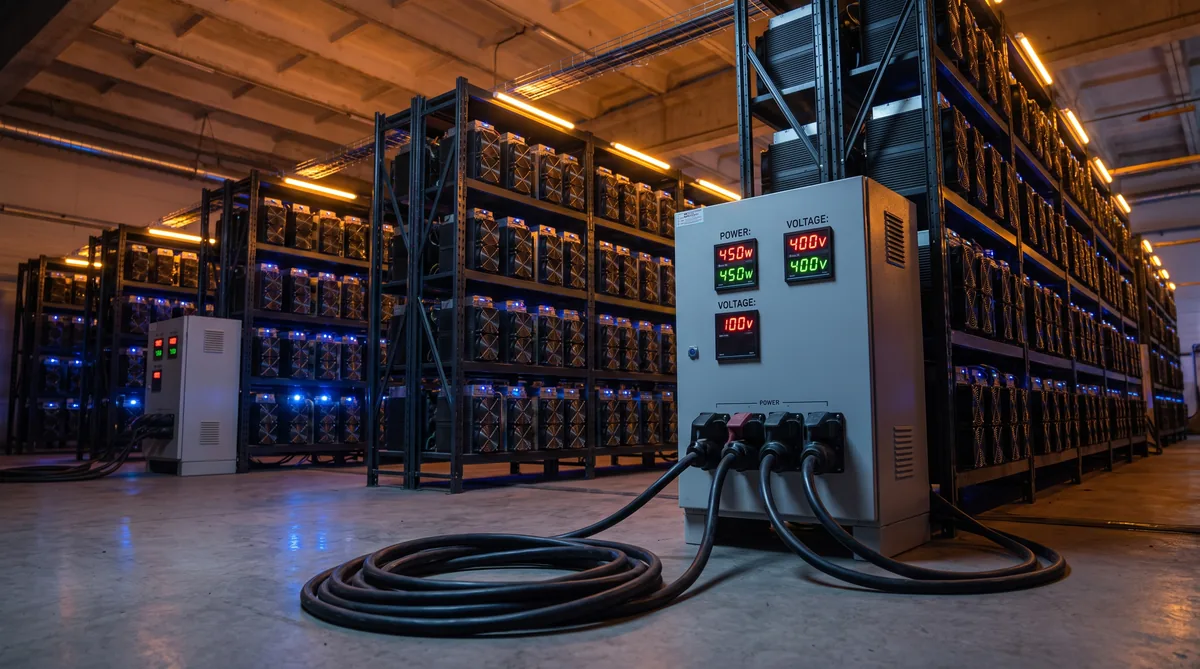
Electricity accounts for 60-80% of the operating cost of a Bitcoin mining operation. Yet many miners focus primarily on hardware selection while treating electricity as a fixed background cost. This is a mistake. The structure of your electricity contract -- not just the rate -- can swing your annual profitability by tens of thousands of dollars.
This article breaks down the three dominant electricity pricing models used in Bitcoin mining, shows how each affects ROI under different market conditions, and explains what to look for when negotiating with hosting providers or utilities.
The Three Electricity Pricing Models
1. Fixed-Rate Contracts
A fixed-rate contract locks in a per-kWh price for a defined term, typically 12-36 months. You pay the same rate regardless of market energy prices, time of day, or grid conditions.
How it works: You agree to a rate (e.g., $0.065/kWh) and a minimum power commitment (e.g., 500 kW). The hosting provider or utility guarantees that rate for the contract term.
| Advantages | Disadvantages |
|---|---|
| Budget predictability -- know exact costs month to month | Miss savings when wholesale energy prices drop |
| Protection against price spikes during grid emergencies | Locked in if better rates become available |
| Simpler operations -- no need to monitor energy markets | Provider builds in a risk premium (higher base rate) |
| Easier financial modeling for investors | Early termination penalties common |
Best for: Operations prioritizing financial stability, mining-backed lending arrangements, and smaller miners who cannot staff energy market monitoring.
2. Variable-Rate (Market-Indexed) Contracts
Variable-rate contracts tie your electricity cost to a wholesale energy index, typically with a small premium added by the hosting provider. Your effective rate changes hourly or daily based on grid conditions.
How it works: Your rate might be "ERCOT Day-Ahead + $0.015/kWh" or "spot market + 20%." When wholesale energy is cheap, you save. When it spikes, you pay more.
| Advantages | Disadvantages |
|---|---|
| Lower average cost over time (in most markets) | Unpredictable monthly bills |
| Benefit from off-peak and seasonal low prices | Exposure to price spikes ($1+/kWh during grid stress) |
| No lock-in penalty (typically shorter terms) | Requires energy market awareness |
Best for: Operations with the flexibility to adjust load based on price signals, and those in markets with generally low wholesale prices.
3. Curtailment-Based (Demand Response) Contracts
Curtailment contracts combine a competitive base rate with an agreement to reduce or shut down operations during periods of high grid demand. You earn revenue (or receive rate discounts) for curtailing when the grid operator requests it.
How it works: You get a base rate of, say, $0.045/kWh, but agree to shut down for 50-200 hours per year during grid stress events. Some contracts pay you a capacity payment for being available to curtail, effectively reducing your net electricity cost even further.
Real-World Impact: A 1 MW mining operation on a curtailment contract might curtail 150 hours/year. If those 150 hours would have cost $2-5/kWh on the spot market, the miner avoids $300K-$750K in potential spike costs while earning $15K-$50K in demand response payments.
Best for: Large-scale operations (500+ kW) in deregulated markets with robust demand response programs, particularly in regions like US data center markets with active grid balancing incentives.
ROI Comparison: Fixed vs. Variable vs. Curtailment
Let's model a realistic scenario: 100 Antminer S21 Pro units (3,500W each, 234 TH/s), total draw of 350 kW.
| Metric | Fixed ($0.065) | Variable (avg $0.052) | Curtailment ($0.045 base) |
|---|---|---|---|
| Annual electricity cost | $199,290 | $159,432 | $132,300* |
| Annual savings vs. fixed | -- | $39,858 | $66,990 |
| Uptime | 99.9%+ | 99.9%+ | 98.3% (150h curtailed) |
| Revenue impact of downtime | Minimal | Minimal | ~$5,000-$8,000 |
| Net annual advantage | Baseline | +$39,858 | +$59,000-$62,000 |
*Includes demand response credits. Assumes curtailment avoids the 150 most expensive hours.
The curtailment model shows the strongest ROI despite lower uptime, because the hours you curtail are precisely the hours when electricity would be most expensive. You lose a small amount of mining revenue but save disproportionately on power costs.
Factors That Determine Which Model Wins
Market Structure
Deregulated energy markets (like ERCOT in Texas) have more volatile wholesale prices, making variable and curtailment models more advantageous. Regulated markets with stable rates favor fixed contracts.
Scale
Curtailment programs typically require minimum loads of 250-500 kW. Smaller operations default to fixed or variable. At scale (5+ MW), you can negotiate bespoke hybrid structures combining elements of all three models.
Operational Flexibility
Variable and curtailment models require the ability to modulate power consumption -- either automatically via smart PDUs and mining firmware, or through manual shutdowns. If your hosting facility cannot remotely control individual machines, curtailment becomes operationally difficult.
Bitcoin Price Volatility
During Bitcoin bull markets, every hour of mining is more valuable, increasing the opportunity cost of curtailment. During bear markets, curtailment becomes even more attractive because the mining revenue forgone during curtailed hours is lower relative to the power cost savings.
Negotiating Your Electricity Contract
Whether you are negotiating with a hosting provider or directly with a utility, focus on these terms:
- All-in rate: Ensure the quoted rate includes transmission, distribution, and any facility charges. A "$0.04/kWh" rate that doesn't include demand charges can effectively cost $0.07+/kWh.
- Minimum commitment: Understand the power floor and penalties for underutilization. Avoid committing to more power than your hardware needs.
- Escalation clauses: Check whether the rate adjusts annually. A 3% annual escalator on a 3-year contract turns $0.06/kWh into $0.064 by year 3.
- Curtailment terms: If your contract includes curtailment, clarify: how many hours per year, notification lead time (15 min vs. 1 hour), and whether curtailment is mandatory or voluntary.
- Renewable energy credits: Some hosting providers offer renewable-powered mining, which may qualify for tax benefits or ESG-compliant investment structures.
The UAE Advantage for Mining Power Costs
The UAE offers a compelling combination for Bitcoin mining economics:
- Competitive industrial electricity rates: Favorable pricing compared to European markets and many US regions.
- Stable grid: Modern power infrastructure with minimal outages or price spikes, reducing the risk premium that volatile grids impose.
- Year-round operations: No seasonal energy price swings from heating demand, though cooling costs are a consideration in summer months.
- Renewable energy growth: The UAE's massive solar investment creates opportunities for solar-offset mining with favorable environmental positioning.
Rax Data & Energy offers competitive hosting rates with transparent pricing, high-density power, and the advanced cooling infrastructure needed for large-scale ASIC deployments.
Frequently Asked Questions
What is the biggest cost in Bitcoin mining?
Electricity is the largest operating expense in Bitcoin mining, typically accounting for 60-80% of total costs. For a single Antminer S21 Pro drawing 3,500W, electricity at $0.06/kWh costs approximately $1,839 per year. This is why the electricity rate and pricing model are the most important factors in mining profitability.
What electricity rate is profitable for Bitcoin mining?
With current Bitcoin prices and modern ASIC hardware (200+ TH/s efficiency), mining is generally profitable at electricity rates below $0.08/kWh. At $0.04-0.06/kWh, margins are healthy. Below $0.04/kWh, mining is highly profitable. Rates above $0.10/kWh make mining unprofitable for most hardware.
What is curtailment-based mining?
Curtailment-based mining uses variable electricity pricing tied to grid demand. Miners operate at full capacity during off-peak hours when electricity is cheapest and reduce or shut down during peak hours when prices spike. This model can reduce effective electricity costs by 20-40% compared to fixed-rate contracts.
Should I choose fixed or variable electricity rates for mining?
Fixed rates provide budget predictability and protect against price spikes, making them ideal for stable operations. Variable rates offer lower average costs but require operational flexibility to curtail during peak prices. Large-scale operations often use a hybrid approach: fixed-rate base load with variable pricing for additional capacity.
How do power costs in the UAE compare for Bitcoin mining?
The UAE offers competitive electricity rates for industrial and data center operations, typically lower than European markets and comparable to favorable US markets. Combined with modern infrastructure, strategic global positioning, and year-round operational stability, the UAE is an attractive location for Bitcoin mining. Contact us for current rate information.
Optimize Your Mining Power Costs
Get transparent, competitive electricity pricing for your Bitcoin mining operation with enterprise-grade hosting infrastructure.
Get a QuoteRelated Articles
- Data Center Power Redundancy: Why N+1 and 2N Architectures Matter
- colocation-ai-training-data-center.html">GPU Colocation for AI Training: How to Choose the Right Data Center
- Bitcoin Mining Hosting in the UAE: What Operators Need to Know