Why Cooling Technology Matters More Than Ever
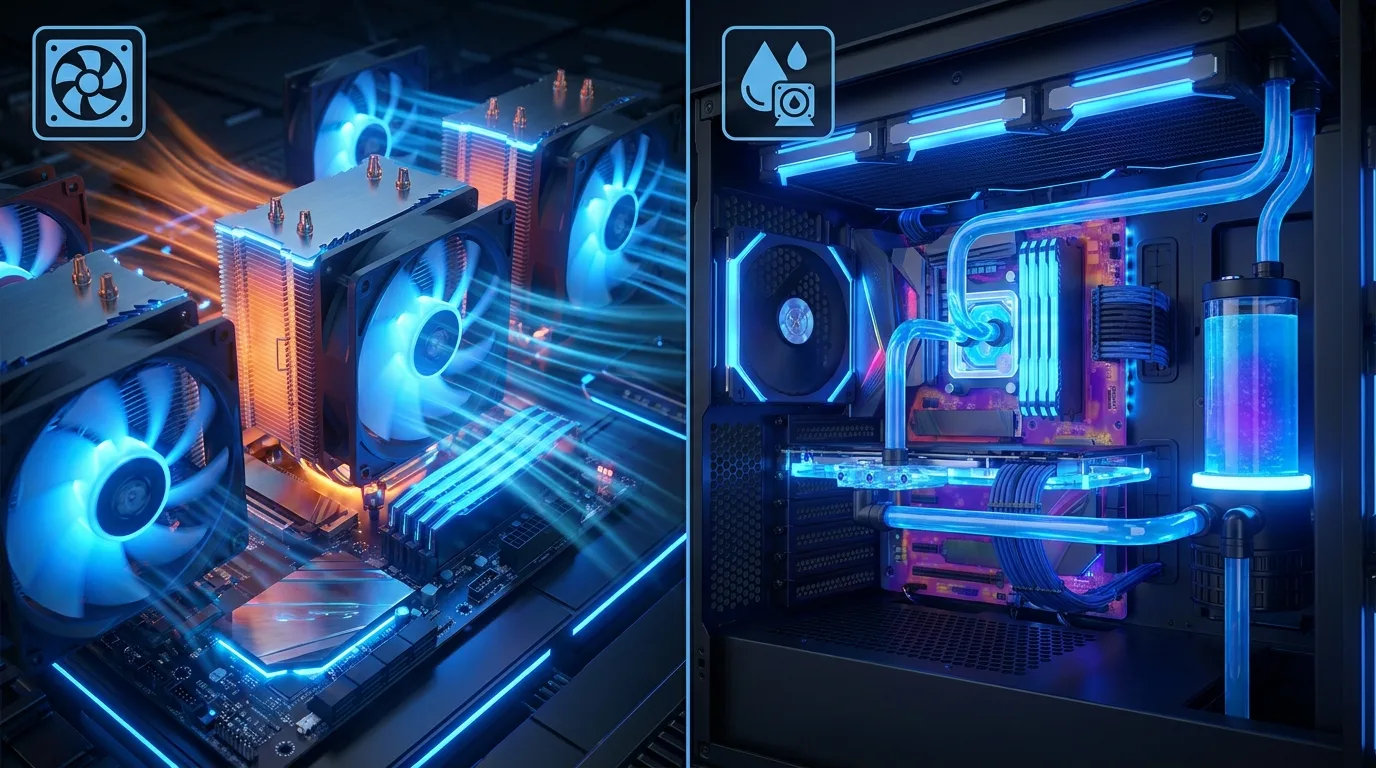
Every watt of electricity consumed by computing equipment becomes heat that must be removed from the data center. This is a fundamental law of thermodynamics with direct financial implications: the energy spent on cooling is pure overhead that generates no revenue. As power densities have exploded from 5-10 kW per rack for traditional IT workloads to 40-120+ kW per rack for modern GPU servers and ASIC miners, cooling has transformed from a routine background function into the primary infrastructure challenge and a major differentiator between facilities.
The right cooling technology can reduce total energy costs by 30-50%, enable deployment of the latest GPU hardware that cannot run on air cooling, extend equipment lifespan by maintaining optimal operating temperatures, and improve computational performance by preventing thermal throttling. The wrong cooling technology creates artificial limits on what hardware you can deploy, wastes energy, creates hot spots that accelerate component failure, and ultimately constrains your business.
This guide examines every major cooling technology used in data centers today, from traditional air conditioning to cutting-edge immersion systems, providing the technical specifications, cost data, and practical guidance that facility operators and technology buyers need to make informed decisions. Whether you are building a new facility from the ground up, retrofitting an existing data center for higher density, or evaluating cooling options for a planned GPU or mining deployment, the information here will help you match the right technology to your specific requirements and budget constraints.
Understanding Power Usage Effectiveness (PUE)
Before comparing cooling technologies, it is essential to understand PUE, the industry standard metric for data center energy efficiency. PUE is calculated as total facility power divided by IT equipment power. A PUE of 1.0 would mean zero overhead (physically impossible), while a PUE of 2.0 means the facility uses as much power for cooling, lighting, and other overhead as it does for actual computing.
- PUE 1.6-2.0: Inefficient legacy facilities with old cooling technology and no optimization
- PUE 1.3-1.6: Average modern facility with standard air cooling and basic efficiency measures
- PUE 1.1-1.3: Well-designed facility with economizer cooling and optimization
- PUE 1.05-1.1: Excellent efficiency, typically using liquid cooling technology
- PUE 1.01-1.05: Near-perfect efficiency, achievable with immersion cooling
Each 0.1 improvement in PUE saves approximately 10% on cooling energy costs. For a 10 MW facility at $0.05/kWh, improving PUE from 1.4 to 1.1 saves approximately $1.3 million per year. Over a facility's 15-20 year lifespan, this efficiency difference is worth tens of millions of dollars. PUE should be measured continuously using metered data (not estimated or calculated from nameplate ratings) and reported as an annual average to account for seasonal variations in cooling load. The best operators track PUE in real time and use it as a key performance indicator for their facilities management teams.
Air-Based Cooling Technologies
CRAC (Computer Room Air Conditioning)
CRAC units are the most traditional and widely installed data center cooling technology. They use a compressor-based direct expansion (DX) refrigeration cycle, essentially the same technology as a home air conditioner but at industrial scale, to cool air that is then distributed through a raised floor plenum or directly into the data hall.
- Maximum capacity: 5-20 kW per rack with hot/cold aisle containment
- PUE contribution: 0.4-0.6 (significant energy overhead from compressor operation)
- Capital cost: $200-400 per kW of cooling capacity
- Best for: Legacy deployments, small server rooms, low-density environments
- Limitation: Compressor-based cooling is energy-intensive and cannot efficiently handle modern high-density racks
CRAH (Computer Room Air Handler)
CRAH units use chilled water from a central chiller plant rather than a local compressor to cool the air. This centralized approach is more energy-efficient at scale because large central chillers are more efficient than many distributed compressors, and the system can leverage water-side economizers in cooler weather.
- Maximum capacity: 10-25 kW per rack with containment
- PUE contribution: 0.2-0.4 (better than CRAC due to chiller efficiency and economizer capability)
- Capital cost: $400-800 per kW including chiller plant
- Best for: Medium-density enterprise data centers, facilities that benefit from economizer hours
- Limitation: Still insufficient for the highest-density GPU deployments exceeding 25-30 kW per rack
In-Row Cooling
In-row cooling units are placed between server racks within the row, drawing hot exhaust air directly from the hot aisle and returning cooled air to the cold aisle. By placing the cooling closer to the heat source, air travel distance is minimized, reducing fan energy and improving heat capture efficiency.
- Maximum capacity: 15-35 kW per rack
- PUE contribution: 0.15-0.3
- Capital cost: $300-600 per kW
- Best for: Medium to high-density deployments, retrofitting existing data halls
Evaporative (Adiabatic) Cooling
Evaporative cooling uses the natural process of water evaporation to cool air, dramatically reducing or eliminating the need for mechanical refrigeration. This technology powers some of the most efficient data centers in the world, including facilities operated by Google, Microsoft, and Facebook in dry climates.
- Maximum capacity: 10-30 kW per rack
- PUE contribution: 0.05-0.15 (extremely efficient; cooling uses minimal electricity)
- Capital cost: $150-400 per kW
- Best for: Large-scale facilities in dry climates, mining operations in arid regions
- Limitation: Effectiveness directly depends on ambient humidity; high humidity climates severely reduce performance. Also consumes significant water, which may be a concern in water-scarce regions.
Liquid-Based Cooling Technologies
Rear-Door Heat Exchangers (RDHX)
RDHXs mount on the back door of server racks and use chilled water circulating through a radiator to neutralize the hot exhaust air before it enters the data hall. They are an effective bridge technology that adds liquid cooling capability to air-cooled servers without requiring server hardware modifications.
- Maximum capacity: 30-50 kW per rack
- PUE contribution: 0.1-0.2
- Capital cost: $3,000-8,000 per rack unit, plus chilled water distribution infrastructure
- Best for: Retrofitting existing facilities for higher density, bridging the transition from air to liquid cooling
- Limitation: Still relies on server-internal fans for air movement over heat sinks; cannot handle densities above approximately 50 kW per rack
Direct-to-Chip Liquid Cooling (Cold Plates)
Direct liquid cooling (DLC) circulates coolant through cold plates mounted directly on the hottest components (GPUs, CPUs, memory) inside the server. By removing heat at the source where thermal density is highest, DLC achieves dramatically better heat transfer than air. This is rapidly becoming the mandatory cooling technology for the latest AI hardware.
- Maximum capacity: 80-150+ kW per rack
- PUE contribution: 0.05-0.15
- Capital cost: $5,000-15,000 per rack, plus facility-level coolant distribution units (CDUs), piping, and external heat rejection
- Best for: High-density GPU deployments (H100 SXM, B200, GB200), any deployment above 50 kW per rack
- Requirements: Servers must have DLC-compatible cold plates installed (most new GPU servers support this); facility needs coolant distribution infrastructure
DLC has become the de facto standard for NVIDIA H100 SXM deployments at scale and is mandatory for Blackwell GB200 systems. The technology handles the heat generated by individual high-TDP components far more effectively than air, while allowing the remaining lower-heat components (drives, power supplies, network cards) to be air-cooled within the server chassis.
Immersion Cooling
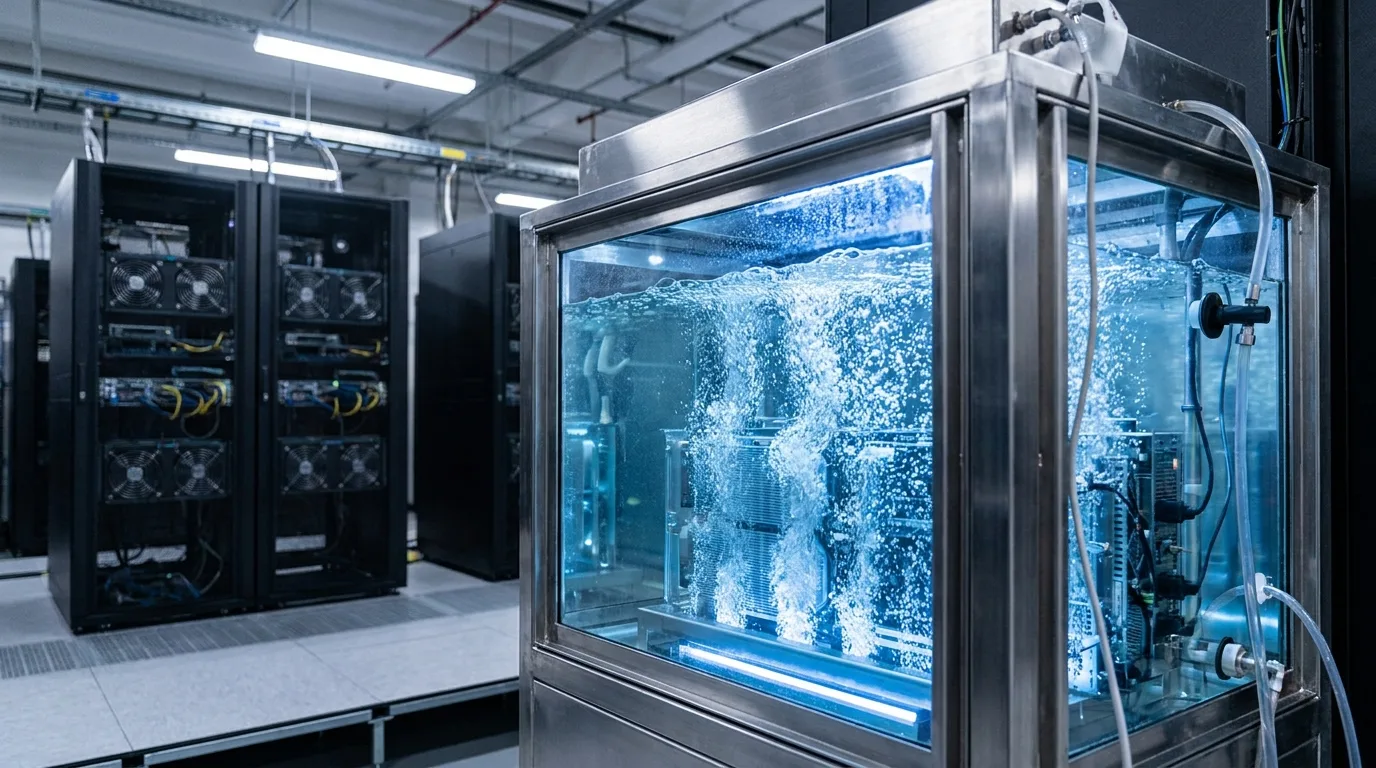
Immersion cooling submerges entire servers or individual components in a tank of dielectric (non-conductive) fluid. The fluid absorbs heat through direct contact with all surfaces of all components simultaneously, providing the most uniform and efficient heat transfer possible. For a detailed economic analysis specific to mining and AI, see Immersion Cooling vs Air Cooling: Complete ROI Analysis for Mining and AI.
Single-Phase Immersion
- How It Works: Servers are submerged in a fluid that remains liquid at all operating temperatures. Pumps circulate the warm fluid through external heat exchangers (dry coolers or cooling towers) where heat is rejected to the atmosphere.
- Maximum capacity: 100-250+ kW per tank
- PUE contribution: 0.02-0.08
- Best for: Cryptocurrency mining (eliminates fan noise and dust), AI inference, any workload where maximum density and minimum PUE are priorities
Two-Phase Immersion
- How It Works: Servers are submerged in a specially engineered fluid with a low boiling point (typically 49-56 degrees Celsius). The fluid boils on contact with hot component surfaces, and the vapor rises to condenser coils at the top of the sealed tank where it condenses back to liquid and drips down. This phase-change process transfers heat extremely efficiently.
- Maximum capacity: 200+ kW per tank
- PUE contribution: 0.01-0.05 (closest to theoretical minimum)
- Best for: Maximum density deployments, extreme heat loads, overclocking applications
- Limitation: Two-phase fluids are significantly more expensive than single-phase fluids, and the sealed tank design adds complexity to hardware maintenance and replacement
Comprehensive Technology Comparison
| Technology | Max kW/Rack | Facility PUE | CapEx per kW | Complexity |
|---|---|---|---|---|
| CRAC/CRAH | 15-25 | 1.4-1.8 | $200-800 | Low |
| In-Row | 25-35 | 1.3-1.5 | $300-600 | Low |
| Evaporative | 20-30 | 1.1-1.3 | $150-400 | Low-Medium |
| RDHX | 30-50 | 1.1-1.3 | $400-700 | Medium |
| Direct Liquid | 80-150+ | 1.05-1.15 | $600-1,200 | High |
| Immersion (single-phase) | 100-250+ | 1.02-1.10 | $800-1,500 | High |
| Immersion (two-phase) | 200+ | 1.01-1.05 | $1,000-2,000 | Very High |
Choosing the Right Cooling Technology
Decision Framework by Power Density
- Under 15 kW per rack: Traditional air cooling (CRAC/CRAH with hot/cold aisle containment) is sufficient and most cost-effective. No need for liquid cooling complexity.
- 15-35 kW per rack: In-row cooling or rear-door heat exchangers provide the additional capacity needed. Evaporative cooling is excellent if your climate supports it.
- 35-80 kW per rack: Transition zone where liquid cooling becomes increasingly necessary. RDHX can handle the lower end; DLC is preferred for the upper end and for future-proofing.
- 80+ kW per rack: Direct liquid cooling or immersion cooling are the only viable options. Air-based solutions simply cannot remove heat fast enough at these densities.
Design Philosophy: RAX Data & Energy selects cooling technologies based on each deployment's specific workload profile, local climate conditions, and long-term client requirements. Our facilities often combine multiple cooling approaches, using efficient air or evaporative cooling for lower-density sections while deploying DLC or immersion for high-density GPU and mining areas. This hybrid approach achieves optimal efficiency across the full range of power densities we support.
Implementation Considerations
Transitioning from one cooling technology to another, or designing a new facility to support multiple cooling approaches, requires careful planning across several dimensions. Structural considerations include floor loading capacity (immersion tanks are heavy), ceiling height (for overhead coolant distribution or hot air containment), and available floor space for CDUs, dry coolers, or chiller plants. Plumbing and piping for liquid cooling must be designed for leak containment, with drip trays, leak detection sensors, and automatic shutoff valves at critical junctions to prevent fluid damage to IT equipment.
Staff training is another critical factor. Technicians accustomed to air-cooled environments require new skills for liquid cooling maintenance, including fluid sampling and filtration procedures, pump and CDU servicing, cold plate connection and disconnection protocols, and fluid spill response procedures. Investing in comprehensive training before deploying liquid cooling technology prevents costly mistakes and ensures the system operates at its design efficiency from day one.
Vendor selection for cooling equipment should prioritize manufacturers with proven deployment track records, strong warranty terms, and responsive technical support. The cooling system is the backbone of facility reliability, and equipment failures in the cooling plant can force emergency shutdowns of all computing equipment within minutes. Redundancy in cooling infrastructure, such as N+1 CDUs or pumps, provides the maintenance flexibility and fault tolerance that production environments require.
Future Trends
- Liquid Cooling as the New Default: As GPU TDP climbs past 1,000W (NVIDIA Blackwell) and rack densities exceed 100 kW, liquid cooling is transitioning from a specialty option to the baseline expectation for new data center construction
- Waste Heat Recovery: Data centers are the world's most concentrated source of low-grade waste heat. Using this heat for building heating, agriculture (greenhouses, aquaculture), or industrial processes is gaining traction as both a sustainability measure and a potential revenue source
- Higher Coolant Temperatures: Operating liquid cooling loops at higher temperatures (40-50 degrees C rather than 20-30 degrees C) enables more efficient heat rejection to the atmosphere, extending the hours of free cooling even in warmer climates
- AI-Optimized Cooling Controls: Machine learning algorithms are being applied to cooling system management, dynamically adjusting fan speeds, pump flows, and chiller setpoints based on real-time workload predictions rather than static temperature thresholds. Early deployments report 10-20% additional cooling energy savings beyond what traditional control systems achieve