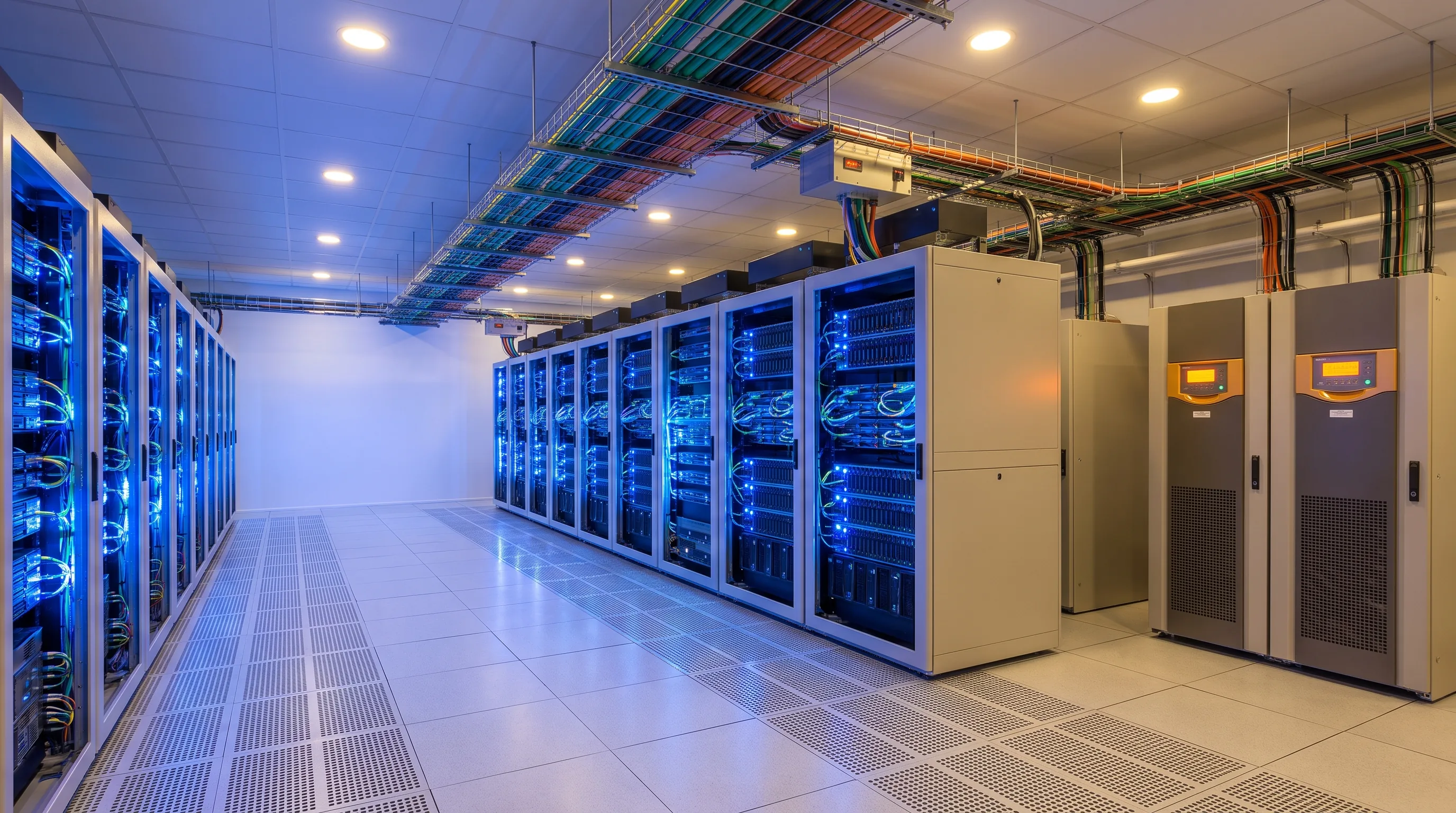
What Are Data Center Tiers?
When you evaluate colocation providers, cloud hosting platforms, or dedicated server facilities, one of the first specifications you encounter is the tier rating. Data center tier classification is a standardized framework developed by the Uptime Institute that rates facilities from Tier 1 (basic capacity) through Tier 4 (fault tolerant). Each tier defines specific requirements for power redundancy, cooling infrastructure, maintenance capabilities, and overall reliability.
Understanding these tiers is essential for making informed hosting decisions. The tier you choose directly affects your uptime guarantees, service level agreements, and total cost of ownership. Choosing too low a tier risks costly downtime; choosing too high wastes budget on redundancy you may not need.
Key Point: Tier certification is awarded by the Uptime Institute after rigorous on-site inspection. A facility claiming “Tier 3 equivalent” without official certification has not been independently verified. Always ask for the actual Uptime Institute certificate when evaluating providers.
The Four Tiers at a Glance
| Specification | Tier 1 | Tier 2 | Tier 3 | Tier 4 |
|---|---|---|---|---|
| Uptime Guarantee | 99.671% | 99.741% | 99.982% | 99.995% |
| Annual Downtime | 28.8 hours | 22 hours | 1.6 hours | 26.3 minutes |
| Power Redundancy | None (N) | Partial (N+1) | Full (N+1) | Full (2N or 2N+1) |
| Cooling Redundancy | None | Partial | N+1 | 2N |
| Distribution Paths | Single | Single | Multiple (one active) | Multiple (all active) |
| Concurrently Maintainable | No | No | Yes | Yes |
| Fault Tolerant | No | No | No | Yes |
| Typical Cost per kW | $5,000–$8,000 | $8,000–$12,000 | $15,000–$25,000 | $25,000–$40,000+ |
Tier 1: Basic Capacity
A Tier 1 data center provides dedicated space for IT systems with a single, non-redundant power and cooling distribution path. It includes an uninterruptible power supply (UPS) for filtering power fluctuations and a generator for extended outages, but there is no backup for any component. If the UPS fails or needs maintenance, the entire facility goes down.
Characteristics
- Single path for power and cooling distribution
- No redundant capacity components
- Must be shut down completely for planned maintenance
- Susceptible to disruptions from both planned and unplanned activity
Best Suited For
Small businesses with non-critical IT systems, development and testing environments, or organizations where occasional downtime is acceptable. Some bitcoin mining operations use Tier 1 facilities when hardware can tolerate brief power interruptions without data loss.
Tier 2: Redundant Capacity Components
Tier 2 builds on Tier 1 by adding redundant capacity components — an extra UPS module, additional cooling unit, or backup generator. The distribution path remains single, meaning a failure in the path itself still causes downtime, but individual component failures can be absorbed by the redundant units.
Characteristics
- Single distribution path served by redundant components (N+1)
- Engine generators and UPS modules beyond what is needed to run the facility
- Planned maintenance of the redundant components can occur without downtime
- Maintenance of the distribution path still requires shutdown
Best Suited For
Small to medium businesses with moderate uptime requirements. Many mining farm operations operate comfortably at Tier 2 because ASIC miners resume hashing immediately after power restoration — no data recovery is needed. The cost savings over Tier 3 can be redirected toward more efficient cooling infrastructure or additional hash rate.
Tier 3: Concurrently Maintainable
Tier 3 represents a significant jump in reliability. Every power and cooling component can be removed from service for maintenance without affecting IT operations. This requires multiple distribution paths, though only one path is active during normal operation (the other is available as a backup). Planned maintenance never causes downtime.
Characteristics
- Multiple independent power and cooling distribution paths
- Only one path active at a time (the other is on standby)
- N+1 redundancy for all capacity components
- All maintenance activities can occur without impacting the critical load
- A single unplanned event (fire, leak, equipment failure) can still cause downtime
Best Suited For
Enterprises running production workloads, AI model training that cannot tolerate checkpoint restarts, e-commerce platforms, financial services, and organizations where unplanned downtime has significant business impact. Most colocation providers offering enterprise SLAs operate at Tier 3 or above.
Tier 4: Fault Tolerant
Tier 4 is the highest classification. Every component and distribution path is fully duplicated (2N redundancy). Both paths are simultaneously active, sharing the load. Any single point of failure — whether a failed UPS, a broken chiller, or a severed utility feed — is automatically absorbed by the redundant system with zero impact on operations. Even an unplanned event does not cause downtime.
Characteristics
- Two simultaneously active power and cooling distribution paths
- 2N or 2N+1 redundancy for all components
- Fully fault tolerant — any single failure causes no disruption
- Compartmentalized construction to isolate failures
- Continuous cooling is maintained even during extended power outages
Best Suited For
Mission-critical applications where even seconds of downtime carry severe consequences: major financial trading platforms, government systems, healthcare record management, global SaaS platforms, and large-scale AI inference serving real-time applications. The cost premium over Tier 3 is substantial, so Tier 4 is justified only when the cost of downtime far exceeds the cost of redundancy.
Choosing the Right Tier for Your Workload
The right tier depends on your specific uptime requirements, budget, and the nature of your workload. The most common mistake is defaulting to the highest tier available without calculating whether the incremental reliability justifies the cost.
Cost of Downtime Analysis
Start by calculating what one hour of downtime costs your operation. For a bitcoin mining operation generating $500 per hour in revenue, 22 hours of annual downtime (Tier 2) represents $11,000 in lost revenue. Upgrading to Tier 3 reduces that to 1.6 hours ($800 lost), saving $10,200 per year. If the Tier 3 premium exceeds that savings, Tier 2 is the rational choice.
For an e-commerce platform generating $50,000 per hour, the calculus reverses dramatically. Even the difference between Tier 3 and Tier 4 — roughly 1.2 hours annually — represents $60,000 in revenue protection, easily justifying the Tier 4 premium.
Workload-Specific Recommendations
| Workload Type | Recommended Tier | Reasoning |
|---|---|---|
| Bitcoin / ASIC Mining | Tier 2–3 | Hardware tolerates brief outages; cost efficiency critical |
| AI Model Training | Tier 3 | Checkpoint restarts are expensive; concurrent maintenance essential |
| AI Inference (Production) | Tier 3–4 | Real-time SLAs require near-zero downtime |
| GPU Colocation | Tier 3 | High-value hardware needs reliable power and cooling |
| Web Hosting / SaaS | Tier 3 | Customer-facing availability is a competitive differentiator |
| Development / Staging | Tier 1–2 | Downtime has no revenue impact |
| Financial Trading | Tier 4 | Milliseconds of downtime can mean millions in losses |
Power and Cooling: The Core of Every Tier
The tier system fundamentally measures two things: how many ways power can reach your equipment, and how reliably cooling can be maintained. Three-phase power delivery is standard across all tiers, but how that power is protected varies dramatically.
At Tier 1, a single utility feed connects through a single UPS to a single power distribution unit (PDU). At Tier 4, two completely independent utility feeds connect through separate transformers, separate UPS systems, separate PDUs, and separate circuit paths to dual-corded equipment. A construction crew could sever one utility feed, and the facility would continue operating without interruption.
Cooling follows the same pattern. Modern cooling systems — including immersion cooling, precision air conditioning, and chilled water loops — are all rated by their redundancy configuration. N+1 means one extra unit beyond what is needed; 2N means the entire cooling system is fully duplicated.
Beyond the Tier: What Else Matters
Tier classification is important but not sufficient. Several factors that significantly affect real-world reliability are not captured by the tier system:
- Geographic Risk: A Tier 4 facility in a flood zone or seismic region faces risks that redundancy alone cannot address. Location selection matters as much as tier rating.
- Operational Maturity: The Uptime Institute also certifies operational sustainability — how well a facility is actually managed. A well-operated Tier 3 facility can outperform a poorly managed Tier 4.
- Technology Currency: Older Tier 3 facilities may use less efficient equipment than modern Tier 2 builds, affecting power usage effectiveness (PUE) and total cost.
- Network Connectivity: Tier classification says nothing about network redundancy, carrier diversity, or latency. These require separate evaluation.
- Energy Cost: A Tier 3 facility with $0.04/kWh power may deliver better total value than a Tier 4 facility at $0.12/kWh, depending on your workload.
The UAE Data Center Landscape
The UAE has emerged as a global data center hub, with most major facilities in Dubai and Abu Dhabi operating at Tier 3 or above. The country’s strategic position between Europe and Asia, combined with government investment in digital infrastructure and clear regulatory frameworks through TDRA, makes it an attractive location for high-tier colocation.
For organizations looking to host infrastructure in the region, the combination of modern Tier 3+ facilities, competitive power pricing, and proximity to emerging markets offers compelling value — particularly for AI compute and blockchain workloads that demand both reliability and cost efficiency.
Frequently Asked Questions
What is data center tier classification?
Data center tier classification is a standardized system created by the Uptime Institute that rates data center infrastructure on a scale from Tier 1 (basic) to Tier 4 (fault tolerant). Each tier defines specific requirements for power, cooling, and redundancy that determine the facility’s uptime guarantee.
What is the difference between Tier 3 and Tier 4 data centers?
Tier 3 data centers are concurrently maintainable, meaning any component can be serviced without taking the facility offline, with 99.982% uptime (1.6 hours annual downtime). Tier 4 data centers are fully fault tolerant with 99.995% uptime (26 minutes annual downtime) and can withstand any single equipment failure without impacting operations.
Which data center tier do I need for bitcoin mining or AI workloads?
Bitcoin mining operations typically perform well in Tier 2 or Tier 3 facilities because mining hardware can tolerate brief interruptions without data loss. AI training workloads, especially long-running model training jobs, benefit from Tier 3 or higher due to the cost of restarting interrupted training runs. AI inference serving mission-critical applications may require Tier 4.
Find the Right Tier for Your Infrastructure
Rax operates high-redundancy facilities designed for mining, AI compute, and enterprise colocation across multiple regions.
Contact Us Explore Rax Data