What Is Bitcoin Mining?
Bitcoin mining is the process by which new Bitcoin transactions are verified and added to the blockchain ledger. Miners use specialized computer hardware to solve complex mathematical puzzles, and in return, they receive newly minted Bitcoin as a reward. This process serves two critical functions: it secures the network against fraud and it introduces new Bitcoin into circulation according to a predictable, deflationary schedule.
Unlike traditional currencies issued by central banks, Bitcoin has no central authority. Instead, it relies on a decentralized network of miners spread across the globe to validate transactions and maintain consensus about the state of the ledger. This makes Bitcoin mining one of the most important innovations in modern finance and computer science.
At its core, mining is a competitive race. Thousands of miners around the world compete to be the first to find a valid solution to a cryptographic puzzle. The winner gets to add the next block of transactions to the blockchain and claim the block reward, currently 3.125 BTC after the Bitcoin Halving Guide 2024-2028: Impact on Mining, Price, and Strategy.
The term "mining" is an analogy to gold mining. Just as gold miners expend resources like labor, equipment, and energy to extract gold from the earth, Bitcoin miners expend computational resources including hardware and electricity to extract new Bitcoin from the protocol. The analogy extends further: just as gold becomes harder to mine over time as easily accessible deposits are exhausted, Bitcoin becomes harder to mine as the network grows and difficulty increases. This built-in scarcity mechanism is fundamental to Bitcoin's value proposition as digital gold.
For newcomers to cryptocurrency, understanding mining is essential because it underpins everything else in the Bitcoin ecosystem. The security of your Bitcoin holdings, the speed of your transactions, and the long-term value of the network all depend on a healthy, competitive mining industry. Whether you are considering becoming a miner yourself, investing in mining companies, or simply trying to understand how Bitcoin works at a deeper level, this guide will give you the comprehensive foundation you need.
The Proof-of-Work Algorithm Explained
Bitcoin uses a consensus mechanism called Proof-of-Work (PoW). This requires miners to expend computational energy to find a number, called a nonce, that when combined with the block data and passed through the SHA-256 hash function produces a hash value below a certain target threshold. The SHA-256 hash function takes any input and produces a fixed 256-bit output. Crucially, even the smallest change in input produces a completely different output, and there is no way to predict what input will produce a desired output other than trying every possibility.
Here is a simplified breakdown of how the process works:
- Step 1 - Transaction Collection: Miners gather unconfirmed transactions from the Bitcoin mempool (the waiting area for transactions). They select transactions based on fee priority, assembling them into a candidate block. Miners prioritize transactions offering higher fees per byte of data, maximizing the transaction fee revenue for that block.
- Step 2 - Block Header Construction: The miner constructs a block header containing the previous block hash, a Merkle root of all transactions, a timestamp, the current difficulty target, and a nonce field. The Merkle root is a cryptographic summary of all transactions in the block, computed by repeatedly hashing pairs of transaction hashes until a single hash remains.
- Step 3 - Hashing: The miner repeatedly hashes the block header using SHA-256 (actually double SHA-256, meaning the output is hashed again), incrementing the nonce each time, until they find a hash that is numerically less than the current difficulty target. Modern ASICs perform this operation hundreds of trillions of times per second.
- Step 4 - Block Propagation: Once a valid hash is found, the miner broadcasts the block to the network. Other nodes verify the solution by performing a single hash computation (which is trivial compared to finding the solution) and, if valid, add the block to their copy of the blockchain.
- Step 5 - Reward Collection: The successful miner receives the block reward (newly minted BTC) plus all transaction fees from the transactions included in the block. This reward is encoded in a special transaction called the coinbase transaction, which is the first transaction in every block.
The elegance of this system is that finding a valid hash is extremely difficult and requires enormous computational effort, but verifying that a hash is valid takes a single computation. This asymmetry is what makes the blockchain secure: it would cost an attacker billions of dollars in hardware and electricity to rewrite even a small portion of the blockchain's history, while any node on the network can instantly verify the entire chain's integrity.
When the 32-bit nonce field is exhausted (all 4.3 billion possible values have been tried without finding a valid hash), miners modify other fields in the block template, typically the extra nonce field embedded in the coinbase transaction or the timestamp, which changes the Merkle root and effectively resets the search space to another 4.3 billion possibilities.
Mining Hardware: From CPUs to ASICs
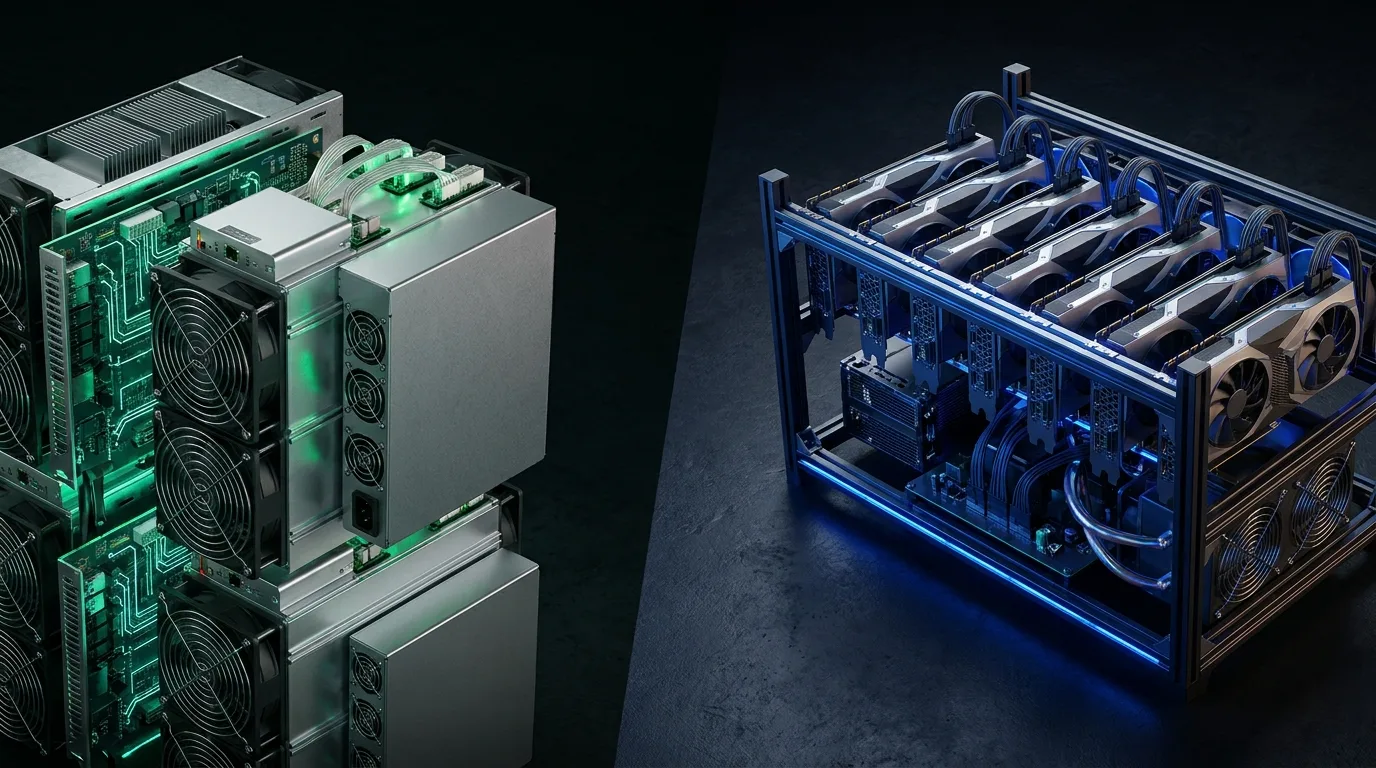
The evolution of Bitcoin mining hardware tells the story of an arms race driven by economics. When Bitcoin launched in 2009, anyone could mine with a standard CPU. Today, mining requires purpose-built machines that cost thousands of dollars each. For a detailed comparison, see our ASIC vs GPU Mining: Complete Comparison Guide for 2026.
The Four Generations of Mining Hardware
| Generation | Hardware | Era | Hash Rate | Efficiency |
|---|---|---|---|---|
| 1st Gen | CPUs | 2009-2010 | 2-20 MH/s | ~10,000 J/TH |
| 2nd Gen | GPUs | 2010-2013 | 200-800 MH/s | ~500 J/TH |
| 3rd Gen | FPGAs | 2011-2013 | ~1 GH/s | ~50 J/TH |
| 4th Gen | ASICs | 2013-Present | 100-350+ TH/s | 15-21 J/TH |
Modern ASIC miners like the Bitmain Antminer S21 Pro deliver over 230 TH/s at approximately 15 J/TH, representing a million-fold improvement over first-generation CPU mining. This relentless efficiency improvement is what drives the ever-increasing network hash rate and Bitcoin Mining Difficulty Explained: How It Works and Why It Matters.
What Makes ASICs So Efficient?
Application-Specific Integrated Circuits (ASICs) are chips designed to do one thing and one thing only: compute SHA-256 hashes. By eliminating all general-purpose computing capability, ASIC designers can optimize every transistor for maximum hashing throughput per watt of electricity consumed. This specialization makes ASICs orders of magnitude more efficient than general-purpose hardware. A modern ASIC contains billions of transistors arranged in massively parallel hash engines, each independently computing SHA-256 hashes. The chip's control logic coordinates these engines and checks outputs against the difficulty target, reporting valid nonces back to the mining controller software.
The major ASIC manufacturers as of 2026 include Bitmain (Antminer series), MicroBT (WhatsMiner series), and Canaan (AvalonMiner series). Each manufacturer pushes the boundaries of semiconductor technology, with current-generation chips fabricated on 5nm and 3nm process nodes, the same advanced manufacturing processes used in cutting-edge smartphone and server processors.
Mining Pools: Joining Forces
Solo mining, where a single miner attempts to find blocks independently, is essentially a lottery. With today's network difficulty, a single modern ASIC would statistically need to mine for years or even decades before finding a block on its own. This extreme variance makes solo mining financially impractical for most operators because it provides no predictable revenue stream.
Mining pools solve this problem by allowing thousands of miners to combine their hash rate and share rewards proportionally. When the pool finds a block, the reward is distributed among participants based on the computational work each contributed. This turns mining from a high-variance lottery into a relatively predictable income stream.
How Pool Mining Works
When a miner connects to a pool, the pool server assigns them work units, which are variations of the current block template with different starting nonce ranges. The miner hashes these work units and submits "shares" back to the pool. A share is a hash that meets a lower difficulty threshold than the actual Bitcoin difficulty, proving the miner is doing real work. When one of these shares happens to also meet the full Bitcoin difficulty target, the pool has found a valid block and everyone gets paid.
Pool Reward Structures
- PPS (Pay Per Share): Miners receive a fixed payment for each valid share submitted, regardless of whether the pool finds a block. The pool operator assumes the variance risk. This provides the most steady and predictable income, similar to receiving a salary rather than commission.
- FPPS (Full Pay Per Share): Similar to PPS, but also distributes estimated transaction fees in addition to the block subsidy. This has become the most popular method in 2026 as transaction fees represent an increasingly important revenue component.
- PPLNS (Pay Per Last N Shares): Rewards are only distributed when the pool finds a block, based on the last N shares submitted. This method discourages pool hopping but introduces more income variance. It typically results in slightly higher long-term returns for loyal pool members.
Major mining pools in 2026 include Foundry USA, AntPool, F2Pool, ViaBTC, and Braiins Pool. Pool selection affects not just revenue but also network decentralization, an important consideration for Bitcoin's long-term health. Miners are encouraged to distribute their hash rate across multiple pools to promote decentralization.
The Economics of Bitcoin Mining
Profitable Bitcoin mining in 2026 requires careful attention to three variables: hardware efficiency, electricity cost, and Bitcoin price. The interplay between these factors determines whether a mining operation generates profit or loss.
Key Economic Metrics
| Metric | Description | Target Range |
|---|---|---|
| Electricity Cost | All-in power cost per kWh | $0.03 - $0.06/kWh |
| Hash Price | Daily revenue per TH/s | Variable (market-dependent) |
| J/TH (Efficiency) | Joules per terahash | 15-25 J/TH (current gen) |
| Breakeven Power Cost | Max power cost for profitability | Varies by hardware + BTC price |
Electricity is the single largest operating expense for any mining operation, typically representing 70-80% of total costs. This is why site selection and power procurement are the most critical decisions in mining infrastructure. Operations with access to power below $0.05/kWh have a significant competitive advantage. For strategies on reducing power costs, see our guide on Electricity Cost Optimization for Mining Operations: Strategies That Work.
Beyond the direct costs, miners must account for hardware depreciation. ASIC miners lose value over time as newer, more efficient models are released and as wear and tear takes its toll. A typical ASIC has an economic useful life of 2-4 years, after which the combination of declining efficiency, increasing difficulty, and maintenance costs makes continued operation uneconomical. Smart operators plan for hardware refresh cycles and factor depreciation into their profitability calculations from day one.
Industry Insight: The most profitable mining operations in 2026 are not necessarily those with the newest hardware, but those with the lowest all-in electricity costs. A facility running older-generation S19 XPs at $0.03/kWh can outperform a facility running S21s at $0.08/kWh. Infrastructure and power procurement are the true competitive moats in mining.
What Mining Infrastructure Looks Like
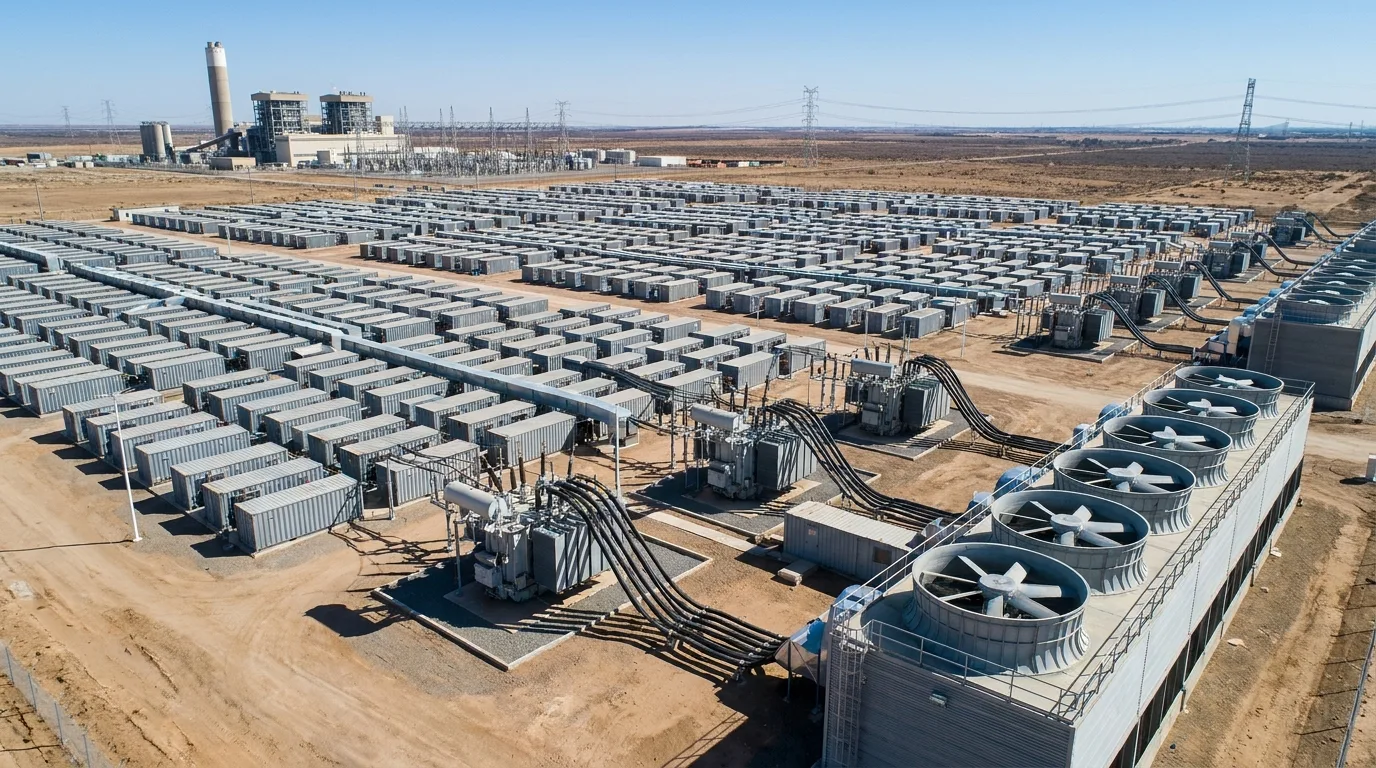
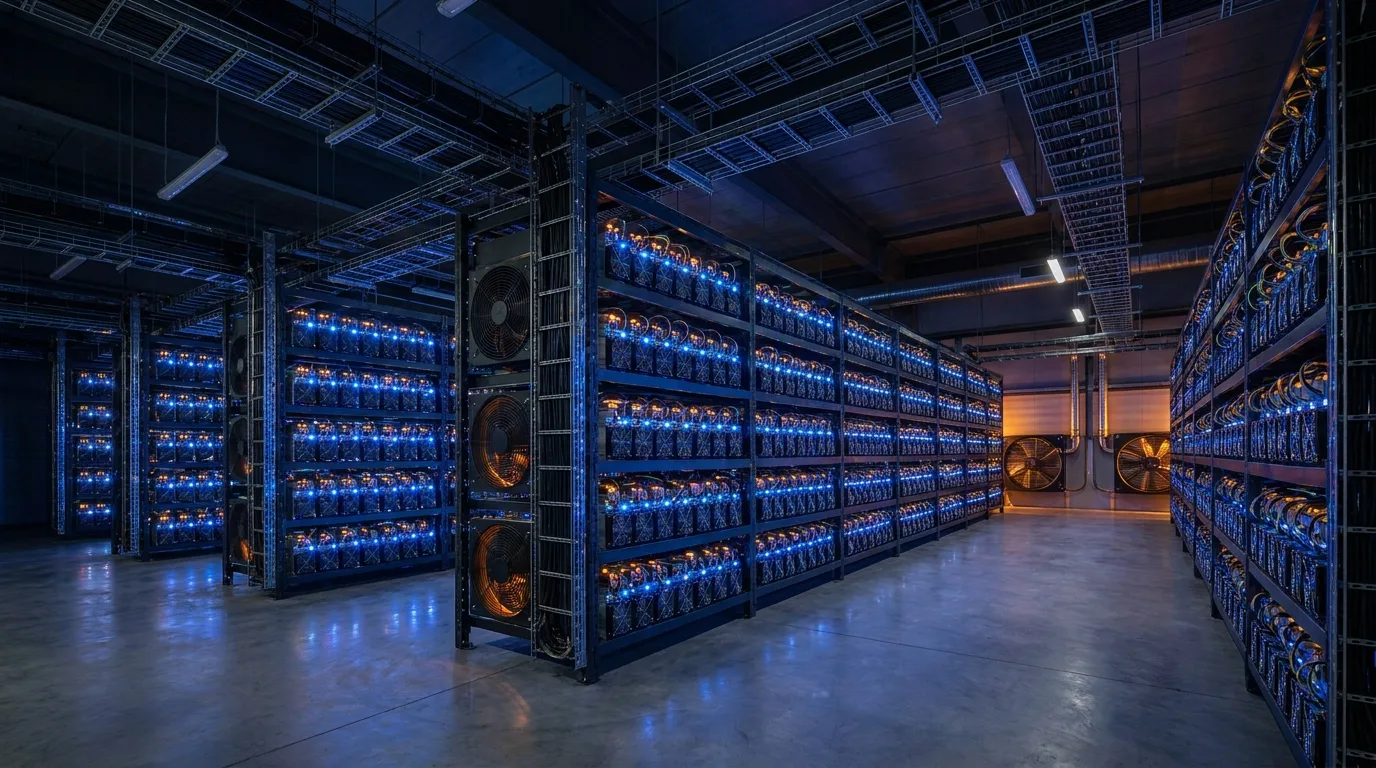
A modern Bitcoin mining facility is a highly engineered environment designed to house, power, cool, and network thousands of ASIC miners. The scale ranges from small containerized deployments of 1 MW to industrial mega-facilities exceeding 100 MW. For a deep dive into facility design, see our Mining Farm Design: From 1MW to 100MW - Complete Planning Guide guide.
Core Infrastructure Components
- Power Distribution: Transformers, switchgear, PDUs, and busways deliver Understanding Three-Phase Power for Mining and Data Centers to each rack or container. Power infrastructure typically accounts for 15-25% of total facility capital cost.
- Cooling Systems: Air cooling, evaporative cooling, or Immersion Cooling vs Air Cooling: Complete ROI Analysis for Mining and AI to manage the intense heat generated by ASICs. Every watt of electricity consumed by a miner becomes heat that must be removed from the facility.
- Networking: Redundant internet connectivity ensures miners maintain constant communication with mining pools. Unlike AI workloads, mining requires minimal bandwidth (about 100-500 Kbps per machine) but demands high reliability.
- Monitoring: SCADA systems, environmental sensors, and hash rate monitoring provide real-time visibility into operations. Modern facilities track temperature, humidity, power consumption, and hash rate for every individual machine.
- Physical Security: Fencing, cameras, access control, and on-site personnel protect millions of dollars in hardware. Mining facilities are attractive targets for theft, making robust physical security essential.
RAX Data & Energy specializes in providing turnkey mining infrastructure with reliable power, professional management, and optimized environments. Whether you are deploying 100 miners or 10,000, purpose-built infrastructure is essential for maximizing uptime and profitability.
Environmental Considerations and Sustainability
Bitcoin mining's energy consumption is one of the most debated topics in cryptocurrency. The network currently consumes approximately 150-180 TWh annually, comparable to the energy usage of a small country. However, the conversation is more nuanced than headlines suggest.
Several important factors provide context:
- Renewable Energy: Studies indicate that 50-60% of Bitcoin mining is powered by renewable energy sources, making it one of the greenest industries by energy mix. Many miners actively seek renewable energy because it tends to be cheaper, aligning environmental and economic incentives.
- Stranded Energy: Miners often utilize stranded or wasted energy, including flared natural gas at oil wells, curtailed wind and solar power that would otherwise go unused, and remote hydroelectric power with no nearby demand. By monetizing this otherwise wasted energy, mining can actually improve the economics of renewable energy projects.
- Grid Stabilization: Mining operations can act as flexible load, ramping down during peak demand periods and absorbing excess energy during off-peak hours, actually helping stabilize electrical grids. This demand-response capability is increasingly valued by grid operators.
- Efficiency Improvements: Each generation of ASIC hardware is dramatically more efficient, meaning the same hash rate requires less energy over time. The network's overall efficiency has improved by over 100x in the past decade.
- Waste Heat Recovery: Forward-thinking mining operators are finding productive uses for the heat generated by mining, including greenhouse heating, district heating systems, aquaculture, and lumber drying. This transforms waste heat into a valuable byproduct.
Getting Started with Bitcoin Mining
For those looking to enter Bitcoin mining, here is a practical roadmap:
Step-by-Step Guide
- 1. Research and Education: Understand the economics thoroughly before committing capital. Calculate projected revenue using online mining calculators with realistic electricity costs and difficulty projections. Factor in hardware depreciation, hosting fees, and the impact of future halvings on revenue.
- 2. Secure Power: Find a location or hosting provider with competitive electricity rates. All-in costs below $0.06/kWh are generally required for profitability. Consider factors beyond the per-kWh rate, including demand charges, power reliability, and contract terms.
- 3. Choose Hardware: Select ASIC miners based on efficiency (J/TH), reliability, and availability. Current-generation models from Bitmain, MicroBT, and Canaan are the standard choices. Buy from authorized resellers to ensure warranty coverage and authentic hardware.
- 4. Set Up Infrastructure: Whether self-hosting or using a What Is Colocation? Complete Guide to Data Center Colocation Services, ensure adequate power delivery, cooling, and networking. Proper infrastructure is not optional; cutting corners leads to downtime, hardware damage, and lost revenue.
- 5. Join a Mining Pool: Select a pool based on payout method, fees, server locations, and reputation. Configure your miners with both a primary and backup pool to ensure continuous operation even if one pool experiences issues.
- 6. Monitor and Optimize: Continuously monitor hash rate, temperatures, and power consumption. Tune firmware settings for optimal efficiency. Custom firmware like Braiins OS or LuxOS can improve efficiency by 5-15% through intelligent frequency and voltage tuning.
Pro Tip: For most miners, bitcoin colocation hosting with a professional facility like RAX Data & Energy is more cost-effective than building your own infrastructure. Hosting eliminates the capital expenditure and operational complexity of managing power, cooling, and physical security independently, letting you focus on the financial side of your mining operation.
The Future of Bitcoin Mining
Bitcoin mining continues to evolve rapidly. Key trends shaping the industry in 2026 and beyond include:
- Sub-15 J/TH Hardware: Next-generation ASICs are pushing below 15 J/TH, with some manufacturers targeting sub-10 J/TH within the next two years. Each efficiency improvement raises the bar for competitiveness and increases the network's total hash rate.
- Immersion Cooling Adoption: Liquid immersion cooling is moving from experimental to mainstream, enabling higher density deployments, extended hardware lifespan, and the ability to overclock miners for 15-30% more hash rate without thermal throttling.
- AI/Mining Convergence: Mining facilities are increasingly designed to be convertible between Bitcoin mining and What Is AI Hosting? Complete Guide to AI Infrastructure Services, providing revenue diversification. The power and cooling infrastructure required for mining overlaps substantially with AI/HPC needs.
- Institutional Participation: Publicly traded mining companies and institutional investors continue to professionalize the industry, driving higher standards for operations, compliance, financial reporting, and environmental responsibility.
- Transaction Fee Economy: As block subsidies continue to decline with each halving, transaction fees will become an increasingly important revenue source. The development of Ordinals, Runes, and other Bitcoin-native applications is expanding the demand for block space and boosting fee revenue.
Understanding how Bitcoin mining works is the foundation for making informed decisions in this rapidly growing industry. Whether you are an investor evaluating mining companies, an operator planning a new facility, or a technology enthusiast exploring cryptocurrency, the fundamentals covered in this guide will serve as your reference point for years to come.