Why Electricity Cost Determines Mining Success
Electricity represents 70-85% of the total operating cost for most Bitcoin mining operations, making it far and away the single most important variable in determining profitability. A difference of just $0.01 per kWh in all-in electricity cost on a 10 MW mining operation translates to approximately $876,000 per year in savings or additional costs. Over a three-year hardware lifecycle, that single cent per kilowatt-hour difference is worth $2.6 million.
As Bitcoin Mining Difficulty Explained: How It Works and Why It Matters continues its long-term upward trajectory and Bitcoin Halving Guide 2024-2028: Impact on Mining, Price, and Strategy events periodically cut block rewards in half, the margin for error on electricity costs shrinks with each passing year. The miners who survive through multiple halving cycles and difficulty increases are invariably those who have relentlessly optimized their power costs. This guide presents the proven strategies that the most successful mining operations use to achieve and maintain competitive electricity rates, organized from highest impact to most specialized approaches.
Understanding Your True Electricity Cost
Before you can optimize your electricity costs, you must understand what you are actually paying. Commercial and industrial electricity bills are significantly more complex than residential bills and typically contain multiple line items that together determine your effective all-in cost per kWh.
Common Bill Components
| Component | What It Is | Typical % of Total Bill | Can You Optimize It? |
|---|---|---|---|
| Energy Charge | Cost per kWh of electricity consumed | 40-60% | Yes (procurement, market selection) |
| Demand Charge | Cost per kW based on peak 15-minute demand in billing period | 20-40% | Yes (load management, demand response) |
| Transmission Charges | Cost for using the high-voltage transmission grid | 5-15% | Limited (behind-the-meter generation avoids this) |
| Distribution Charges | Cost for local distribution network | 5-10% | Limited (behind-the-meter avoids this) |
| Riders and Fees | Renewable mandates, decommissioning, regulatory fees | 5-10% | No (regulated charges) |
Critical Insight: Many miners focus exclusively on the energy charge (the per-kWh rate) when comparing electricity offers. This is a costly mistake. Demand charges, based on your peak power draw during any 15-minute interval in the billing period, can add $0.01-0.03 per kWh to your effective rate. A single spike in power consumption during a billing cycle can inflate your electricity bill for the entire month. Always calculate your all-in cost per kWh by dividing your total electricity bill by your total kWh consumed.
Strategy 1: Power Procurement Optimization
Direct Utility Negotiations
Mining operations consuming 5 MW or more have significant negotiating leverage with electric utilities. You represent a large, predictable, flat load that utilities value because it improves their load factor and capacity utilization. Key negotiation strategies include:
- Interruptible Service Rates: Agree to curtail or shed your load during grid emergencies in exchange for a rate discount of $0.005-0.02/kWh. Mining is uniquely suited for interruptible power because ASIC miners can shut down and restart instantly without data loss, and brief interruptions simply mean a brief pause in hash rate, not catastrophic consequences.
- High Load Factor Discounts: Mining operations run 24/7/365 with near-constant power consumption, resulting in load factors of 95%+ (compared to 50-70% for typical commercial customers). This flat, predictable load is valuable to utilities because it maximizes their asset utilization, and many utilities offer explicit or negotiable discounts for high load factor customers.
- Time-of-Use Rate Optimization: Some rate structures offer significantly cheaper power during off-peak hours (typically nights and weekends). While mining ideally runs 24/7, operators can underclock or partially curtail during expensive peak hours and run at full capacity during cheap off-peak hours, reducing average cost per kWh.
- Multi-Year Contract Lock-In: Committing to a 3-7 year power contract can secure rates 10-30% below spot market or standard tariff rates, providing cost certainty and protection against future rate increases. The trade-off is reduced flexibility, so ensure the contracted rate is competitive even in bear market scenarios.
Power Purchase Agreements (PPAs)
PPAs involve contracting directly with a power generator (often a renewable energy producer) for electricity supply, bypassing the utility's generation component. You still pay transmission and distribution charges to the utility for use of the grid, but the energy itself comes at the PPA-negotiated rate.
- Solar PPAs: Can deliver energy at $0.02-0.04/kWh in high-irradiance locations (Southwest US, Middle East, Australia), but only during daylight hours. Best combined with grid power or battery storage for 24/7 operation.
- Wind PPAs: $0.02-0.05/kWh in strong wind corridors (Texas, Great Plains, Northern Europe). More distributed generation hours than solar but still intermittent.
- Hydroelectric: Often the cheapest and most consistent power source at $0.02-0.04/kWh with near-constant availability. Quebec, British Columbia, Paraguay, and Scandinavia are prime hydroelectric mining regions.
- Behind-the-Meter Generation: On-site or directly adjacent power generation eliminates transmission and distribution charges entirely, which can save $0.01-0.03/kWh. This is the ultimate power cost optimization but requires significant capital investment in generation equipment.
Strategy 2: Demand Response Revenue
Demand response programs pay miners to reduce electricity consumption during periods of grid stress. This transforms your flexible power consumption from a cost into a revenue stream, and mining is uniquely positioned to capture this value because it can curtail instantly and resume just as quickly.
Types of Demand Response Programs
- Emergency Demand Response: Curtail load when the grid operator declares an emergency due to generation shortfall or extreme weather. Payments range from $50 to $200+ per MWh curtailed, and in extreme events (like the 2021 Texas winter storm), real-time wholesale prices have exceeded $9,000/MWh.
- Economic Demand Response: Curtail when wholesale electricity prices spike above a threshold that makes mining temporarily unprofitable anyway. You avoid paying expensive peak prices and may receive additional curtailment payments.
- Capacity Market Payments: In some markets, you receive monthly payments simply for being available to curtail if called upon, whether or not you actually curtail. This is essentially payment for standby capability.
- Ancillary Services: Provide grid frequency regulation by rapidly increasing or decreasing power consumption in response to grid operator signals. This requires fast-response load management systems but can be highly lucrative ($10,000-50,000+ per MW per year).
Revenue Potential
A 10 MW mining operation actively participating in demand response can generate $100,000-$500,000 or more per year in curtailment payments, depending on the market, frequency of events, and program terms. In ERCOT (Texas), some mining operations have reported demand response revenue exceeding $0.01/kWh equivalent, effectively reducing their all-in electricity cost by that amount.
Strategy 3: Infrastructure Efficiency
Power Distribution Optimization
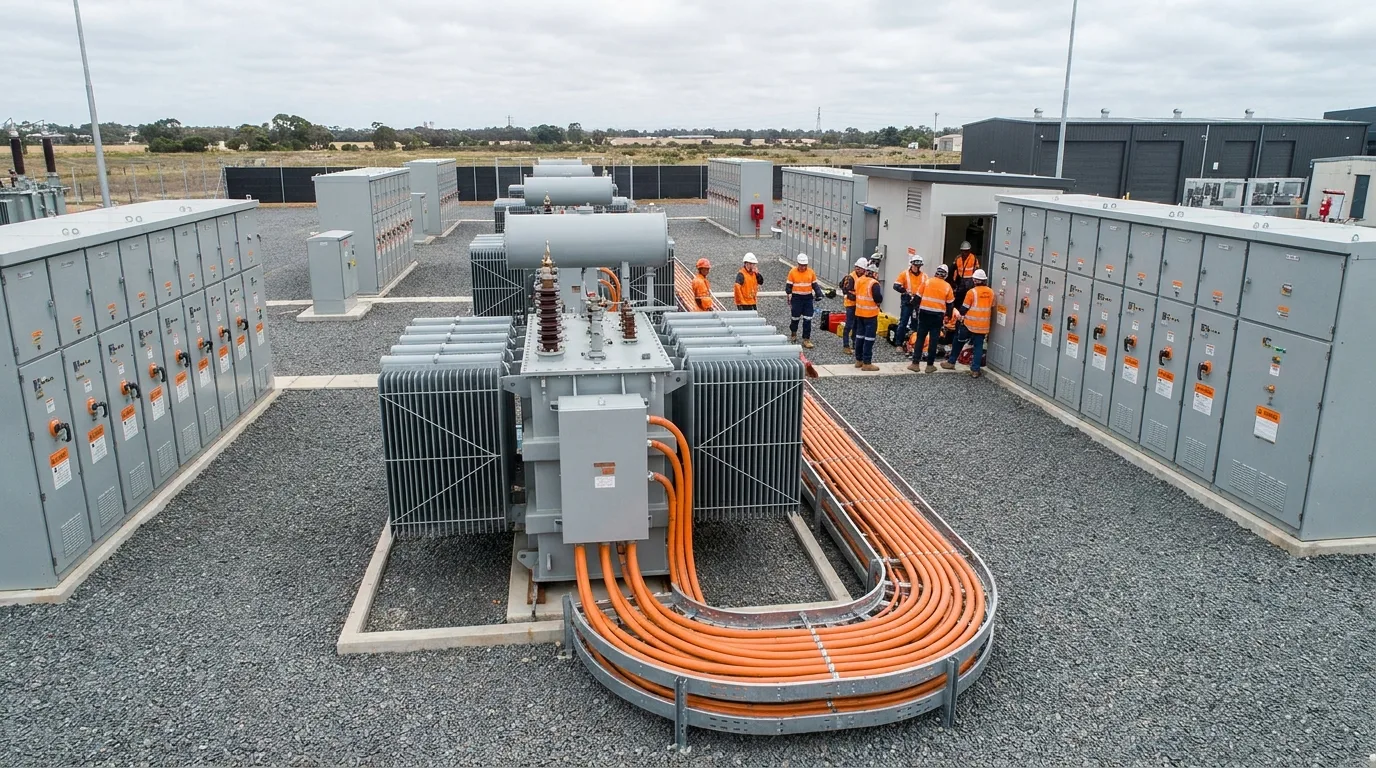
- Higher Voltage Distribution: Using 480V instead of 208V for power distribution to mining equipment reduces resistive losses (I-squared-R losses) by approximately 80%. See Understanding Three-Phase Power for Mining and Data Centers for the engineering details.
- Short Cable Runs: Locate transformers as close as possible to mining equipment to minimize cable length and associated resistive losses. Each 100 feet of cable at high current wastes measurable power.
- Proper Wire Sizing: Sizing conductors one or two gauges larger than the minimum code requirement reduces resistive losses. The additional copper cost typically pays for itself in energy savings within 12-18 months at mining scale.
- Power Factor Correction: Installing capacitor banks to maintain facility power factor above 0.95 avoids utility power factor penalties and reduces the apparent power demand, potentially allowing you to use smaller transformers and switchgear.
Cooling Efficiency
Cooling energy consumption is the second largest power expense after the miners themselves, representing 5-40% of total facility power depending on technology and climate. Optimizing cooling directly reduces the effective cost per hash. Detailed technology comparisons are available in Data Center Cooling Technologies Compared: Air, Liquid, and Immersion and Immersion Cooling vs Air Cooling: Complete ROI Analysis for Mining and AI.
- Free Cooling Maximization: In cooler climates, ambient air can cool mining hardware for 6-12 months per year with no mechanical refrigeration. Even in temperate climates, free cooling should be used whenever outdoor temperatures permit.
- Evaporative Cooling: Uses a fraction of the energy of mechanical refrigeration in dry climates. Adding evaporative pre-cooling to an air-cooled facility can extend free cooling hours by 30-50%.
- Immersion Cooling: While capital-intensive, immersion cooling can reduce total cooling energy by 90% or more compared to mechanical air conditioning, achieving facility PUE of 1.02-1.05.
Strategy 4: Operational Optimization
Firmware Optimization
Custom and third-party firmware (such as Braiins OS+, LuxOS, or VNish) can improve ASIC mining efficiency by 5-15% through intelligent frequency and voltage tuning algorithms. These firmware solutions dynamically adjust each mining chip's operating point to find the optimal balance between hash rate and power consumption, squeezing more hashes per watt than stock firmware. This is equivalent to reducing your electricity cost by the same percentage, with minimal capital investment.
Dynamic Hash Rate Management
- Underclocking Strategy: Reducing ASIC frequency decreases hash rate but improves efficiency (J/TH) disproportionately. Running at 80% hash rate might only use 65% power, significantly improving profitability when margins are tight. Smart operators underclock during periods of high difficulty and low Bitcoin price.
- Price-Responsive Mining: Automatically adjust hash rate based on real-time electricity prices, Bitcoin price, and network difficulty. Mine at full throttle when the combination is favorable; underclock or curtail when it is not. This can improve annual profitability by 10-20% compared to running at constant hash rate.
- Temperature-Responsive Tuning: In hot weather, preemptively underclock rather than letting thermal throttling reduce hash rate unpredictably. Controlled underclocking maintains better efficiency than thermal throttling.
Equipment Selection
Choosing the most efficient available mining hardware is the single most impactful long-term decision for electricity cost management. A machine running at 15 J/TH consumes 40% less electricity per hash than one running at 25 J/TH. Over a three-year operational life, this efficiency difference translates to tens of thousands of dollars in electricity savings per machine. See ASIC vs GPU Mining: Complete Comparison Guide for 2026 for current hardware efficiency comparisons.
Strategy 5: Alternative and Stranded Energy
Stranded Natural Gas
Converting otherwise-flared natural gas at oil well sites to electricity for Bitcoin mining is one of the most compelling economic opportunities in the mining industry. Operators deploy portable generators at well sites, using gas that would otherwise be wastefully burned off into the atmosphere. This approach typically delivers power at $0.020-0.035/kWh with the additional benefit of significantly reducing methane emissions compared to direct flaring.
Curtailed Renewables
Wind and solar farms sometimes produce more electricity than the grid can absorb (particularly during low-demand periods), leading to curtailment where generators are ordered to reduce output. Mining operations co-located with renewable generators can absorb this excess power at near-zero marginal cost during curtailment periods, making the renewable project more economically viable while providing extremely cheap electricity to the miner.
Waste Heat Monetization
Mining generates enormous amounts of heat that is typically wasted. Creative operators are finding productive uses for this waste heat to create additional revenue streams or offset costs: greenhouse heating for agriculture (extending growing seasons in cold climates), aquaculture (maintaining warm water temperatures for fish farming), district heating (feeding heat into municipal heating systems), lumber and grain drying, and even whisky distilling. While waste heat monetization does not reduce electricity costs directly, it creates an offset revenue stream that improves overall operational economics.
Measuring Success
Continuous measurement and benchmarking are essential for electricity cost optimization. Track these metrics monthly and trend them over time:
- All-In Cost per kWh: Total electricity spend divided by total kWh consumed. This single number captures the net effect of all your optimization efforts.
- Cost per TH/s per Day: The electricity cost to operate one TH/s for one day. This normalizes cost across different hardware efficiencies.
- PUE: Total facility power divided by IT equipment power. Target: below 1.2 for air-cooled facilities, below 1.1 for liquid-cooled.
- Revenue per kWh: Mining revenue divided by total kWh consumed. This must exceed your all-in cost per kWh to be profitable.
Additionally, track the trend of these metrics over time. Improving metrics month over month confirms your optimization strategies are working. Flat or worsening metrics signal that external factors (rising utility rates, increasing difficulty) are outpacing your optimization efforts and that more aggressive strategies may be needed. Quarterly reviews of electricity cost performance against industry benchmarks help identify whether you are operating at competitive cost levels or falling behind peers.
RAX Data & Energy combines strategic power procurement, efficient facility design, demand response participation, and operational expertise to deliver highly competitive all-in electricity rates for our hosted mining clients. Our scale, our power market relationships, and our relentless focus on efficiency at every infrastructure level create cost advantages that are difficult for smaller operators to replicate independently.