The Cooling Decision
As power densities in both cryptocurrency mining and AI infrastructure continue to climb, facility operators face a fundamental infrastructure decision: stay with proven, lower-cost air cooling, or invest in immersion cooling technology that promises dramatically better efficiency but comes with significantly higher upfront costs. This decision has financial implications that extend far beyond the initial capital expenditure, affecting operating costs, hardware performance, equipment lifespan, and facility flexibility for years to come.
This analysis provides a comprehensive, data-driven comparison to help operators make an informed decision. We examine capital costs, operating costs, efficiency impacts, hardware longevity, revenue improvements from overclocking, and total cost of ownership over realistic operational timelines for both mining and AI workloads. For background on the full spectrum of cooling options, see our Data Center Cooling Technologies Compared: Air, Liquid, and Immersion guide, which covers every technology from basic CRAC units to two-phase immersion systems.
Air Cooling: The Established Baseline
How Air Cooling Works for Mining
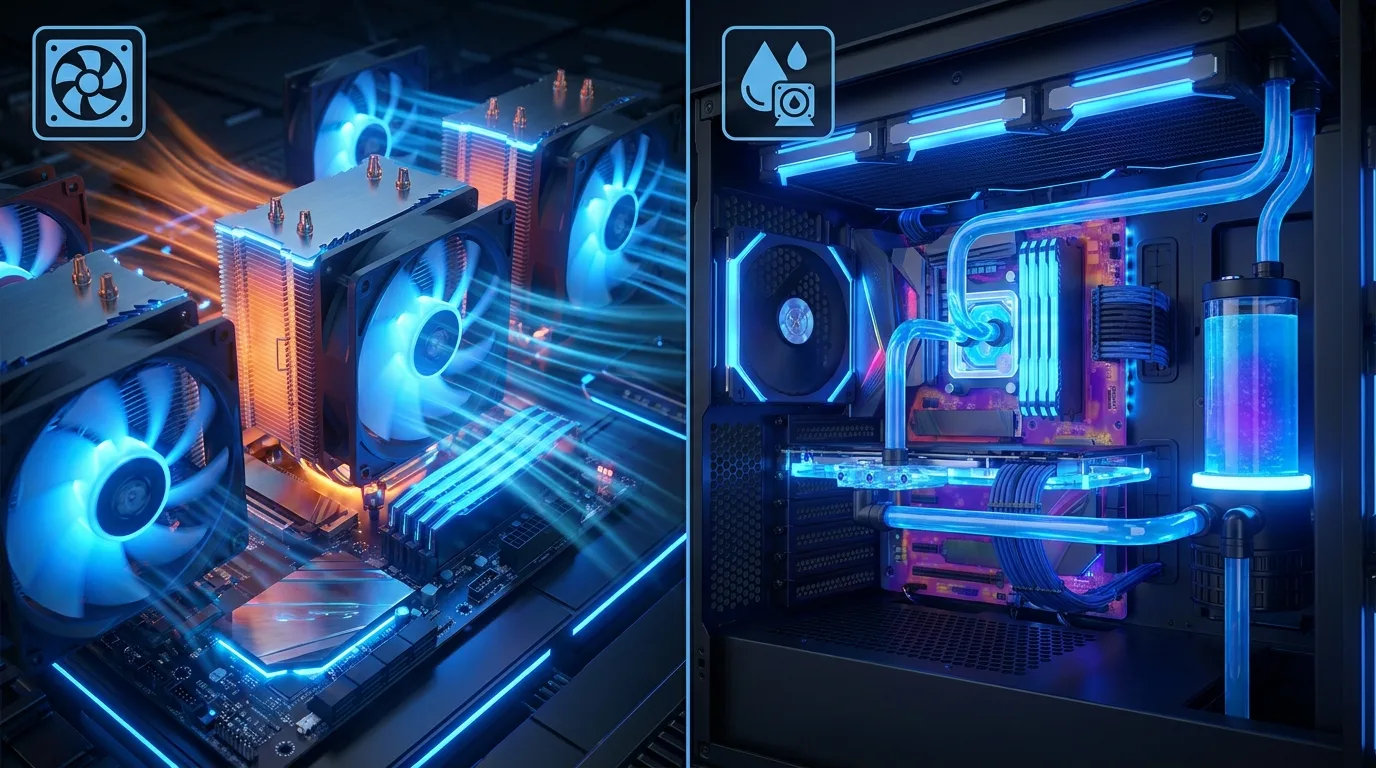
Air cooling for mining operations typically uses high-volume fans to push ambient or conditioned air across the ASIC miners' internal heat sinks and fan assemblies. In containerized deployments, large intake fans pull in ambient air from one end of the container while the miners' own fans and exhaust fans push hot air out the other end. In warehouse-style facilities, more sophisticated configurations using hot/cold aisle containment, in-row coolers, or evaporative systems manage airflow across rows of mining equipment. The detailed technology comparison in Data Center Cooling Technologies Compared: Air, Liquid, and Immersion covers air cooling variants in depth.
Air Cooling Cost Profile (per MW of IT Load)
| Cost Element | Containerized | Warehouse |
|---|---|---|
| Infrastructure CapEx | $50,000-100,000 | $100,000-200,000 |
| Annual Fan and Air Handling Energy | $15,000-30,000 | $20,000-40,000 |
| Annual HVAC/Mechanical Cooling (hot climates) | $30,000-80,000 | $40,000-100,000 |
| Annual Filter Replacement | $2,000-5,000 | $5,000-15,000 |
| Annual Maintenance Labor | $5,000-10,000 | $10,000-25,000 |
Air Cooling PUE by Climate
Power Usage Effectiveness (PUE) represents the overhead ratio of total facility power to IT equipment power. For air-cooled facilities, climate is the dominant variable:
- Hot humid climate (Gulf Coast, Southeast Asia): PUE 1.3-1.5. Mechanical cooling runs most of the year. Cooling can represent 20-35% of total electricity bill.
- Temperate climate (Mid-Atlantic, Central Europe): PUE 1.15-1.30. Free cooling possible 4-8 months per year, with mechanical cooling needed in summer.
- Cold climate (Northern Canada, Scandinavia): PUE 1.05-1.15. Free air cooling viable 8-12 months per year, with minimal or no mechanical cooling needed.
Immersion Cooling: The High-Performance Alternative
How Single-Phase Immersion Cooling Works
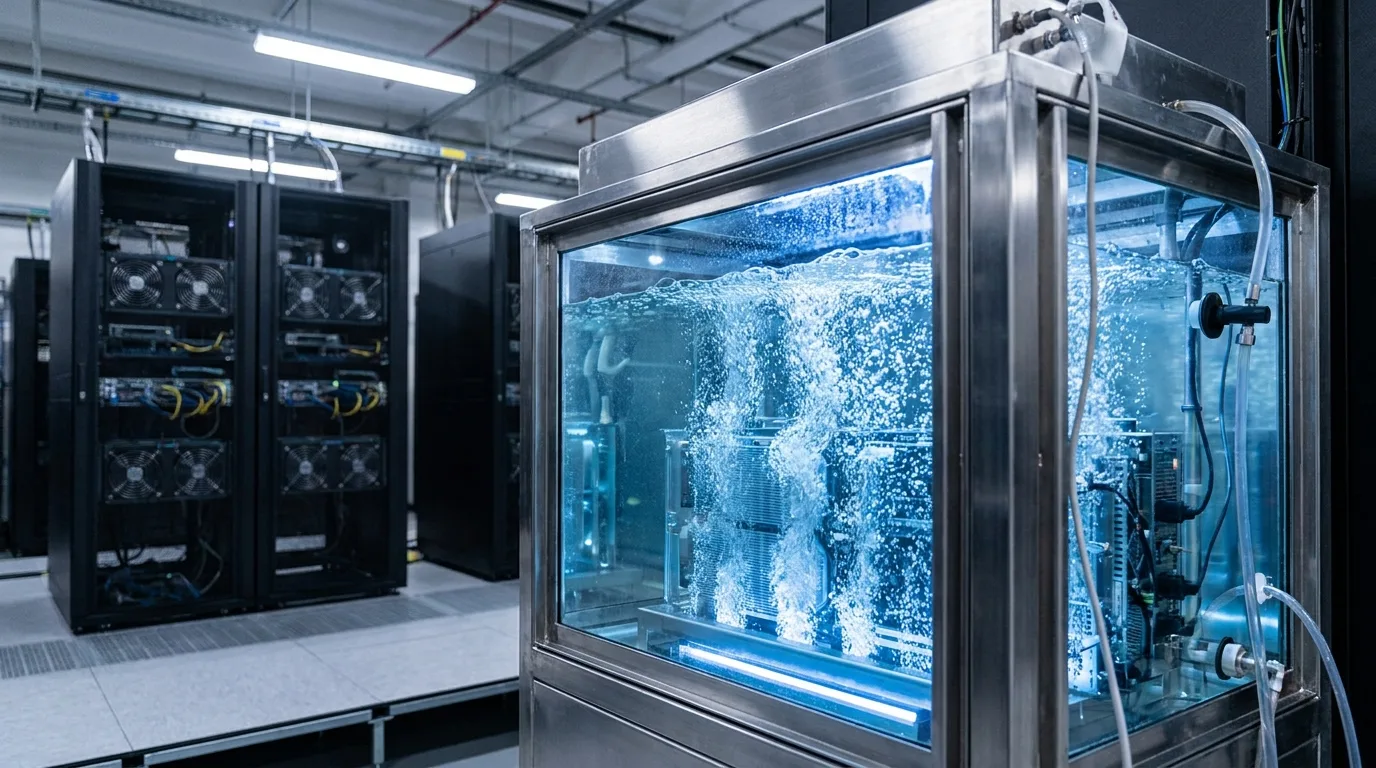
In single-phase immersion cooling, the most common type used in mining and increasingly in AI, computing hardware is fully submerged in a tank of dielectric fluid, a specially formulated, non-conductive, non-corrosive liquid designed for electronics cooling. The fluid makes direct contact with every component surface, absorbing heat through convection. Pumps circulate the warmed fluid through an external heat exchanger (typically a dry cooler with fans) where the heat is rejected to the outdoor ambient air. The cooled fluid returns to the tank in a continuous loop.
The key insight is that liquid absorbs heat approximately 1,000-3,000 times more efficiently than air per unit of contact area. This massive efficiency advantage means the fluid can absorb heat from all components simultaneously, maintain extremely uniform temperatures across the hardware, and reject that heat to the atmosphere with far less energy than air-based systems require.
Immersion Cooling Cost Profile (per MW of IT Load)
| Cost Element | Estimated Cost |
|---|---|
| Immersion Tanks (engineered, with racks) | $80,000-150,000 |
| Dielectric Fluid (initial fill) | $60,000-120,000 |
| External Heat Exchangers (Dry Coolers) | $40,000-80,000 |
| Pumps, Plumbing, and Controls | $20,000-50,000 |
| Total Infrastructure CapEx | $200,000-400,000 |
| Annual Pump and Dry Cooler Energy | $10,000-30,000 |
| Annual Fluid Top-Off (carry-out losses) | $3,000-8,000 |
| Annual Maintenance Labor | $5,000-15,000 |
Immersion Cooling PUE
Immersion cooling achieves near-unity PUE regardless of climate, which is its most significant advantage over air cooling:
- Hot climate: PUE 1.02-1.08. Dry cooler fans work harder but liquid cooling is fundamentally efficient.
- Temperate climate: PUE 1.02-1.06.
- Cold climate: PUE 1.01-1.04. Near-zero cooling overhead.
The climate-independence of immersion cooling PUE is a powerful advantage. It means you can locate your facility based on power cost and other factors without worrying about cooling penalties from a hot climate, opening up site selection options that air cooling would make prohibitively expensive. This is especially relevant for operators considering renewable energy integration or facilities in hot regions like the UAE.
Detailed ROI Analysis: 10 MW Mining Operation
Let us model a realistic 10 MW Bitcoin mining deployment in Texas (hot summers, mild winters, competitive electricity market) to compare total cost of ownership over a 3-year hardware lifecycle. For a broader look at how electricity cost optimization affects mining profitability, see our dedicated guide. You can also explore our Texas hosting page for location-specific infrastructure details.
Assumptions
- Location: Texas (average summer temperature 95 degrees F, winter 50 degrees F)
- Base electricity rate: $0.045/kWh all-in
- Mining hardware: ~3,000 ASIC miners averaging 3.3 kW each, totaling 10 MW IT load
- Operating hours: 8,760 per year (continuous operation)
- Air cooling PUE in Texas: 1.35 (requiring 3.5 MW of cooling for 10 MW IT load)
- Immersion cooling PUE in Texas: 1.05 (requiring 0.5 MW of cooling for 10 MW IT load)
3-Year Total Cost Comparison
| Category | Air Cooling | Immersion Cooling | Delta |
|---|---|---|---|
| Cooling Infrastructure CapEx | $1,000,000 | $3,000,000 | +$2,000,000 |
| Annual Cooling Electricity (PUE overhead) | $1,380,000 | $197,000 | -$1,183,000/yr |
| 3-Year Cooling Electricity | $4,140,000 | $591,000 | -$3,549,000 |
| 3-Year Maintenance | $225,000 | $180,000 | -$45,000 |
| Overclocking Revenue Gain (15% more hash rate) | $0 | -$1,500,000 (revenue credit) | -$1,500,000 |
| Extended Hardware Life (20% longer) | $0 | -$500,000 (deferred replacement) | -$500,000 |
| 3-Year Total Cost of Ownership | $5,365,000 | $1,771,000 | -$3,594,000 |
Note: The overclocking revenue gain assumes a conservative 15% hash rate increase from immersion cooling's superior thermal management. Some operators report 20-30% overclocking capability. The extended hardware life assumes 20% longer useful economic life due to lower and more uniform operating temperatures, elimination of dust and humidity exposure, and elimination of fan failures.
Payback Period Calculation
The additional capital investment for immersion cooling is approximately $2,000,000 compared to air cooling. The annual savings from reduced cooling electricity alone are approximately $1,183,000. Adding overclocking revenue and maintenance savings brings total annual benefits to approximately $1,865,000 per year. Simple payback period: approximately 13 months.
In a hot climate like Texas with a 10 MW operation, immersion cooling pays for itself in just over a year and then continues to generate savings for the remaining operational life of the facility. The ROI is strongly positive and, in this scenario, choosing air cooling would be the more expensive option over any time horizon beyond 18 months.
Sensitivity Analysis
| Variable Change | Impact on Payback Period |
|---|---|
| Hotter climate (PUE 1.5 for air) | Shorter (9-10 months payback) |
| Higher electricity cost ($0.06/kWh) | Shorter (10-11 months payback) |
| Higher BTC price (more overclocking value) | Shorter (8-12 months payback) |
| Cooler climate (PUE 1.15 for air) | Longer (24-30 months payback) |
| Lower electricity cost ($0.03/kWh) | Longer (18-22 months payback) |
| Smaller scale (1 MW) | Longer (higher per-MW CapEx) |
Beyond Financial ROI: Qualitative Benefits
Advantages of Immersion Cooling
- Noise Elimination: Immersion-cooled facilities are dramatically quieter because ASIC fan assemblies are removed or disabled. This eliminates a major barrier to site selection, allowing deployment in locations where air-cooled mining noise (75-82 dB per machine) would be prohibited.
- Dust and Humidity Immunity: Hardware is completely isolated from airborne contaminants including dust, pollen, salt spray, and humidity. This eliminates the leading causes of hash board corrosion and connector degradation, significantly reducing failure rates.
- Density Improvement: Immersion tanks can achieve higher MW per square foot than air-cooled racks because there is no need for hot and cold aisles, raised floors, or large air handling equipment. A smaller facility footprint reduces construction and lease costs.
- Climate Independence: As demonstrated by the PUE data, immersion cooling performs nearly identically regardless of ambient temperature, freeing site selection from climate constraints.
- Overclocking Revenue: The superior thermal management of immersion cooling enables 15-30% higher clock speeds compared to air cooling, directly increasing hash rate and revenue without proportional increases in power consumption.
Challenges and Considerations
- Higher Initial Capital: 3-4x the infrastructure CapEx of air cooling. Operators need access to capital or financing to fund the additional investment.
- Maintenance Procedures: Servicing submerged equipment requires different skills, tools, and procedures. Technicians must be trained on fluid handling, drip-dry procedures, and tank management.
- Fluid Management: Dielectric fluid must be monitored for contamination (from solder flux, thermal paste, or foreign materials) and periodically filtered. Carry-out losses from equipment removal require periodic fluid top-off.
- Hardware Warranty: Some ASIC manufacturers do not warrant hardware operated in immersion cooling. However, this is becoming less common as immersion adoption grows and manufacturers see the reliability data.
- Resale Considerations: Hardware that has been operated in dielectric fluid may have residual fluid on components. Buyer acceptance of used immersion-cooled hardware varies, though the secondary market is maturing.
Immersion Cooling for AI Infrastructure
The ROI analysis shifts even more favorably toward liquid cooling (immersion or direct-to-chip) for AI and GPU infrastructure:
- Cooling is a hard constraint, not optional: Modern GPU servers like the NVIDIA DGX H100 (10.2 kW) and the GB200 NVL72 (120 kW per rack) simply cannot be cooled by air alone at typical deployment densities. Liquid cooling becomes a requirement, not an optimization choice.
- Higher value per compute-hour: GPU compute time is worth significantly more per watt than mining hash rate, making the efficiency and performance benefits of liquid cooling proportionally more valuable.
- Thermal throttling costs more: GPU thermal throttling directly reduces inference throughput and training speed. Unlike mining where throttling just reduces hash rate, GPU throttling can impact customer-facing SLA commitments and training deadlines.
- Uptime is more critical: AI inference serving production applications has higher availability requirements than mining. The reliability improvements from eliminating fans, dust, and thermal cycling stress provide tangible uptime benefits.
For detailed GPU specifications and cooling requirements, see our NVIDIA GPU Guide for Data Center Operators: H100, A100, L40S, and Beyond.
Making Your Decision
The choice between air cooling and immersion cooling is fundamentally an economic decision driven by your specific circumstances. Use this framework:
- Air Cooling Is Optimal When: You operate in a cold/dry climate where free cooling is available 8+ months per year, your power costs are already very low (under $0.03/kWh), you are minimizing upfront capital, your deployment is small (under 2 MW), or you need maximum deployment speed.
- Immersion Cooling Is Optimal When: You operate in a hot or humid climate, electricity costs exceed $0.04/kWh, you are deploying at 5+ MW scale, you want maximum hardware density, you need to overclock for additional revenue, or noise restrictions limit air-cooled options.
- Liquid Cooling Is Mandatory When: You are deploying NVIDIA Blackwell GB200 NVL72 racks (120 kW), you need rack densities above 80 kW, or your application demands the highest possible compute performance without thermal throttling.
RAX Perspective: RAX Data & Energy evaluates cooling technology on a per-deployment basis, recognizing that the optimal solution depends on the specific intersection of hardware type, deployment scale, geographic location, power cost, and client requirements. Our engineering team works with each client to model the ROI of different cooling approaches for their specific situation, ensuring that infrastructure investments deliver the best possible long-term returns.
Financing and Procurement Considerations
The higher upfront cost of immersion cooling can be addressed through several financing approaches. Equipment financing or leasing spreads the capital expenditure over 3-5 years, closely aligning payments with the operational savings the technology generates. Some immersion cooling vendors offer cooling-as-a-service models where the vendor owns and maintains the cooling infrastructure while the operator pays a monthly fee per kW of cooling capacity. This converts the entire cooling investment into an operating expense with no upfront capital requirement.
When procuring immersion cooling equipment, evaluate vendors on their deployment track record (how many MW of immersion cooling are currently in production with their equipment), fluid compatibility with your hardware (not all dielectric fluids are compatible with all component materials), tank engineering quality (welds, seals, material thickness, and pressure ratings), and after-sales support availability (can they dispatch a technician to your facility within 24 hours if needed). Request references from existing customers operating at similar scale and with similar hardware to validate the vendor's claims and understand real-world operational experience.
Whatever cooling approach you choose, design the system correctly from the start. Retrofitting from air to immersion after deployment is significantly more expensive and disruptive than building for immersion initially. If immersion cooling is likely within your 2-3 year roadmap, consider investing in immersion-ready infrastructure now, even if you deploy with air cooling in the interim. Our Mining Farm Design Guide covers how to plan for scalable cooling from day one, and our Power Redundancy Guide addresses the electrical infrastructure that supports both approaches.