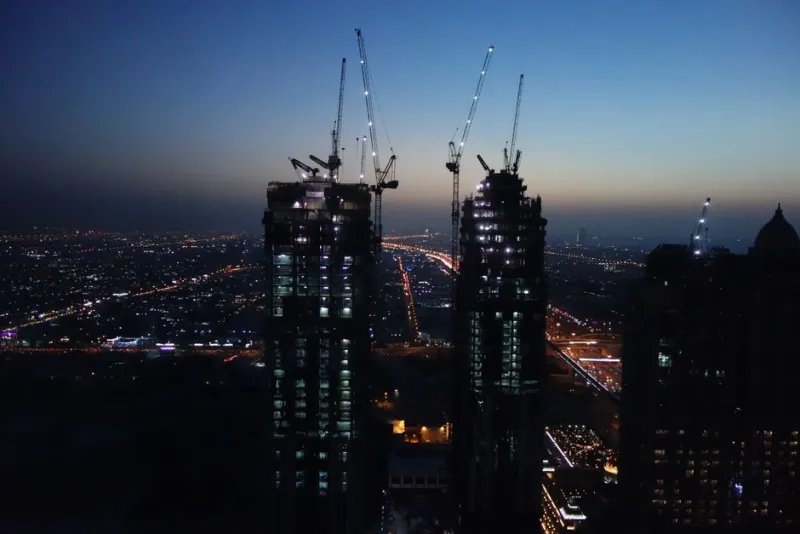
The Scale of What Is Being Built
The UAE data center market has moved from regional significance to global relevance in less than two years. By mid-2026, more than $30 billion in committed investment is flowing into AI-ready data center infrastructure across the country, driven by a convergence of government AI strategy, hyperscaler expansion, and the infrastructure demands of large language models and generative AI workloads.
The numbers paint a clear picture. The UAE colocation market is forecast to grow at a compound annual growth rate of 21.7% from 2026 to 2030, expanding from approximately $1.39 billion to $3.90 billion. The broader Middle East data center construction market is growing even faster, at 25.79% CAGR through 2031. These are not speculative projections. They are backed by signed contracts, construction permits, and equipment orders that are already in progress.
For operators and enterprises evaluating where to deploy AI hosting infrastructure, the UAE has become one of a handful of markets where capacity, connectivity, regulatory clarity, and energy availability intersect at the scale that modern AI workloads require.
Anchor Investments Driving the Buildout
Microsoft and G42: 200 MW Expansion
Microsoft and Abu Dhabi-based G42 announced a 200-megawatt expansion of data center capacity through G42 subsidiary Khazna Data Centers, with operations expected to begin by the end of 2026. This expansion is part of Microsoft's broader $15.2 billion investment commitment to the UAE by 2029, one of the largest single-country cloud infrastructure investments by any hyperscaler in the Middle East.
The Microsoft-G42 partnership extends beyond raw capacity. It includes Azure AI services, sovereign cloud capabilities, and enterprise AI tooling designed for regional data residency requirements. For colocation customers, this investment signals long-term commitment to the UAE as a primary compute hub, not a secondary spillover market.
Stargate UAE: 1 GW AI Compute Campus
The Stargate UAE project represents one of the most ambitious AI infrastructure initiatives ever undertaken outside the United States. A partnership between G42, OpenAI, Oracle, NVIDIA, Cisco, and SoftBank, the project targets 1 gigawatt of AI compute capacity in Abu Dhabi, backed by up to $10 billion in investment.
The first 200 MW phase is on an accelerated timeline toward delivery in 2026. This initial deployment will house approximately 100,000 NVIDIA Grace Blackwell GB300 chips, making it one of the largest concentrations of next-generation Blackwell GPU infrastructure globally. The facility requires purpose-built liquid cooling systems and power density capabilities far beyond what conventional data centers provide.
Capacity in context: The UAE's existing colocation capacity exceeds 400 MW. The combined Stargate (200 MW) and Microsoft-Khazna (200 MW) expansions will effectively double the country's total data center capacity by the end of 2026 or early 2027.
Hyperscaler Availability Zones
All three major cloud providers now operate dedicated availability zones in the UAE:
- AWS launched the me-central-1 region with NVIDIA H100 SXM instances available on-demand
- Google Cloud operates me-central1 (Doha) with GPU instances and is expanding UAE-based capacity
- Microsoft Azure runs UAE North and UAE Central regions with GPU VM availability
H200 availability in Gulf data centers remains limited as of mid-2026, with hyperscalers prioritizing US-East and EU-West regions for initial H200 deployment. B200 instances from hyperscalers are not yet available in the Gulf. This availability gap creates opportunity for independent managed AI hosting providers and colocation operators who can source and deploy next-generation GPU hardware ahead of hyperscaler rollout schedules.
Why the UAE Is Attracting AI Infrastructure Investment
Geographic Positioning
The UAE sits at the intersection of Europe, Asia, and Africa, with submarine cable connectivity to all three continents. For AI inference workloads that are latency-sensitive, this positioning allows a single UAE-based deployment to serve users across a wide geographic footprint without the need for replicated infrastructure in multiple regions.
Dubai and Abu Dhabi are within 100 milliseconds of round-trip latency to most of Europe, South Asia, and East Africa. For AI inference applications where response time directly affects user experience, this reach is a significant infrastructure advantage.
Regulatory Clarity
The UAE has established clear regulatory frameworks for data center operations, data residency, and digital asset activity. The Telecommunications and Digital Government Regulatory Authority (TDRA) provides oversight for data center operators, while free zones like ADGM and DIFC offer specialized regulatory environments for financial services and technology companies that require specific data handling standards.
For operators considering cryptocurrency and blockchain operations, the Virtual Assets Regulatory Authority (VARA) provides a licensing framework that is among the most developed globally. This regulatory maturity reduces operational risk for enterprises deploying capital-intensive infrastructure.
Energy Availability and Cost
Large-scale AI infrastructure requires reliable, abundant power. The UAE generates approximately 35 GW of installed electricity capacity, with significant reserves above current demand. Industrial electricity rates are competitive by global standards, particularly when negotiated at the scale that hyperscale and wholesale data center operators require.
The country is also investing heavily in renewable energy. The Al Dhafra Solar PV project (2 GW) and the Barakah nuclear power plant (5.6 GW across four units) provide clean baseload power that is increasingly important for enterprises with sustainability mandates for their AI operations.
Cooling Challenges and Innovation
The UAE's hot climate, with ambient temperatures regularly exceeding 45 degrees Celsius during summer months, presents a genuine challenge for data center cooling. Traditional air-cooled facilities face higher PUE (power usage effectiveness) penalties in the Gulf compared to facilities in cooler climates like Scandinavia or the Pacific Northwest.
However, the shift toward liquid cooling for high-density AI workloads is actually reducing the significance of ambient temperature. Direct-to-chip liquid cooling systems, which are mandatory for hardware like the NVIDIA GB200 NVL72, operate on closed-loop systems where the external ambient temperature has less impact on cooling efficiency than it does for air-cooled facilities. Data center operators in the UAE who invest in modern liquid cooling infrastructure can achieve competitive PUE figures even during peak summer conditions.
Market Segments Driving Demand
Enterprise AI Adoption
Regional enterprises across financial services, oil and gas, logistics, healthcare, and government are deploying AI workloads at accelerating rates. Many of these organizations have data residency requirements that mandate processing within the UAE or the broader GCC region, creating demand for locally hosted GPU colocation and managed AI hosting services.
AI Model Training and Fine-Tuning
Organizations training proprietary models or fine-tuning foundation models on region-specific data, particularly Arabic-language models, need sustained access to GPU clusters. The infrastructure being built in the UAE will provide the scale of compute required for these workloads without the latency penalty of training on hardware located in distant regions.
Sovereign AI Initiatives
The UAE's national AI strategy emphasizes sovereign AI capabilities, including the ability to train and deploy AI models on infrastructure wholly within the country's borders. This drives demand for domestic data center capacity that is purpose-built for AI workloads rather than repurposed from traditional enterprise hosting.
Infrastructure Requirements for the Next Phase
The data center capacity being built in the UAE is fundamentally different from what the market required five years ago. AI workloads demand:
- Power density: 30 to 50 kW per rack for current-generation GPU deployments, scaling to 120 kW or more for Blackwell-class hardware
- Liquid cooling: mandatory for next-generation GPU racks, requiring facility-level coolant distribution infrastructure
- High-bandwidth networking: InfiniBand or high-speed Ethernet for GPU-to-GPU communication across racks
- Redundant power: 2N or N+1 redundancy with UPS and generator backup for workloads where interruption means losing days of training progress
- Physical security: enterprise-grade access control and monitoring for facilities hosting high-value GPU hardware
Operators who build to these specifications now will be positioned to capture demand as enterprises scale their AI infrastructure requirements over the next three to five years.
What This Means for AI Hosting Customers
The investment flowing into UAE data center infrastructure is creating meaningful options for organizations that need AI hosting in the Middle East:
- More GPU availability: as Stargate and Microsoft-Khazna capacity comes online, the current constraint on GPU access in the region will ease
- Competitive pricing: increased supply and competition among operators should moderate hosting costs over time
- Next-generation hardware access: the Stargate deployment of 100,000 GB300 chips means cutting-edge GPU hardware will be available in the UAE at a scale previously reserved for US-based facilities
- Colocation flexibility: enterprises can choose between hyperscaler cloud, managed hosting, and colocation depending on their control, compliance, and cost requirements
For organizations evaluating AI hosting options, the AI hosting provider evaluation checklist provides a structured framework for comparing providers across the criteria that matter most for AI workloads.
Frequently Asked Questions
How much is being invested in UAE data centers for AI?
More than $30 billion has been committed to AI data center infrastructure in the UAE by mid-2026. Microsoft alone has pledged $15.2 billion by 2029. The Stargate UAE project, backed by G42, OpenAI, Oracle, NVIDIA, and SoftBank, targets up to $10 billion for a 1 GW AI compute campus in Abu Dhabi, with the first 200 MW phase on track to go live in 2026.
What is the projected growth rate of the UAE data center market?
The UAE data center colocation market is forecast to grow at a compound annual growth rate of 21.7% from 2026 to 2030, expanding from approximately $1.39 billion to $3.90 billion. The broader Middle East data center construction market is growing at an even faster 25.79% CAGR through 2031.
Which GPU models are available in UAE data centers?
As of mid-2026, NVIDIA H100 SXM instances are available through AWS (me-central-1), Google Cloud (me-central1), and Azure (UAE North) on-demand. H200 availability in Gulf data centers remains limited as hyperscalers prioritize US-East and EU-West regions. The Stargate UAE phase one deployment will bring approximately 100,000 NVIDIA Grace Blackwell GB300 chips online.
Why is the UAE attracting AI data center investment?
The UAE offers a combination of strategic advantages: geographic positioning between Europe and Asia, a stable regulatory environment with clear data residency frameworks, strong government backing through national AI strategies, competitive energy costs, availability of land and power for large-scale builds, and growing demand from regional enterprises adopting AI workloads.
What is the Stargate UAE project?
Stargate UAE is a partnership between G42, OpenAI, Oracle, NVIDIA, Cisco, and SoftBank to build what will become the largest AI infrastructure campus outside the United States. Located in Abu Dhabi, the project targets 1 GW of AI compute capacity. The first 200 MW phase, equipped with approximately 100,000 NVIDIA GB300 chips, is expected to go live in 2026.
Deploy AI Infrastructure in the UAE
Rax Data & Energy provides GPU colocation, managed AI hosting, and high-density data center infrastructure built for the demands of modern AI workloads.
Contact Us Our Infrastructure