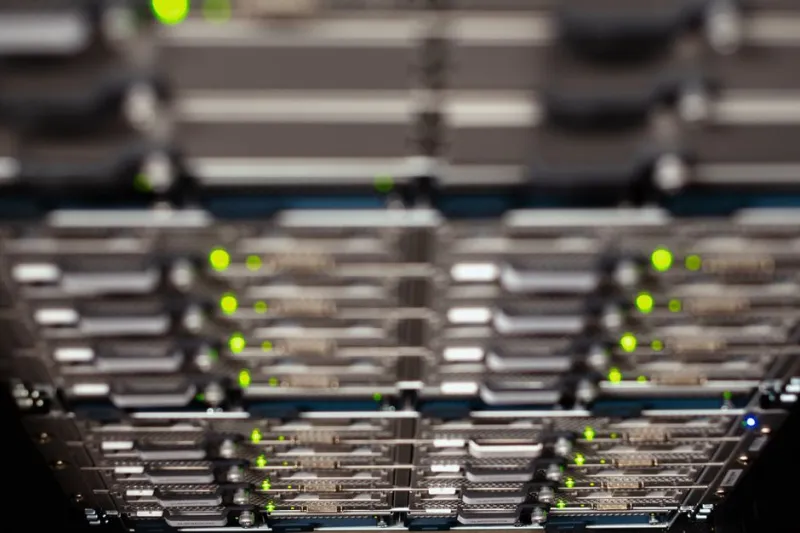
The Blackwell Architecture Shift
NVIDIA's Blackwell GPU architecture represents the most significant infrastructure challenge the data center industry has faced in decades. The flagship GB200 NVL72 system packs 72 Blackwell GPUs and 36 Grace CPUs into a single rack, delivering approximately 1.4 exaflops of AI compute performance with 30 TB of unified fast memory. For context, that is more AI throughput than an entire row of previous-generation DGX H100 systems.
This performance leap comes with infrastructure demands that render most existing data center facilities structurally, electrically, and thermally unable to host the system. At 120 kW nominal power draw (130 to 132 kW at sustained full load), the GB200 NVL72 consumes roughly 10 to 15 times more power than a traditional enterprise server rack. It weighs 1,360 kg (approximately 3,000 lbs), requires mandatory direct-to-chip liquid cooling, and needs network connectivity that most facilities have never provisioned.
By early 2026, Blackwell rack-scale capacity became generally available across major cloud providers and neoclouds. The first 200 MW of the Stargate UAE cluster, equipped with approximately 100,000 GB300-class chips, is on course to go live this year. For data center operators evaluating whether to host these systems, understanding the full scope of infrastructure requirements is essential before making investment decisions.
Power Infrastructure Requirements
The GB200 NVL72's 120 kW power draw per rack fundamentally changes how data centers must approach power delivery. A facility designed to deliver 8 to 12 kW per rack using traditional power distribution cannot support these systems without substantial infrastructure upgrades or purpose-built deployment zones. For a deep dive into the electrical architectures enabling 100 kW to 1 MW per rack, see our guide to megawatt-scale rack power delivery.
Power Density and Distribution
Each GB200 NVL72 rack requires dedicated power feeds with capacity for at least 130 kW to accommodate full-load conditions plus headroom. This typically means:
- Dedicated busway or power whip rated for the full rack load, rather than shared overhead busway that distributes power across multiple racks
- High-amperage PDUs within the rack, typically 3-phase 415V units capable of delivering 200A or more
- Upstream switchgear sized to support the aggregate load of a Blackwell deployment zone, which can easily reach multiple megawatts for a single row of racks
- Redundancy architecture (typically 2N or N+1 redundancy) that doubles the provisioned capacity for critical AI workloads
For a deployment of 10 GB200 NVL72 racks, the total power requirement is approximately 1.2 to 1.3 MW for IT load alone, plus cooling overhead. With a facility PUE of 1.3, total power draw reaches 1.6 to 1.7 MW. A 100-rack deployment requires 13 MW or more, a scale that many regional data centers cannot accommodate without utility-level infrastructure upgrades. For the broader industry context behind these escalating power demands, see our analysis of AI data center power density trends.
Planning rule of thumb: Budget 150 kW per rack position for GB200 NVL72 deployments (120 kW IT load + cooling + distribution losses). A row of 10 racks needs 1.5 MW of total facility capacity. This is 10x what the same floor space would need for traditional enterprise workloads.
UPS and Backup Power
High-density GPU workloads place unique demands on UPS systems. AI training runs that consume hundreds of GPU-hours can lose days of progress from a momentary power interruption. UPS systems must be sized not just for steady-state load but for the transient power spikes that occur during GPU workload transitions, which can momentarily exceed nominal draw by 10 to 15 percent.
Lithium-ion UPS batteries are increasingly favored over lead-acid for Blackwell deployments because of their higher power density (smaller footprint for equivalent capacity), faster recharge times, and longer operational lifespan. A detailed comparison of UPS battery technologies is essential during facility planning.
Cooling Infrastructure: Liquid Is Mandatory
The GB200 NVL72 ships with integrated direct-to-chip liquid cooling manifolds. This is not an optional feature. The thermal density of 72 Blackwell GPUs in a single rack generates more heat than air cooling can remove, regardless of how much airflow is provisioned. Each Blackwell B200 GPU has a TDP exceeding 1,200W, and the aggregate heat output of 72 such chips in a confined rack space makes liquid cooling the only viable thermal management approach.
Cooling System Architecture
A typical cooling infrastructure for GB200 NVL72 deployments includes:
- Coolant Distribution Units (CDUs) that interface between the facility chilled water loop and the rack-level cooling circuits. CDUs manage coolant flow rates, temperatures, and pressures for each rack
- Facility chilled water plant sized to reject the full thermal load of all deployed racks. For a 10-rack deployment at 120 kW each, the cooling plant must handle at least 1.2 MW of heat rejection
- Supply and return piping rated for the required flow rates, with redundant paths to prevent single-point cooling failures
- Leak detection systems deployed throughout the liquid cooling circuit, with automated isolation valves to contain any coolant leaks before they reach critical IT equipment
The cooling system must supply chilled water at approximately 18 to 25 degrees Celsius and handle a return temperature of 40 to 50 degrees Celsius. This relatively high return temperature enables efficient heat rejection, particularly when combined with free-cooling or adiabatic systems in cooler months.
For data centers in hot climates like the UAE, where ambient temperatures regularly exceed 45 degrees Celsius, the cooling infrastructure must be designed with sufficient capacity to maintain target supply temperatures even during peak summer conditions. Our guide to liquid cooling for UAE data centers covers these considerations in detail.
Physical Infrastructure
Floor Loading
The GB200 NVL72 rack weighs approximately 1,360 kg (3,000 lbs) before coolant is added. With coolant, the total weight can approach 1,500 kg. Most traditional raised-floor data centers are designed for 500 to 750 kg per rack position, making them unsuitable for Blackwell deployments without structural reinforcement.
Purpose-built facilities for GB200 NVL72 systems use reinforced concrete slab construction rated for at least 1,500 kg per rack position, with additional margin for coolant distribution piping and CDU equipment that may be located adjacent to the racks. Seismic considerations in applicable regions add further to structural requirements.
Rack Dimensions and Layout
The GB200 NVL72 occupies a standard 42U rack footprint but is significantly deeper and heavier than traditional server racks. Facilities must provide adequate front and rear clearance for airflow (even liquid-cooled systems require some air movement for ancillary components), cable management, and maintenance access.
Row spacing should accommodate liquid cooling piping runs, CDU placement, and the ability to service individual racks without disrupting adjacent systems. A minimum of 1.2 meters of clearance behind each rack is recommended for maintenance access and pipe routing.
Networking Requirements
Intra-Rack: NVLink at Scale
Within the GB200 NVL72 rack, 72 GPUs communicate via fifth-generation NVLink, providing 1.8 TB/s of bidirectional bandwidth per GPU. This NVLink fabric allows the entire rack to operate as a single logical GPU with 30 TB of unified fast memory, enabling AI models that would require complex model-parallel distribution across separate nodes to run on a single rack instead.
The NVLink interconnect is internal to the rack and requires no external network provisioning. However, it does require that all 72 GPUs are operational and properly connected through the NVLink switch tray for the rack to function as designed. A single GPU failure can reduce the available NVLink bandwidth and memory capacity of the entire system.
Inter-Rack: High-Speed Ethernet and InfiniBand
For workloads that span multiple GB200 NVL72 racks (common for the largest AI training runs), external networking must provide sufficient bandwidth to prevent inter-rack communication from becoming a bottleneck. Each rack includes NVIDIA ConnectX-8 SuperNIC adapters supporting 400 Gbps Ethernet or InfiniBand per port, with multiple ports per compute tray.
Aggregate rack-level external bandwidth can exceed 3.6 TB/s, requiring a network fabric built on high-radix spine-leaf architectures with 400 GbE or InfiniBand HDR/NDR switches. For AI training clusters, InfiniBand networking remains the preferred choice due to its lower latency and more efficient RDMA implementation, though 400 GbE with RoCEv2 is gaining adoption for inference-focused deployments.
GB200 NVL72 vs. Previous Generation: Infrastructure Comparison
| Specification | DGX H100 (8-GPU) | DGX H200 (8-GPU) | GB200 NVL72 |
|---|---|---|---|
| GPUs per system | 8 | 8 | 72 |
| AI compute (FP8) | ~32 PFLOPS | ~32 PFLOPS | ~1,400 PFLOPS (1.4 EFLOPS) |
| GPU memory | 640 GB HBM3 | 1.1 TB HBM3E | 30 TB HBM3E (unified via NVLink) |
| Power draw (typical) | ~10 kW | ~10.5 kW | ~120 kW |
| Cooling | Air (standard) | Air (standard) | Liquid (mandatory) |
| Weight | ~160 kg | ~160 kg | ~1,360 kg |
| Inter-GPU bandwidth | 900 GB/s NVLink 4.0 | 900 GB/s NVLink 4.0 | 1,800 GB/s NVLink 5.0 |
| Form factor | 4U node | 4U node | Full 42U rack |
Blackwell Ultra: The B300 Evolution
NVIDIA's Blackwell Ultra variant, built on the B300 GPU, extends the architecture with 288 GB of HBM3E memory per chip. This expanded memory capacity addresses the needs of 2026's largest reasoning models, which require massive context windows and model weights that exceed the memory capacity of standard B200 chips.
The GB300 NVL72 (using B300 chips) maintains the same rack form factor and cooling requirements as the GB200 NVL72 but delivers higher per-GPU memory bandwidth and capacity. Data center operators who build infrastructure for the GB200 NVL72 today can host GB300 NVL72 systems without additional facility modifications, making current investments forward-compatible.
The first 200 MW of the Stargate UAE cluster is being built with approximately 100,000 of the most advanced GB300-class chips, representing one of the largest single AI infrastructure deployments globally and underscoring the UAE's position as a hub for sovereign AI infrastructure.
Cost Considerations for Operators
The infrastructure investment required to host GB200 NVL72 systems is substantial. Beyond the GPU hardware itself (which NVIDIA prices through its partner channel), data center operators must budget for:
- Power infrastructure upgrades: Switchgear, transformers, PDUs, and UPS systems sized for 120+ kW per rack position can add $500,000 to $1.5 million per MW of deployable capacity
- Liquid cooling installation: CDUs, piping, chilled water plant capacity, and leak detection systems typically cost $200,000 to $500,000 per MW, depending on facility design and climate
- Structural modifications: Floor reinforcement for existing facilities can range from $50 to $200 per square foot depending on current construction and required load capacity
- Network infrastructure: High-radix spine-leaf fabrics with 400 GbE or InfiniBand switches, cabling, and optics represent a significant cost for multi-rack deployments
Despite these costs, NVIDIA's claim of a 25x reduction in total cost of ownership for inference workloads compared to previous-generation systems means that the per-unit-of-AI-throughput cost is dramatically lower with Blackwell. For operators with the infrastructure to support them, GB200 NVL72 deployments can deliver compelling economics, particularly for customers running sustained, high-utilization AI training and inference workloads.
Facility Readiness Checklist
Data center operators evaluating GB200 NVL72 hosting should assess the following infrastructure dimensions:
- Power availability: Can you deliver 150 kW per rack position (IT + overhead) with appropriate redundancy?
- Cooling capacity: Do you have or can you install a liquid cooling plant with sufficient chilled water capacity?
- Floor loading: Is your facility rated for at least 1,500 kg per rack position?
- Network fabric: Can you provision 400 GbE or InfiniBand connectivity with sufficient spine-leaf capacity?
- Fire suppression: Is your suppression system compatible with liquid-cooled equipment and high-density electrical loads?
- Maintenance access: Do row spacing and clearances allow rack-level service without disrupting adjacent systems?
- Utility interconnection: Is your upstream utility capacity sufficient for the planned deployment scale?
- PUE targets: Have you modeled the facility PUE with liquid cooling at the planned density?
FAQ: NVIDIA Blackwell GB200 NVL72 for Data Center Operators
How much power does a single NVIDIA GB200 NVL72 rack consume?
A single GB200 NVL72 rack draws approximately 120 kW at nominal load and 130 to 132 kW under sustained full-load AI training workloads. This is roughly 10 to 15 times the power draw of a traditional enterprise server rack. Power delivery infrastructure must support this density with appropriate PDU sizing, busway capacity, and upstream switchgear.
Does the GB200 NVL72 require liquid cooling?
Yes. Liquid cooling is mandatory. The system ships with integrated direct-to-chip liquid cooling manifolds. Each rack requires chilled water supply and return connections to a facility coolant distribution unit (CDU). Air cooling cannot remove sufficient heat from 72 Blackwell GPUs in a single rack.
What floor loading capacity is needed for the GB200 NVL72?
The GB200 NVL72 rack weighs approximately 1,360 kg (3,000 lbs). Most traditional raised-floor data centers are designed for 500 to 750 kg per rack position, making them unsuitable without structural reinforcement. Facilities need reinforced concrete slab construction rated for at least 1,500 kg per rack position.
What networking does the GB200 NVL72 use?
Within the rack, 72 GPUs communicate via fifth-generation NVLink at 1.8 TB/s bidirectional per GPU. For external connectivity between racks, the system uses NVIDIA ConnectX-8 SuperNIC adapters supporting 400 Gbps Ethernet or InfiniBand per port, with aggregate rack-level bandwidth exceeding 3.6 TB/s.
How does the GB200 NVL72 compare to the DGX H100?
The GB200 NVL72 delivers approximately 1.4 exaflops from 72 GPUs versus roughly 32 petaflops from an 8-GPU DGX H100. NVIDIA claims 25x lower TCO for inference. However, the GB200 NVL72 draws roughly 120 kW per rack compared to approximately 10 kW for a DGX H100 node, requiring liquid cooling that H100 deployments do not need.
Frequently Asked Questions
How much power does a single NVIDIA GB200 NVL72 rack consume?
A single GB200 NVL72 rack draws approximately 120 kW at nominal load and 130 to 132 kW under sustained full-load AI training workloads. This is roughly 10 to 15 times the power draw of a traditional enterprise server rack (8 to 12 kW) and approximately double that of previous-generation DGX A100 or DGX H100 deployments. Power delivery infrastructure must support this density with appropriate PDU sizing, busway capacity, and upstream switchgear.
Does the GB200 NVL72 require liquid cooling?
Yes. Liquid cooling is mandatory, not optional, for the GB200 NVL72. The system ships with integrated direct-to-chip liquid cooling manifolds. Each rack requires chilled water supply and return connections to a facility coolant distribution unit (CDU). Air cooling cannot remove sufficient heat from 72 Blackwell GPUs in a single rack. The cooling infrastructure must provide approximately 40 to 50 degrees Celsius delta-T water flow at sufficient volume to handle the full thermal load.
What floor loading capacity is needed for the GB200 NVL72?
The GB200 NVL72 rack weighs approximately 1,360 kg (3,000 lbs), which is significantly heavier than standard IT racks that typically weigh 300 to 500 kg fully loaded. Most traditional raised-floor data centers are designed for 500 to 750 kg per rack position. Facilities hosting GB200 NVL72 systems need reinforced concrete slab construction rated for at least 1,500 kg per rack position, with additional consideration for coolant weight when the system is filled.
What networking does the GB200 NVL72 use?
Within the rack, 72 GPUs communicate via fifth-generation NVLink at 1.8 TB/s bidirectional per GPU, allowing the entire rack to function as a single logical GPU with 30 TB of unified fast memory. For external connectivity between racks, the system uses NVIDIA ConnectX-8 SuperNIC network adapters supporting 400 Gbps Ethernet or InfiniBand per port, with multiple ports per compute tray for aggregate rack-level bandwidth exceeding 3.6 TB/s.
How does the GB200 NVL72 compare to the DGX H100 in performance and power?
The GB200 NVL72 delivers approximately 1.4 exaflops of AI compute from 72 Blackwell GPUs in a single rack, compared to roughly 32 petaflops from an 8-GPU DGX H100 system. Per unit of AI throughput, NVIDIA claims a 25x reduction in total cost of ownership for inference workloads. However, the GB200 NVL72 draws roughly 120 kW per rack compared to approximately 10 kW for a DGX H100 node, concentrating significantly more power demand into each rack position and requiring liquid cooling infrastructure that air-cooled H100 deployments do not need.
Ready to Host Blackwell Infrastructure?
Rax Data & Energy delivers liquid-cooled, high-density colocation purpose-built for NVIDIA Blackwell and next-generation AI workloads.
Contact Us Our Infrastructure