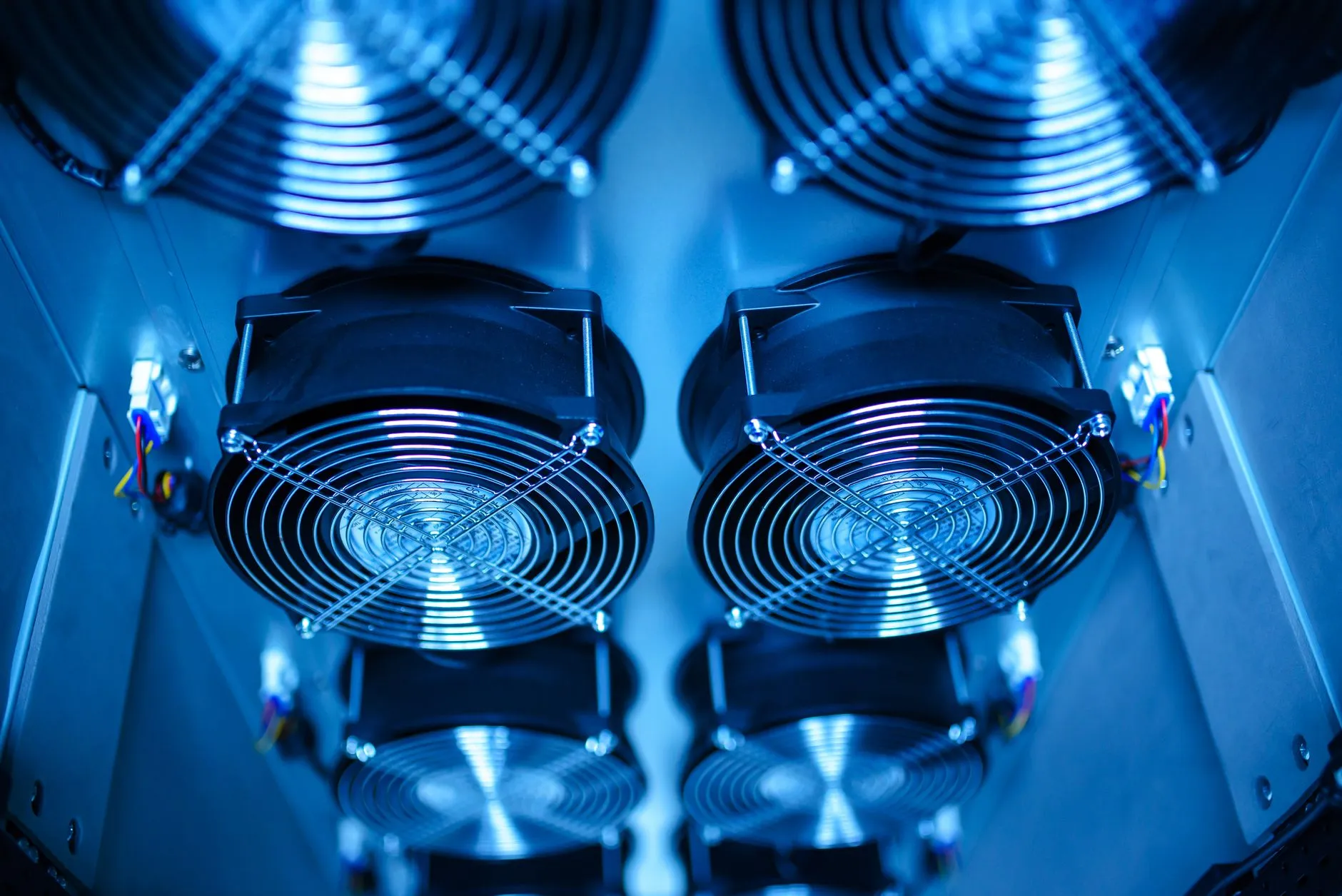
The Hot-Climate Cooling Challenge
Data centers generate enormous amounts of heat. Removing that heat efficiently is what keeps servers running reliably and operating costs under control. In temperate climates, this challenge is significant. In the UAE, where ambient temperatures routinely exceed 45 degrees Celsius during summer months, it becomes the single most important infrastructure design decision.
Traditional air cooling works by pushing cold air through server racks, absorbing heat, and then rejecting that heat to the outside environment through chillers and cooling towers. The hotter the outside air, the harder these systems must work. In the UAE's climate, air-cooled facilities face two compounding problems: the delta between indoor server exhaust temperatures and outdoor ambient is small (reducing heat-rejection efficiency), and mechanical chillers must run at maximum capacity for much of the year (driving up energy consumption and PUE).
Add to this the rise of high-density GPU and AI workloads that pack 40 to 140 kW into a single rack, and the case for liquid cooling in UAE data centers becomes not just compelling but unavoidable. The UAE data center cooling market is projected to grow at over 18% CAGR through 2031, with liquid cooling systems leading that growth.
How Liquid Cooling Works
Liquid cooling uses water or engineered fluids to absorb and transport heat away from computing components. Because liquids have roughly 25 times the thermal conductivity of air, they can remove far more heat per unit volume, enabling higher power densities and lower cooling energy consumption. Three primary liquid cooling architectures are deployed in data centers today.
Direct-to-Chip (Cold Plate) Cooling
Direct-to-chip cooling is the most widely deployed liquid cooling method for GPU servers. Cold plates — metal blocks with internal channels for liquid flow — are mounted directly on CPUs and GPUs, the components that generate the most heat. Chilled liquid (typically treated water or a water-glycol mixture) flows through the plates, absorbs heat, and returns to a coolant distribution unit (CDU) where the heat is rejected to the building's chilled water loop.
- Heat removal capacity: Can handle 40–100+ kW per rack.
- Server modification: Requires GPU servers with factory-installed cold plates (NVIDIA DGX, HGX, and most OEM AI platforms support this).
- Residual air cooling: Memory, storage, and other components still rely on fans and air cooling. A rear-door heat exchanger or supplemental CRAH unit captures residual heat.
- Adoption status: Production-proven at major cloud providers and colocation facilities worldwide.
Why direct-to-chip dominates GPU deployments: NVIDIA's H100, H200, and B200 GPU platforms are all available with factory-integrated cold plates. The server vendor handles the integration, and the data center provides chilled water supply and return connections at each rack. This clean division of responsibility is why direct-to-chip has become the default for GPU colocation.
Rear-Door Heat Exchangers (RDHx)
A rear-door heat exchanger replaces the standard rear door of a server rack with a door containing a liquid-to-air heat exchanger. Hot exhaust air from the servers passes through the coils, which absorb the heat into chilled water. The air exits the rack at or near room temperature, eliminating the need for room-level CRAH units in many configurations.
- Heat removal capacity: Typically handles 20–40 kW per rack, depending on the model and water temperature.
- Server modification: None — works with standard air-cooled servers, making it an effective retrofit option.
- Best use case: Medium-density deployments (15–35 kW per rack) or as a supplemental system alongside direct-to-chip cooling for high-density racks.
- UAE relevance: Particularly valuable in retrofit scenarios where existing air-cooled facilities need to support higher densities without a full rebuild.
Full Immersion Cooling
Immersion cooling submerges entire servers in a tank of dielectric fluid — a non-conductive liquid engineered to safely contact electronic components. The fluid absorbs heat from all components simultaneously (GPUs, CPUs, memory, storage, VRMs), eliminating the need for fans, heat sinks, and cold plates. Heat is removed from the fluid through heat exchangers connected to the building's cooling plant.
- Heat removal capacity: Can support 100+ kW per rack equivalent.
- Two variants: Single-phase immersion (fluid remains liquid) and two-phase immersion (fluid boils at low temperature, vapor condenses on a heat exchanger). Single-phase is simpler and more widely deployed.
- Advantages: Eliminates fans (reducing server power draw by 10–15%), provides uniform cooling across all components, and operates efficiently even with very high ambient temperatures.
- Challenges: Requires purpose-built tanks and modified server form factors, maintenance procedures differ from air-cooled environments (fluid handling, component inspection), and the dielectric fluid itself is an additional capital cost.
For a detailed ROI comparison between immersion and air cooling, see our immersion cooling vs. air cooling analysis.
Why the UAE Is Accelerating Liquid Cooling Adoption
Several factors specific to the UAE are driving liquid cooling adoption faster than in temperate regions.
Climate Makes Air Cooling Expensive
A data center in Northern Europe can use outside air for free cooling during most of the year, achieving PUEs below 1.1. A facility in the UAE has almost zero free cooling hours. Mechanical chillers run year-round at high capacity, consuming 40–60% of the facility's total power in a traditional air-cooled design. This drives PUE above 1.5 and in some cases above 1.8.
Liquid cooling reduces the load on mechanical chillers because the chilled water loop can operate at higher temperatures (30–45 degrees Celsius for direct-to-chip, compared to 7–12 degrees for air cooling chillers). Higher supply water temperatures allow the use of dry coolers or evaporative cooling towers that reject heat more efficiently, even in hot ambient conditions. The result: a liquid-cooled facility in the UAE can achieve PUE of 1.2–1.3, saving 20–30% on total energy costs compared to an equivalent air-cooled facility. For a deeper look at PUE optimization strategies, see our dedicated guide.
AI Demand Is Concentrating in the Region
The UAE's sovereign AI strategy and its position as a global data center hub are attracting GPU-intensive workloads at scale. Enterprises, governments, and hyperscalers deploying AI training and inference infrastructure in the region need the rack densities (40–100+ kW) that only liquid cooling can reliably support. New data center construction in the UAE is increasingly specifying liquid cooling as a baseline requirement rather than an optional upgrade.
Water Usage Concerns Favor Closed-Loop Systems
Water is a scarce resource in the UAE, produced primarily through energy-intensive desalination. Traditional data center cooling uses evaporative cooling towers that consume significant volumes of water — a metric tracked as Water Usage Effectiveness (WUE). Closed-loop liquid cooling systems (direct-to-chip and immersion) dramatically reduce or eliminate evaporative water consumption, making them both economically and environmentally preferable in water-scarce regions. For more on this metric, see our WUE guide.
| Cooling Method | Typical PUE (UAE) | Water Consumption | Max Rack Density |
|---|---|---|---|
| Air cooling (CRAH + chiller) | 1.5–1.8 | High (evaporative towers) | 15–20 kW |
| Rear-door heat exchanger | 1.3–1.5 | Moderate | 20–40 kW |
| Direct-to-chip liquid | 1.15–1.3 | Low (closed loop) | 40–100+ kW |
| Full immersion | 1.02–1.15 | Minimal to zero | 100+ kW |
Planning a Liquid-Cooled Deployment in the UAE
Whether you are building a new facility or upgrading an existing one, liquid cooling deployment involves decisions across several infrastructure layers.
Choosing the Right Architecture
The best liquid cooling approach depends on your density requirements, budget, and operational model.
- Below 30 kW per rack: Rear-door heat exchangers offer a cost-effective path that works with existing air-cooled servers and requires minimal facility modification.
- 30–80 kW per rack: Direct-to-chip cooling is the standard choice for GPU deployments at this density. Requires CDUs, piping infrastructure, and servers with cold-plate support.
- Above 80 kW per rack: Full immersion cooling or a hybrid of direct-to-chip plus rear-door becomes necessary. Immersion offers the best thermal performance but requires purpose-built tanks and modified operational procedures.
Facility Infrastructure Requirements
Liquid cooling requires plumbing infrastructure that air-cooled facilities do not have. Key components include:
- Coolant Distribution Units (CDUs): Heat exchangers that transfer heat from the server-level cooling loop to the building's chilled water system. Sized per row or per cluster.
- Piping network: Supply and return lines running from CDUs to each rack. Must be designed for the flow rates and pressures required by the connected servers.
- Leak detection: Sensors at every connection point, under raised floors, and within CDUs. Automated isolation valves can shut off sections of the loop if a leak is detected.
- Redundancy: N+1 CDUs and pumps ensure that a single component failure does not take down cooling for the cluster. The same redundancy principles that apply to power apply to cooling.
Integration with Existing Air Cooling
Most real-world deployments are hybrid: liquid cooling handles the GPU heat load, while supplemental air cooling manages residual heat from memory, drives, and networking equipment. Facility design must account for both systems operating simultaneously, with careful attention to airflow patterns to prevent hot spots in areas not served by liquid cooling.
Operational Considerations
Liquid cooling changes maintenance workflows. Technicians need training on fluid handling, quick-disconnect fittings, and leak-response procedures. Immersion-cooled hardware requires different racking, de-racking, and inspection procedures than air-cooled gear. Maintenance windows may differ because draining and refilling cooling loops takes time. Build these operational differences into your staffing and training plans from day one.
The ROI of Liquid Cooling in a Hot Climate
The financial case for liquid cooling in the UAE is stronger than in temperate regions because the air-cooling baseline is more expensive.
Consider a 5 MW IT load deployment. In a traditional air-cooled UAE facility with a PUE of 1.6, total facility power (IT plus cooling plus overhead) reaches 8 MW. At a competitive UAE electricity rate of $0.06 per kWh, annual power cost is approximately $4.2 million.
The same 5 MW IT load in a liquid-cooled facility achieving PUE 1.2 draws 6 MW total. Annual power cost drops to approximately $3.15 million — a saving of over $1 million per year. Over a typical three-year colocation contract, that is $3 million+ in savings on power alone, before accounting for the additional rack density (fewer racks needed, less floor space, fewer cross-connects) that liquid cooling enables.
Beyond energy savings: Liquid cooling also extends hardware lifespan by maintaining more stable operating temperatures. GPU throttling events — where the card reduces performance to prevent overheating — are virtually eliminated in liquid-cooled environments, meaning you get full sustained performance from every GPU cycle you pay for.
Liquid Cooling and Rax Data Infrastructure
Rax Data facilities are designed with liquid cooling as a core infrastructure layer, not a retrofit. This means integrated CDUs, pre-plumbed rack positions, leak detection throughout, and engineering staff trained on liquid-cooled operations. Our technology platform supports direct-to-chip and hybrid cooling architectures across all facility locations, enabling customers to deploy GPU colocation at densities from 20 kW to well beyond 100 kW per rack.
For operators considering adiabatic and free-cooling augmentation alongside liquid systems, our energy team evaluates site-specific conditions to identify which combination delivers the optimal PUE for your specific workload profile and contract duration.
FAQ: Liquid Cooling for UAE Data Centers
Why is liquid cooling necessary for data centers in the UAE?
The UAE experiences ambient temperatures that regularly exceed 45 degrees Celsius in summer, which dramatically reduces the efficiency of air-based cooling. Air cooling systems must work much harder to reject heat into hot outside air, driving up energy consumption and PUE. Liquid cooling transfers heat roughly 25 times more effectively than air, making it both more efficient and more reliable in hot climates. For high-density GPU racks drawing 40 kW and above, liquid cooling is the only viable option regardless of climate.
What types of liquid cooling are used in UAE data centers?
Three main types are deployed: direct-to-chip (cold plate) cooling, where chilled liquid circulates through plates attached to CPUs and GPUs; rear-door heat exchangers (RDHx), which mount on the back of server racks and use liquid to capture exhaust heat; and full immersion cooling, where servers are submerged in dielectric fluid. Direct-to-chip is the most common for GPU deployments, while immersion cooling is gaining adoption for the highest-density workloads.
How much does liquid cooling reduce energy costs in a hot climate?
Liquid cooling can reduce cooling energy consumption by 30 to 50 percent compared to traditional air cooling in hot-climate facilities. In PUE terms, a well-designed liquid-cooled facility in the UAE can achieve a PUE of 1.2 to 1.3, compared to 1.5 to 1.8 for an air-cooled facility in the same environment. For a 10 MW deployment, that difference translates to 2 to 5 MW of saved cooling power, worth hundreds of thousands of dollars annually.
Is liquid cooling safe for servers and GPU hardware?
Yes. Direct-to-chip systems use closed-loop circuits with non-conductive coolant or treated water that never contacts electronic components directly. Immersion cooling uses purpose-engineered dielectric fluids that are electrically non-conductive and safe for direct contact with circuit boards. Both approaches are proven in production at scale by major cloud providers, GPU manufacturers, and enterprise data centers worldwide.
Frequently Asked Questions
Why is liquid cooling necessary for data centers in the UAE?
The UAE experiences ambient temperatures that regularly exceed 45 degrees Celsius in summer, which dramatically reduces the efficiency of air-based cooling. Air cooling systems must work much harder to reject heat into hot outside air, driving up energy consumption and PUE. Liquid cooling transfers heat 25 times more effectively than air, making it both more efficient and more reliable in hot climates. For high-density GPU racks drawing 40 kW and above, liquid cooling is the only viable option regardless of climate.
What types of liquid cooling are used in UAE data centers?
Three main types are deployed: direct-to-chip (cold plate) cooling, where chilled liquid circulates through plates attached to CPUs and GPUs; rear-door heat exchangers (RDHx), which mount on the back of server racks and use liquid to capture exhaust heat; and full immersion cooling, where servers are submerged in dielectric fluid. Direct-to-chip is the most common for GPU deployments, while immersion cooling is gaining adoption for the highest-density workloads.
How much does liquid cooling reduce energy costs in a hot climate?
Liquid cooling can reduce cooling energy consumption by 30 to 50 percent compared to traditional air cooling in hot-climate facilities. In PUE terms, a well-designed liquid-cooled facility in the UAE can achieve a PUE of 1.2 to 1.3, compared to 1.5 to 1.8 for an air-cooled facility in the same environment. For a 10 MW deployment, that difference translates to 2 to 5 MW of saved cooling power, worth hundreds of thousands of dollars annually.
Is liquid cooling safe for servers and GPU hardware?
Yes. Direct-to-chip systems use closed-loop circuits with non-conductive coolant or treated water that never contacts electronic components directly. Immersion cooling uses purpose-engineered dielectric fluids that are electrically non-conductive and safe for direct contact with circuit boards. Both approaches are proven in production at scale by major cloud providers, GPU manufacturers, and enterprise data centers worldwide.
Ready for Liquid-Cooled Infrastructure?
Rax Data & Energy delivers liquid-cooled, high-density colocation purpose-built for GPU and AI workloads in the UAE.
Contact Us Our Infrastructure