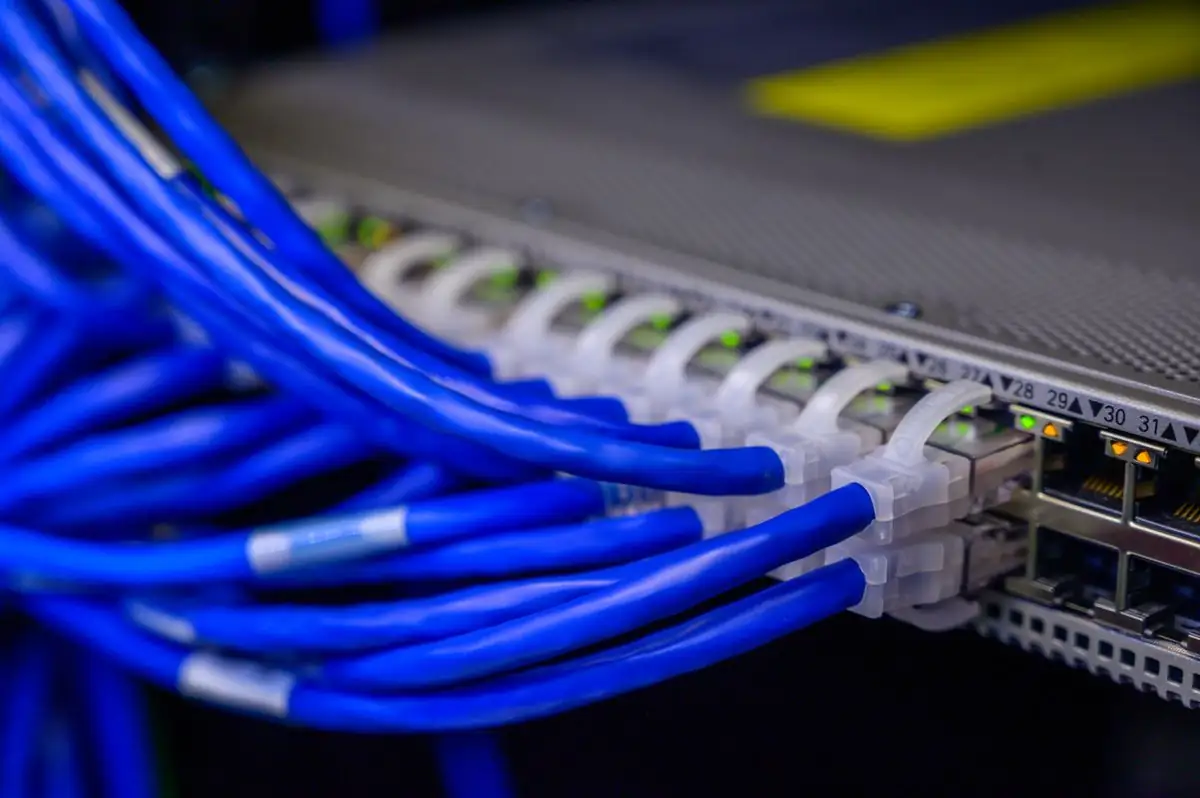
Why Networking Matters for GPU Clusters
In distributed AI training, GPUs across multiple nodes must synchronize gradients after every forward-backward pass. This collective communication (all-reduce, all-gather, reduce-scatter) generates massive bursts of traffic where every GPU waits for the slowest communication path to complete. A single congested link or dropped packet can stall an entire 1,000-GPU cluster, wasting millions of dollars in idle compute time.
The network interconnect between GPU nodes is therefore the critical bottleneck in scaling AI training beyond a single server. While intra-node connectivity uses NVLink (900 GB/s on H100), inter-node traffic traverses the data center fabric -- either InfiniBand or Ethernet with RDMA. The choice between these technologies determines training efficiency, maximum cluster scale, and total infrastructure cost.
For operators offering GPU colocation services, network architecture directly affects the value proposition. Customers training large language models (LLMs) with hundreds of billions of parameters require lossless, low-latency fabrics that maintain linear scaling efficiency up to thousands of GPUs.
InfiniBand: The HPC Standard
InfiniBand is a purpose-built high-performance interconnect developed specifically for low-latency, high-bandwidth data movement. Unlike Ethernet which was designed for general-purpose networking and later adapted for RDMA, InfiniBand provides hardware-guaranteed lossless delivery, credit-based flow control, and sub-microsecond latency from the ground up.
Current InfiniBand Generations
| Generation | Speed (per lane) | Typical Config | Total Bandwidth | Year Introduced |
|---|---|---|---|---|
| HDR | 50 Gb/s | 4x (HDR100) or 1x (HDR) | 200 Gb/s | 2019 |
| NDR | 100 Gb/s | 4x | 400 Gb/s | 2022 |
| XDR | 200 Gb/s | 4x | 800 Gb/s | 2025 |
| GDR (announced) | 400 Gb/s | 4x | 1.6 Tb/s | 2027 (expected) |
Key InfiniBand Advantages
- Credit-based flow control: Hardware prevents buffer overflow at every hop, guaranteeing zero packet loss without relying on software retransmission. This eliminates tail latency spikes that devastate collective operations.
- Adaptive routing: Switches dynamically route packets across available paths, distributing load across the fabric and avoiding congestion without software involvement.
- In-network computing: NVIDIA SHARP (Scalable Hierarchical Aggregation and Reduction Protocol) offloads collective operations to switches, reducing traffic volume by 2x for all-reduce operations and cutting completion time by 25-50%.
- Guaranteed isolation: Virtual lanes and quality-of-service enforcement provide hardware-level traffic isolation between tenants without performance interference.
InfiniBand Hardware Stack
A complete InfiniBand deployment requires: Host Channel Adapters (HCAs) like NVIDIA ConnectX-7 in each server, InfiniBand switches (NVIDIA Quantum-2 for NDR), optical transceivers, and specialized management software (UFM for fabric management). The entire stack comes from a single vendor ecosystem (NVIDIA/Mellanox), which ensures interoperability but creates vendor lock-in.
RoCE: RDMA Over Converged Ethernet
RoCE (RDMA over Converged Ethernet) brings RDMA capabilities to standard Ethernet infrastructure. RoCE v2 encapsulates InfiniBand transport packets in UDP/IP headers, enabling RDMA over routed L3 networks -- critical for multi-rack GPU clusters where L2 domain boundaries exist.
RoCE Architecture
RoCE uses the same ConnectX-7 network adapters as InfiniBand (operating in Ethernet mode) connected to standard Ethernet switches. This shared hardware means organizations can deploy ConnectX-7 NICs and later decide between InfiniBand or RoCE based on switch infrastructure choices.
Key RoCE Advantages
- Standard Ethernet ecosystem: Compatible with switches from multiple vendors (Arista, Cisco, Juniper, NVIDIA), avoiding single-vendor lock-in and enabling competitive pricing.
- Operational familiarity: Network teams already understand Ethernet monitoring, troubleshooting, and management tools. InfiniBand requires specialized expertise.
- Converged infrastructure: The same physical fabric carries both RDMA training traffic and standard TCP/IP management, storage, and control-plane traffic. InfiniBand requires a separate physical network.
- Cost advantage: At scale, RoCE deployments cost 20-40% less than InfiniBand for equivalent port counts due to switch competition and reuse of existing Ethernet management tools.
RoCE Challenges
Unlike InfiniBand's credit-based lossless fabric, Ethernet achieves losslessness through Priority Flow Control (PFC) -- a pause-based mechanism that can cause head-of-line blocking, deadlocks, and unfairness under heavy load. Achieving reliable lossless Ethernet requires careful configuration of PFC, ECN (Explicit Congestion Notification), and DCQCN (Data Center Quantized Congestion Notification). Misconfiguration causes catastrophic performance degradation that can reduce effective bandwidth to 10-20% of line rate.
InfiniBand vs RoCE: Head-to-Head Comparison
| Factor | InfiniBand NDR (400G) | RoCE v2 (400GbE) |
|---|---|---|
| Raw bandwidth | 400 Gb/s | 400 Gb/s |
| Effective bandwidth (all-reduce) | 380-395 Gb/s (95-99%) | 320-360 Gb/s (80-90%) |
| Latency (port-to-port) | 90-130 ns | 300-600 ns |
| Tail latency (99.9th percentile) | 150-200 ns | 1-10 us (under congestion) |
| Lossless guarantee | Hardware credit-based (absolute) | PFC-based (configurable, failure-prone) |
| Adaptive routing | Native hardware support | ECMP / spray (limited adaptivity) |
| In-network compute (SHARP) | Yes (2x all-reduce efficiency) | No |
| Multi-vendor switches | No (NVIDIA only) | Yes (Arista, Cisco, NVIDIA, etc.) |
| Cost per 400G port | $3,000-$5,000 | $2,000-$3,500 |
| Operational complexity | High (specialized skills) | Moderate (familiar Ethernet) |
| Maximum proven scale | 100,000+ GPUs (Meta, xAI) | 16,000+ GPUs (Google, Microsoft) |
| Congestion management | Hardware credit + adaptive routing | ECN + DCQCN + PFC (software-heavy) |
Performance Impact on Training
Benchmarks on identical hardware (8x H100 per node, 256 nodes, 2048 GPUs) show InfiniBand NDR achieving 15-30% faster training completion than 400GbE RoCE for LLMs with 70B+ parameters. The gap narrows for smaller models and widens for communication-heavy architectures like Mixture-of-Experts (MoE) where all-to-all communication patterns stress the fabric differently than standard all-reduce.
The performance difference primarily comes from InfiniBand's superior tail latency behavior. In collective operations, every GPU waits for the slowest participant. InfiniBand's credit-based flow control and adaptive routing eliminate the tail latency spikes that PFC-based Ethernet occasionally produces, maintaining consistent per-iteration training time.
Network Topologies for GPU Clusters
Fat-Tree (Clos) Topology
The standard non-blocking fat-tree topology provides full bisection bandwidth: any GPU can communicate with any other GPU at line rate simultaneously. This topology uses leaf switches (connecting to servers), spine switches (connecting leaf switches), and optionally core switches for three-tier deployments exceeding 2,000 nodes.
A 2:1 oversubscribed fat-tree (common for cost optimization) cuts inter-pod bandwidth in half, which is acceptable for inference workloads but reduces distributed training efficiency by 10-20% when communication spans multiple pods.
Rail-Optimized Topology
Rather than connecting all GPUs through a single shared fabric, rail-optimized topologies assign each GPU within a node to a dedicated network "rail." In an 8-GPU node, GPU 0 across all nodes connects to Rail 0 switches, GPU 1 to Rail 1 switches, etc. This creates 8 independent smaller fabrics that avoid congestion from mixed traffic patterns. NVIDIA DGX SuperPOD uses this architecture for clusters up to 4,096 GPUs.
Dragonfly Topology
For massive scale (10,000+ nodes), dragonfly topologies reduce switch and cable counts by 40-60% compared to fat-trees while providing near-equivalent performance for AI collective workloads. Nodes are grouped into "router groups" with full connectivity within each group and partial connectivity between groups. Adaptive routing compensates for the reduced inter-group bandwidth.
Multi-Rail and Multi-Plane Architectures
Modern GPU servers include 4-8 network ports per node (multi-rail) to provide aggregate bandwidth matching the combined compute throughput of 8 GPUs. A single 400Gb/s link cannot saturate the 8x H100 node which generates collective traffic requiring 3.2 Tb/s of aggregate network bandwidth for optimal performance.
Multi-Rail Bandwidth Calculation
| Configuration | Network Ports | Aggregate Bandwidth | Bandwidth per GPU | Typical Use Case |
|---|---|---|---|---|
| Single-rail | 1x 400G | 400 Gb/s | 50 Gb/s | Inference, small models |
| Dual-rail | 2x 400G | 800 Gb/s | 100 Gb/s | Medium training clusters |
| Quad-rail | 4x 400G | 1.6 Tb/s | 200 Gb/s | Large LLM training |
| Octa-rail (DGX H100) | 8x 400G | 3.2 Tb/s | 400 Gb/s | Maximum-scale training |
Each additional rail multiplies not just bandwidth but also the switch infrastructure required, making network costs scale linearly (or super-linearly at large scale). Facility operators must provision cross-connect capacity, power, and cooling for switch racks proportional to the rail count chosen by tenants.
Which to Choose: Decision Framework
Choose InfiniBand When:
- Training models larger than 70B parameters across 256+ GPUs
- Communication-heavy architectures (MoE, pipeline parallelism across many stages)
- Maximum training throughput is the priority over cost
- SHARP in-network computing benefits your workload (large-scale all-reduce)
- You have budget for NVIDIA-specialized network engineering staff
- Cluster will operate at 1,000+ GPU scale
Choose RoCE When:
- Clusters under 256 GPUs where tail latency impact is minimal
- Mixed workload environments (training + inference + storage on shared fabric)
- Cost sensitivity: 20-40% lower network infrastructure cost
- Existing Ethernet operational expertise and tools
- Multi-vendor strategy is a requirement (avoiding NVIDIA lock-in)
- Inference-dominant workloads with modest inter-node communication
Hybrid Approach
Some large deployments use InfiniBand for the GPU compute fabric (training traffic) while running standard Ethernet for management, storage, and control-plane traffic. This captures InfiniBand's performance advantage for latency-sensitive collective operations while maintaining Ethernet familiarity for everything else. The managed AI hosting model simplifies this by abstracting network complexity from tenants.
Colocation and Hosting Considerations
For data center operators offering GPU colocation services, network architecture decisions have long-term implications for facility design, tenant mix, and competitive positioning.
Physical Infrastructure Requirements
| Requirement | InfiniBand | RoCE/Ethernet |
|---|---|---|
| Cable type | Active optical cables (AOC) or fiber | Standard fiber, DAC for short runs |
| Maximum cable length (passive) | 2m (copper DAC) | 5m (copper DAC) |
| Maximum cable length (active) | 100m+ (AOC/fiber) | 100m+ (fiber) |
| Switch power per 400G port | ~15-20W | ~12-18W |
| Switch cooling | Front-to-back airflow, high CFM | Front-to-back, standard CFM |
| Cross-connect density | 8 fibers per node (octa-rail) | 8 fibers per node (octa-rail) |
| Separate fabric required | Yes (dedicated IB switches) | No (converged with management) |
Facilities supporting high-density GPU colocation must pre-provision sufficient fiber pathway capacity for multi-rail configurations. An 8-rail cluster with 256 nodes requires 2,048 fiber connections from compute racks to network racks -- a massive structured cabling undertaking that must be planned during facility construction, not retrofitted after tenant deployment.
Power and Cooling for Network Infrastructure
Network switches for a 1,024-GPU InfiniBand cluster consume 50-100kW of power (leaf + spine switches). This represents 3-5% of total cluster power but generates concentrated heat in network rack positions. Facility design must account for these power and cooling requirements separately from compute rack density calculations.
Frequently Asked Questions
Is InfiniBand better than Ethernet for AI training?
For large-scale distributed AI training (hundreds to thousands of GPUs), InfiniBand delivers 15-30% better training throughput than RoCE Ethernet due to lower tail latency, lossless fabric guarantees, and superior collective operations support. For inference workloads or clusters under 64 GPUs, RoCE v2 over 400GbE provides comparable performance at lower cost and operational complexity.
What is the cost of InfiniBand vs Ethernet per GPU node?
InfiniBand NDR (400Gb/s) networking costs approximately $3,000-$5,000 per port including HCA, cables, and switch port amortization. Equivalent 400GbE RoCE costs $2,000-$3,500 per port. For a 1,024-GPU cluster, InfiniBand adds $1.5M-$2.5M more than RoCE to total infrastructure cost. However, InfiniBand's 15-30% training efficiency gain often recovers this premium within 6-12 months through faster model iteration.
What bandwidth does GPU-to-GPU communication require?
Modern large language model training requires 400-800Gb/s per GPU for all-reduce collective operations during gradient synchronization. NVIDIA H100 GPUs have 18x NVLink ports providing 900GB/s intra-node, but inter-node traffic flows over InfiniBand or Ethernet at 400Gb/s per ConnectX-7 HCA (50GB/s). Multi-rail configurations with 4-8 network ports per node are standard for clusters exceeding 256 GPUs to prevent network bottlenecks.
Deploy GPU Clusters with Optimized Networking
Rax Data & Energy offers GPU colocation with InfiniBand NDR and 400GbE RoCE fabrics pre-provisioned. Our network architects design optimal topologies for your workload scale and budget.
Discuss Your GPU Cluster Requirements