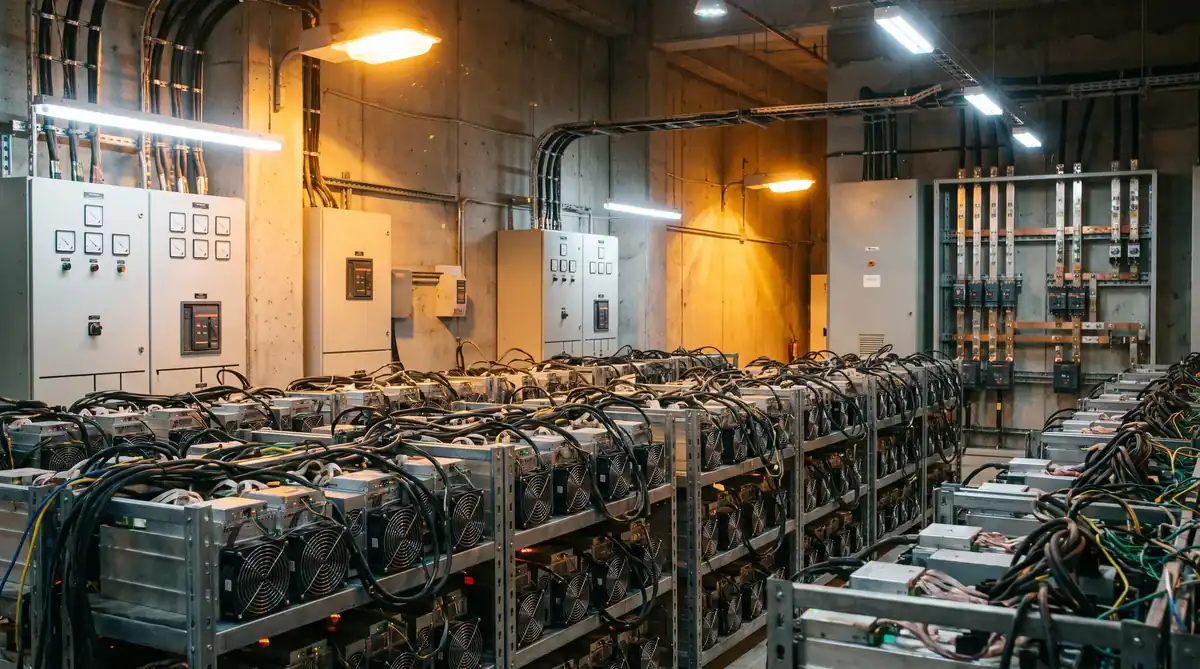
What Behind-the-Meter Power Means for Compute Operations
Behind-the-meter (BTM) power describes any arrangement where electricity is generated and consumed at the same physical site without traversing the public transmission or distribution grid. The term originates from the utility metering point: power consumed before passing through the revenue meter never incurs grid delivery charges.
For Bitcoin mining operations and high-density data centers, BTM power is not merely a cost optimization. It represents a fundamentally different relationship with electricity. Instead of being a passive consumer subject to utility tariffs, demand charges, and rate schedule changes, the facility operator becomes an integrated participant in the energy value chain.
The economics are straightforward. A typical commercial electricity bill in the United States breaks down into three primary components: generation (40 to 55 percent of total cost), transmission (15 to 25 percent), and distribution plus regulatory charges (20 to 35 percent). BTM arrangements eliminate the second and third components entirely. For a facility paying $0.07/kWh on grid power, the generation-only cost might be $0.03 to $0.04/kWh, representing a 40 to 55 percent reduction in electricity expense.
The Electricity Cost Stack: What You Actually Pay For
Understanding BTM economics requires dissecting the components of a grid electricity bill. Each layer adds cost between the point of generation and the point of consumption.
Generation Charges
The base cost of producing electricity at the power plant. In deregulated markets, this is set by wholesale market clearing prices or bilateral contracts. In regulated markets, it reflects the utility's approved generation cost plus a regulated rate of return. Generation charges in the United States range from $0.02/kWh for efficient combined-cycle natural gas plants in low-cost regions to $0.06/kWh or more in constrained markets.
Transmission Charges
Fees for moving electricity over high-voltage transmission lines from generation sources to local distribution networks. Transmission charges cover the capital and maintenance costs of transmission infrastructure, congestion management, and losses. These typically add $0.01 to $0.03/kWh to the delivered cost and are often assessed as demand charges based on the facility's peak consumption during system peak periods.
Distribution Charges
Fees for delivering electricity from the local substation to the end consumer through medium- and low-voltage distribution infrastructure. Distribution charges cover poles, transformers, meters, and local utility operations. These add another $0.01 to $0.03/kWh and often include fixed demand charges based on the facility's maximum power draw.
Regulatory and Policy Charges
Various surcharges, fees, and policy cost allocations that vary by jurisdiction. These can include renewable portfolio standard compliance costs, energy efficiency program surcharges, nuclear decommissioning charges, stranded cost recovery, and transmission congestion revenue rights. In aggregate, regulatory charges can add $0.005 to $0.02/kWh depending on the jurisdiction.
| Cost Component | Typical Range ($/kWh) | % of Total Bill | Eliminated by BTM? |
|---|---|---|---|
| Generation | $0.025 - $0.060 | 40-55% | Replaced by on-site generation cost |
| Transmission | $0.010 - $0.030 | 15-25% | Yes, fully eliminated |
| Distribution | $0.010 - $0.030 | 15-25% | Yes, fully eliminated |
| Demand Charges | $0.005 - $0.020 | 5-15% | Yes, fully eliminated |
| Regulatory/Policy | $0.005 - $0.020 | 5-10% | Mostly eliminated |
BTM Power Sources for Bitcoin Mining
Not all generation sources are equally suited for behind-the-meter mining operations. The ideal BTM power source combines low marginal generation cost, high availability, and physical co-location potential.
Natural Gas: Wellhead and Pipeline
Natural gas generation is the dominant BTM power source for Bitcoin mining in North America. Two distinct models have emerged. Wellhead generation places mining containers directly at oil and gas production sites, consuming associated gas that would otherwise be flared or vented. Generation costs at the wellhead can be as low as $0.015 to $0.025/kWh because the gas is effectively free or priced at negative value (the producer would otherwise pay flaring penalties). Pipeline-fed generation installs larger natural gas generator sets at facilities connected to gas pipelines, purchasing gas at wholesale prices. Generation costs for pipeline-fed operations range from $0.030 to $0.045/kWh depending on gas prices and generator efficiency.
The Rax Natural Gas Mining Division operates facilities using both models, leveraging stranded gas assets to deliver electricity costs below $0.03/kWh for hosted mining operations.
Solar Photovoltaic
Solar BTM installations pair mining hardware with on-site solar arrays. In high-irradiance locations such as the Middle East and American Southwest, solar generation costs have fallen below $0.025/kWh on a levelized basis. The challenge is intermittency: solar generation peaks during midday hours and drops to zero at night, yielding a capacity factor of 20 to 30 percent without storage. For mining operations, this means either curtailing hash rate during non-solar hours, adding battery energy storage, or maintaining a grid interconnection for supplemental power.
Wind
Wind-powered BTM mining targets high-wind corridors in the central United States, northern Europe, and coastal regions. Modern onshore wind achieves levelized costs of $0.025 to $0.040/kWh with capacity factors of 30 to 45 percent in favorable locations. Wind generation patterns are less predictable than solar but offer better seasonal consistency in many regions. The same intermittency challenges apply: mining operations must either tolerate variable hash rate or supplement with storage or grid backup.
Hydroelectric
Small-scale hydroelectric installations provide some of the lowest-cost and most reliable BTM power available. Run-of-river hydro facilities in regions like Quebec, British Columbia, Scandinavia, and the Pacific Northwest achieve generation costs of $0.015 to $0.030/kWh with capacity factors above 50 percent. The geographic limitation is the primary constraint: suitable hydro sites are fixed and often remote from other infrastructure.
Nuclear Small Modular Reactors
SMRs represent an emerging BTM power option for data centers and potentially mining operations. Projected generation costs of $0.040 to $0.060/kWh with near-100 percent capacity factor make SMRs competitive for large-scale, long-duration deployments. Several data center operators have announced SMR power purchase agreements with projected operational dates in the 2029 to 2032 timeframe. The high upfront capital cost and multi-year deployment timeline currently limit SMR applications to facilities with 50+ MW demand and 20+ year operational horizons.
Financial Modeling: BTM vs Grid Power
The financial case for BTM power depends on four variables: the grid power rate at the proposed location, the BTM generation cost (including capital amortization), the facility power consumption, and the operational time horizon.
10 MW Bitcoin Mining Facility Example
| Parameter | Grid Power | BTM Natural Gas | BTM Solar + Battery |
|---|---|---|---|
| All-in electricity rate | $0.075/kWh | $0.035/kWh | $0.045/kWh |
| Annual electricity cost (10 MW, 95% uptime) | $6,241,800 | $2,913,500 | $3,745,900 |
| Annual savings vs grid | -- | $3,328,300 | $2,495,900 |
| CapEx for generation equipment | $0 | $8,000,000 - $12,000,000 | $15,000,000 - $22,000,000 |
| Payback period on generation CapEx | -- | 2.4 - 3.6 years | 6.0 - 8.8 years |
The natural gas BTM model recovers its capital investment in under 4 years in most scenarios, after which the facility operates at a permanent cost advantage versus grid power. Solar plus battery BTM takes longer to reach payback but offers zero-fuel-cost operations after capital recovery and potentially superior economics over a 15 to 20 year asset life.
Engineering Requirements for BTM Installations
Building a BTM power facility requires engineering capabilities that go beyond traditional data center or mining site design. The facility operator takes on responsibilities normally handled by the utility.
Generation Equipment
For natural gas BTM, the primary equipment consists of reciprocating engine generator sets (gensets) or gas turbines. Reciprocating engines in the 1 to 5 MW range per unit offer 38 to 44 percent electrical efficiency and fast start-up times. Gas turbines become more cost-effective above 10 MW per unit with efficiencies of 30 to 40 percent for simple cycle and 50+ percent for combined cycle configurations. The choice depends on the facility scale, gas pressure availability, and whether waste heat recovery is planned.
Electrical Distribution
BTM facilities must design their own medium-voltage distribution from the generator output to the mining or compute loads. This includes step-up transformers (if the generator output voltage differs from the distribution voltage), medium-voltage switchgear, power distribution units, and protection relaying. The absence of a utility interconnection means the facility must also provide its own voltage and frequency regulation, reactive power compensation, and fault current protection.
Fuel Supply Infrastructure
Natural gas BTM requires either a pipeline interconnection with metering and regulation equipment or on-site compressed natural gas (CNG) or liquefied natural gas (LNG) storage with vaporization systems. Pipeline interconnection is preferred for cost and reliability but requires 6 to 18 months for permitting and construction. CNG and LNG provide flexibility for remote sites but add $0.005 to $0.015/kWh in fuel logistics costs.
Grid Interconnection (Optional but Recommended)
Maintaining a grid interconnection for backup power adds cost but substantially improves operational reliability. The interconnection allows the facility to draw grid power during generator maintenance windows and to export excess generation during periods of low compute load. Interconnection costs vary widely by jurisdiction but typically range from $500,000 to $5,000,000 for a 10 MW facility, depending on the required distribution system upgrades.
Regulatory Landscape
The regulatory treatment of BTM power varies significantly by jurisdiction and is evolving as mining and data center loads grow. Key regulatory considerations include the following areas.
Standby Charges
Utilities in many jurisdictions assess standby charges on BTM facilities that maintain grid interconnections. These charges reflect the utility's cost of maintaining capacity to serve the facility during generator outages. Standby charges can range from $2 to $10 per kW per month of interconnected capacity, partially offsetting the savings from BTM generation. Some jurisdictions have reduced or eliminated standby charges for facilities that demonstrate they will not draw grid power during system peaks.
Departing Load Charges
When an existing grid customer converts to BTM power, some utility commissions assess departing load charges to recover stranded infrastructure investments that were sized to serve the departing load. These charges are typically phased out over 5 to 10 years but can significantly impact the near-term economics of BTM conversion.
Environmental Permitting
BTM generation facilities are subject to air quality permitting requirements that do not apply to grid-connected loads. Natural gas generators require air permits based on their nitrogen oxide (NOx), carbon monoxide (CO), and particulate matter emissions. Permitting timelines range from 3 to 12 months depending on the facility size and local air quality attainment status. In non-attainment areas, emissions offsets may be required, adding significant cost.
Noise and Land Use
Generator noise and the industrial nature of BTM installations may trigger local zoning and land use approvals. Reciprocating engines produce 85 to 105 dB at one meter and require acoustic enclosures or setbacks to meet community noise standards. Acoustic management adds $50,000 to $300,000 to facility costs depending on the noise reduction requirements.
BTM in the Middle East and UAE
The UAE energy landscape presents distinct opportunities and constraints for BTM power. Abundant natural gas resources, high solar irradiance, and growing data center demand create favorable conditions for BTM deployment.
The UAE's regulated electricity market means that grid tariffs for industrial consumers are relatively low ($0.04 to $0.07/kWh depending on the emirate and consumption tier), which narrows the BTM savings margin compared to markets with higher grid rates. However, solar BTM installations benefit from capacity factors of 25 to 30 percent and levelized costs as low as $0.020/kWh, making solar-plus-storage BTM competitive with grid power for data center applications.
DEWA and EWEC tariff structures for large industrial consumers include demand charges that BTM installations can reduce or eliminate. The Shams Dubai and similar programs allow net metering of rooftop and ground-mount solar, though the regulations for large-scale BTM generation serving dedicated compute loads are still evolving.
Operational Considerations
Maintenance and Availability
BTM generation equipment requires planned maintenance that results in periodic downtime. Reciprocating engines need oil changes every 500 to 1,000 operating hours and major overhauls every 30,000 to 60,000 hours. Gas turbines have similar maintenance intervals. A well-maintained genset fleet achieves 92 to 97 percent availability. For mining operations, generator maintenance windows can be scheduled during periods of low Bitcoin network difficulty or high difficulty adjustments to minimize revenue impact.
Fuel Price Risk
Natural gas BTM operators are exposed to gas commodity price risk. A $1/MMBtu increase in gas prices translates to approximately $0.008 to $0.012/kWh increase in generation cost depending on engine efficiency. This risk can be managed through fixed-price gas purchase contracts, financial hedges, or dual-fuel generation capability. Wellhead operations using stranded gas are largely insulated from commodity price fluctuations.
Scaling and Modularity
BTM installations can be designed for modular expansion. Containerized generator and mining solutions allow facilities to add capacity in 1 to 5 MW increments as demand grows or as additional gas supply becomes available. This modularity reduces the initial capital commitment and allows the facility to match generation capacity to actual compute load.
Rax BTM Power Solutions
Rax operates BTM power facilities across multiple energy sources, providing hosted mining and colocation services with electricity costs that grid-connected competitors cannot match. Our natural gas mining operations leverage stranded and associated gas assets to deliver sub-$0.03/kWh power for ASIC hosting, while our solar and hybrid facilities in the UAE combine renewable generation with grid backup for AI compute workloads.
For operators seeking to deploy their own BTM infrastructure, Rax provides engineering consulting, power procurement advisory, and facility design services. Our experience across facilities ranging from 1 MW to 100 MW informs practical design decisions that theoretical models alone cannot capture.
Related Articles
- Stranded Energy and Flare Gas Bitcoin Mining
- Natural Gas Powered Data Centers
- Bitcoin Mining Power Procurement
- Data Center Power Purchase Agreements
- Electricity Cost Optimization for Mining
- Solar Bitcoin Mining Profitability
- Data Center Demand Response and Smart Grid
- Mining Farm Design: 1 MW to 100 MW