What Is a Battery Energy Storage System?
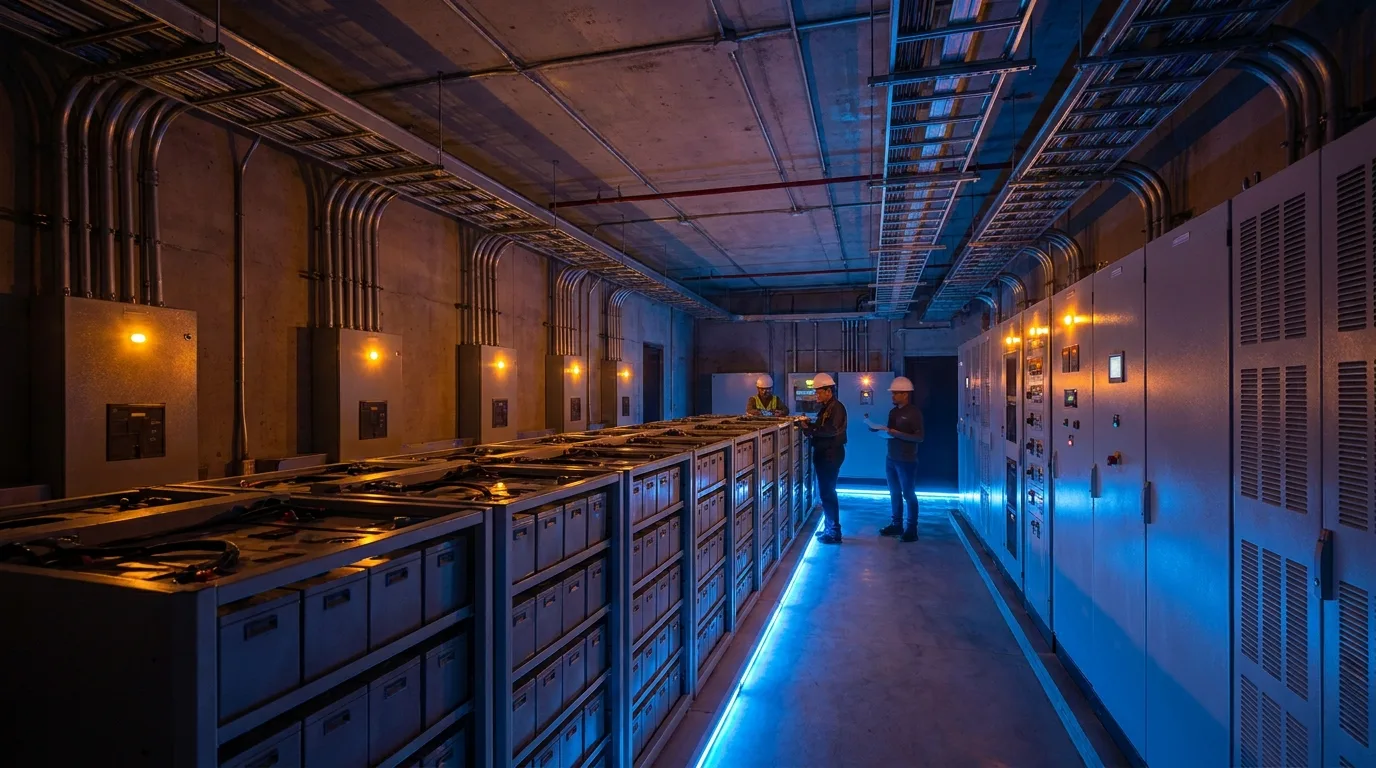
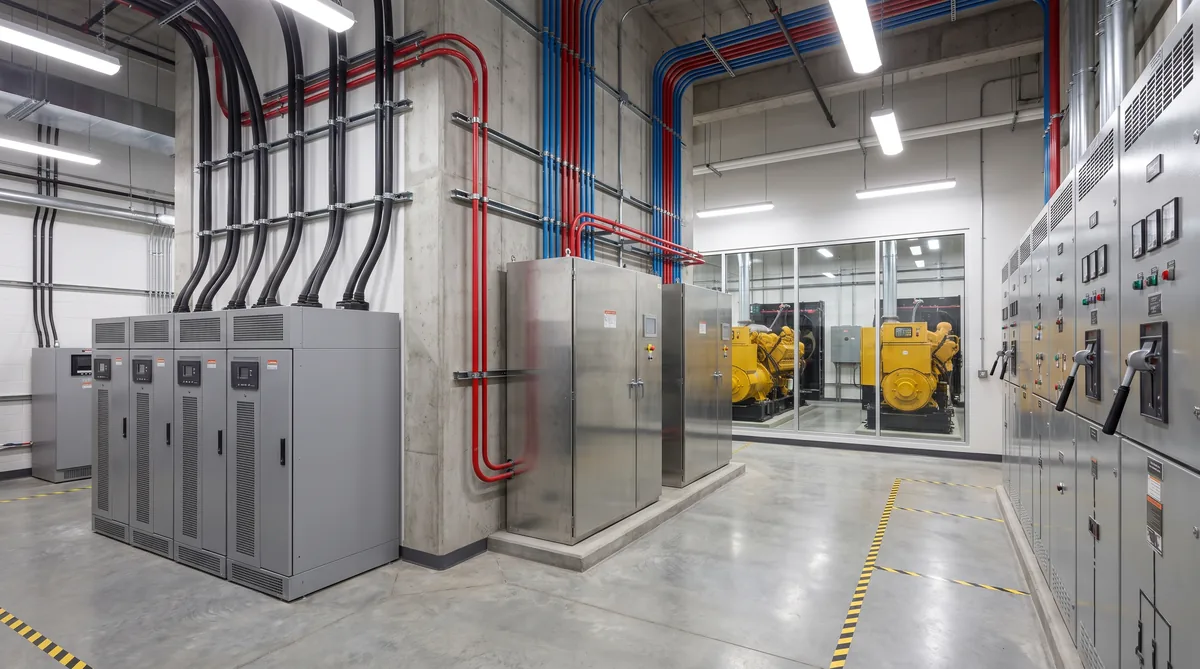
A Battery Energy Storage System (BESS) is a large-scale rechargeable battery installation designed to store electrical energy and discharge it on demand. In a data center context, BESS serves as both a backup power source during grid outages and an active energy management tool that can shift load, shave demand peaks, and integrate renewable energy sources.
Unlike the small battery strings inside traditional UPS systems that provide 5-15 minutes of bridge power, a modern data center BESS installation is sized to sustain full facility loads for 1-4 hours or longer. This extended duration changes the fundamental economics and operational role of battery storage, transforming it from a brief bridge-to-generator system into a primary backup power source that can, in many scenarios, eliminate the need for diesel generators entirely.
The technology has matured rapidly. Lithium-ion battery costs have declined approximately 90% over the past decade, while energy density and cycle life have improved substantially. These improvements, combined with increasing grid instability, carbon reduction mandates, and the rising cost of diesel fuel and emissions compliance, have made BESS economically competitive with traditional generator-based backup for many data center applications.
Why Data Centers Are Adopting BESS
Several converging factors are driving BESS adoption across the data center industry. Understanding these drivers helps operators evaluate whether BESS is appropriate for their specific facility.
Grid Reliability Concerns
Grid outage frequency and duration are increasing in many regions due to aging infrastructure, extreme weather events, and the complexity introduced by distributed generation. Traditional data center backup relied on a simple model: UPS batteries bridge the gap while diesel generators start (typically 10-30 seconds). BESS extends this model by providing hours of backup without the mechanical complexity and fuel dependency of generators, with instant (sub-millisecond) response to power events.
Environmental and Regulatory Pressure
Diesel generators produce nitrogen oxides, particulate matter, and carbon dioxide. Many jurisdictions are tightening emissions standards for stationary diesel engines, with some regions restricting or prohibiting new diesel generator installations in air quality non-attainment zones. BESS produces zero on-site emissions, simplifying permitting and compliance. For facilities pursuing carbon neutrality, eliminating diesel combustion is an important step.
Total Cost of Ownership Improvements
While the upfront capital cost of a BESS installation may be comparable to or higher than an equivalent diesel generator system, the total cost of ownership over a 15-20 year facility lifecycle is increasingly favorable for BESS. Generators require fuel storage infrastructure, regular fuel deliveries, periodic load bank testing, engine maintenance, emissions testing, and eventual overhaul or replacement. BESS requires minimal ongoing maintenance, no fuel, and can generate revenue through grid services programs (discussed below).
Faster Permitting and Deployment
Diesel generator installations require fuel storage permits, emissions permits, noise variances, and sometimes environmental impact assessments. BESS installations, while subject to electrical and fire codes, avoid fuel and emissions-related permitting. In dense urban environments where data center demand is highest, this permitting advantage can shave months off project timelines.
Renewable Energy Integration
As data centers increasingly procure renewable energy through power purchase agreements and direct on-site generation, BESS provides the storage capacity needed to smooth intermittent generation. Solar panels produce power during daylight hours; BESS stores excess production for use during evening demand peaks or overnight operation. This coupling increases the effective utilization of renewable assets.
Battery Technologies for Data Centers
Several battery chemistries are deployed in data center BESS applications, each with distinct performance characteristics, cost profiles, and safety considerations.
Lithium Iron Phosphate (LFP)
LFP has become the dominant chemistry for data center BESS in 2026. Its key advantages include inherent thermal stability (significantly lower thermal runaway risk compared to other lithium-ion chemistries), long cycle life (3,000-6,000+ cycles at 80% depth of discharge), wide operating temperature range, and declining costs. LFP cells are heavier and have lower energy density than NMC alternatives, but for stationary data center applications where weight is not a constraint, this trade-off is favorable.
| Specification | LFP | NMC | Vanadium Redox Flow |
|---|---|---|---|
| Energy Density (Wh/kg) | 90-160 | 150-250 | 15-25 |
| Cycle Life | 3,000-6,000+ | 1,500-3,000 | 10,000-20,000+ |
| Round-Trip Efficiency | 92-96% | 92-96% | 65-80% |
| Thermal Runaway Risk | Very Low | Moderate | None |
| Cost ($/kWh installed) | $250-400 | $300-500 | $400-700 |
| Best For | General purpose, 1-4 hr backup | Space-constrained installs | Long-duration (4-12 hr) storage |
Nickel Manganese Cobalt (NMC)
NMC lithium-ion offers higher energy density than LFP, making it suitable for space-constrained installations. However, NMC presents a higher thermal runaway risk and shorter cycle life. For new data center installations, LFP has largely displaced NMC due to its superior safety profile and longer service life, though NMC remains common in UPS battery modules where space is at a premium.
Vanadium Redox Flow Batteries (VRFB)
Flow batteries decouple power capacity (determined by the electrochemical cell stack) from energy capacity (determined by the volume of electrolyte stored in external tanks). This architecture enables cost-effective scaling for long-duration storage: adding more tank capacity increases runtime without requiring additional cell stacks. VRFBs have essentially unlimited cycle life, zero thermal runaway risk, and can be fully discharged without degradation. The trade-offs are lower round-trip efficiency, larger physical footprint, and higher upfront cost per kWh.
For data centers that need extended backup (4+ hours) or frequent daily cycling for grid services, flow batteries can offer a lower levelized cost of storage than lithium-ion alternatives despite the higher initial investment. For a comparative analysis including non-battery alternatives, see our energy storage comparison guide.
Sodium-Ion Batteries
Sodium-ion technology is emerging as a potential alternative to lithium-ion for stationary storage. Using abundant sodium instead of lithium reduces raw material costs and supply chain risk. While sodium-ion cells have lower energy density than LFP, they offer comparable cycle life, excellent cold-weather performance, and inherent safety. Several manufacturers are beginning to offer sodium-ion BESS products for data center applications in 2026, though the installed base remains small compared to LFP.
How to Size a Data Center BESS
Correctly sizing a BESS installation requires balancing several factors: the critical load to be supported, the desired backup duration, the charge and discharge rate, and the degradation profile over the system's expected life.
Step 1: Determine the Critical Load
Identify which loads the BESS must support during a grid outage. This may be the full facility load or a subset of critical systems (compute, networking, cooling). For colocation facilities, contract SLAs typically require full-load backup. For mining operations, the economics may favor backing up only networking and security systems while allowing miners to go offline during outages.
Step 2: Select the Desired Backup Duration
Common duration targets for data center BESS are:
- 15-30 minutes: Bridge-to-generator equivalent; allows time for manual generator start or utility restoration
- 1-2 hours: Covers the majority of grid outage events; sufficient for facilities with reliable utility service
- 4+ hours: Extended backup for mission-critical facilities or locations with unreliable grid infrastructure
Step 3: Calculate Required Energy Capacity
The required BESS capacity in kilowatt-hours is calculated as:
Required kWh = Critical Load (kW) x Duration (hours) / (Depth of Discharge x Round-Trip Efficiency)
For example, a 5 MW critical load requiring 2 hours of backup with LFP batteries (80% DoD, 95% efficiency):
Required kWh = 5,000 kW x 2 hours / (0.80 x 0.95) = 13,158 kWh
This gross capacity accounts for the fact that batteries should not be discharged to 0% (which accelerates degradation) and that conversion losses consume a portion of stored energy during discharge.
Step 4: Account for Degradation
Battery capacity degrades over time. LFP batteries typically retain 80% of their initial capacity after 3,000-6,000 full cycles or 10-15 years of operation. The BESS should be oversized at installation to ensure that end-of-life capacity still meets the minimum backup requirement. A common approach is to oversize by 15-25% at initial installation.
Step 5: Determine Power Rating
The BESS power rating (MW) must equal or exceed the peak demand of the critical load. Ensure the power conversion system (inverters, transformers) can deliver the required discharge rate. For applications involving both backup power and grid services, the power rating may need to accommodate simultaneous backup reservation and grid services dispatch.
BESS Integration with UPS Systems
The relationship between a BESS installation and the facility's UPS systems is a critical design decision that affects both performance and cost.
Integrated Architecture
In this approach, the BESS replaces the internal battery strings within the UPS cabinets. The UPS inverters, controls, and switchgear remain, but the battery room or cabinet-mounted batteries are replaced with larger, centralized BESS modules. This architecture leverages existing UPS infrastructure while extending backup duration. It is common for UPS upgrades and retrofits.
Parallel Architecture
The BESS operates as a separate power source connected to the facility's main distribution bus. The UPS provides immediate ride-through (milliseconds) while the BESS assumes the full load within seconds. This architecture allows independent scaling of UPS and BESS capacity and can support grid services functions independently of UPS operation. It is more common in new-build facilities.
Considerations for Redundancy
Match the BESS redundancy configuration to the facility's overall power redundancy architecture. An N+1 UPS configuration should be paired with an appropriately redundant BESS installation. Ensure that the failure of any single BESS module does not reduce backup duration below the contracted minimum. For 2N architectures, each independent power path requires its own BESS capacity.
BESS and Renewable Energy Integration
BESS enables data centers to increase their effective utilization of renewable energy sources, addressing the fundamental intermittency challenge of solar and wind generation.
Solar Plus Storage
On-site or nearby solar generation produces power during daytime hours. Without storage, excess solar production during midday peaks is either curtailed or exported to the grid (often at unfavorable rates). BESS captures this excess production and discharges it during evening and overnight periods, increasing solar self-consumption from a typical 30-50% to 70-90%. For facilities in the Middle East, where solar irradiance is among the highest globally, this coupling is particularly effective. Our solar-battery hybrid guide covers UAE-specific deployment considerations.
Wind Integration
Wind generation is less predictable than solar but often produces power during evening and overnight hours when solar is unavailable. BESS smooths the variability of wind output, providing consistent power delivery to the data center. For facilities with wind PPAs, BESS ensures that purchased wind energy is fully utilized rather than exported at wholesale rates.
24/7 Carbon-Free Energy
Several major data center operators have committed to 24/7 carbon-free energy (24/7 CFE) targets, meaning every hour of electricity consumption is matched by local carbon-free generation. Achieving 24/7 CFE without BESS is effectively impossible for grid-connected facilities, since renewable generation does not align with constant data center demand. BESS is the enabling technology that bridges the gap between intermittent generation and constant consumption.
Grid Services and Revenue Generation
One of the most compelling economic advantages of BESS over diesel generators is the ability to generate revenue by providing services to the electrical grid. Diesel generators sit idle for their entire service life except during testing and actual outages. A BESS can actively earn money while simultaneously maintaining its backup power function.
Frequency Regulation
Grid operators pay for resources that can rapidly inject or absorb power to maintain grid frequency at 50 or 60 Hz. BESS responds to frequency deviations in milliseconds, making it an ideal frequency regulation asset. A data center BESS can participate in frequency regulation markets during normal grid operation while reserving a portion of its capacity for backup. Annual frequency regulation revenues can range from $30-80/kW-year depending on market and region.
Demand Response
During grid stress events, utilities offer payments to large consumers that can reduce their grid demand. A BESS-equipped data center can shift to battery power during these events, reducing its grid demand to near zero without any impact on computing operations. Demand response payments vary but can be significant: $50-200 per event depending on duration and market. For a comprehensive guide to demand response program structures, smart grid protocols, and financial modeling, see our data center demand response and smart grid integration guide.
Peak Shaving and Demand Charge Reduction
Many commercial electricity tariffs include demand charges based on the facility's peak power draw during a billing period. A single 15-minute demand spike can set the demand charge for an entire month. BESS can cap peak grid demand by discharging during high-consumption periods, reducing demand charges by 10-30% in some rate structures. For large data center facilities with demand charges of $15-25/kW-month, the savings can be substantial.
Energy Arbitrage
Where time-of-use (TOU) electricity pricing applies, BESS can charge during low-rate off-peak periods and discharge during high-rate peak periods. The spread between off-peak and peak rates must exceed the round-trip efficiency loss (typically 4-8% for lithium-ion) to generate net savings. In markets with large peak-to-off-peak spreads, this can be a meaningful revenue stream.
Cost Analysis: BESS vs Diesel Generators
The economic comparison between BESS and diesel generators depends on several site-specific factors. The following framework captures the major cost components.
| Cost Component | BESS (10 MW / 20 MWh LFP) | Diesel Generators (10 MW) |
|---|---|---|
| Capital Cost | $5-8 million | $3-5 million |
| Installation | $1-2 million | $1-2 million |
| Fuel Infrastructure | $0 | $0.5-1.5 million (tanks, piping) |
| Annual Fuel | $0 | $50-150K (testing + events) |
| Annual Maintenance | $50-100K | $150-300K |
| Emissions Compliance | $0 | $10-50K/year |
| Grid Services Revenue | $(200-500K)/year | $0 |
| Expected Life | 15-20 years | 20-30 years |
| Replacement | Battery modules at year 12-15 | Major overhaul at year 15-20 |
While the upfront capital cost for BESS is typically 30-60% higher than an equivalent diesel installation, the grid services revenue stream can offset $200-500K per year, fundamentally changing the lifetime economics. Over a 20-year facility life, a BESS that generates $300K annually in grid services revenue produces $6 million in income that a diesel generator system cannot access.
For a more detailed head-to-head comparison including specific scenarios, see our BESS vs diesel generators guide.
Safety, Codes, and Fire Protection
Battery energy storage systems introduce specific safety considerations that require careful design, proper code compliance, and appropriate fire protection measures.
Thermal Runaway Risk
Lithium-ion batteries can experience thermal runaway, a self-sustaining exothermic reaction that produces heat, flammable gases, and potentially fire. Modern LFP chemistry has a significantly higher thermal runaway threshold (approximately 270 degrees C) compared to NMC (approximately 210 degrees C), making LFP the preferred chemistry for stationary storage applications. Battery Management Systems (BMS) continuously monitor cell voltage, current, temperature, and impedance to detect anomalies before they escalate.
Applicable Codes and Standards
- NFPA 855: Standard for the Installation of Stationary Energy Storage Systems. Covers spacing, ventilation, fire detection and suppression, and signage requirements.
- UL 9540: Standard for Energy Storage Systems and Equipment. Product certification standard for BESS components.
- UL 9540A: Test Method for Evaluating Thermal Runaway Fire Propagation in Battery Energy Storage Systems. Determines whether a thermal runaway event in one cell propagates to adjacent cells or modules.
- IEC 62619: Safety requirements for secondary lithium cells and batteries for industrial applications.
Fire Protection Design
Data center BESS installations require fire protection systems designed specifically for battery fires, which differ from conventional fires in their chemistry and suppression requirements. For comprehensive coverage of data center fire protection approaches including those applicable to BESS installations, see our fire suppression systems guide. Key design elements include gas detection systems that identify off-gassing (a precursor to thermal runaway), dedicated ventilation to manage flammable gas concentrations, clean agent or water mist suppression systems rated for battery fires, and physical separation between battery modules to prevent cascade propagation.
Siting and Separation
BESS installations should maintain appropriate separation distances from occupied buildings, property lines, and other critical infrastructure. Outdoor containerized BESS installations are generally simpler to permit and protect than indoor installations. When BESS is installed indoors, dedicated rooms with fire-rated walls, independent ventilation, and liquid-tight containment are required.
Deployment Best Practices
Drawing on industry experience, the following best practices help ensure successful BESS deployment in data center environments.
Site Assessment
Evaluate the available footprint for BESS installation, considering container or rack placement, required clearances, ventilation pathways, and cable routing. Outdoor containerized installations typically require 800-1,200 square feet per MWh of storage, including maintenance access. Factor in weight loading: a 1 MWh containerized BESS unit weighs approximately 20-30 metric tons.
Electrical Integration
Work with the utility and electrical engineer to determine the optimal interconnection point. BESS can connect at medium voltage (typically 11-33 kV) or low voltage (400-480V) depending on system size and facility architecture. Medium-voltage connection is typical for systems above 1-2 MW. Ensure the facility's switchgear and power distribution can accommodate the bidirectional power flow associated with BESS charging and discharging.
Commissioning and Testing
A thorough commissioning process for a BESS installation includes factory acceptance testing of all major components, site acceptance testing after installation, integrated system testing under various operating modes (backup, grid services, peak shaving), load bank testing to verify full-duration discharge capability, and failure mode testing (single cell failure, BMS communication loss, cooling system failure).
Monitoring and Maintenance
Implement continuous monitoring of cell voltages, temperatures, state of charge, and state of health. Modern BESS installations include cloud-connected monitoring platforms that provide predictive analytics, identifying cells that are beginning to degrade before they affect system performance. Maintenance requirements are minimal compared to generators: primarily periodic visual inspection, thermal imaging, and firmware updates.
End-of-Life Planning
Plan for battery module replacement at approximately 70-80% of initial capacity, typically 12-15 years for LFP in data center applications. Establish a recycling or second-life pathway for retired modules. Used data center BESS modules with 70-80% remaining capacity are suitable for less demanding second-life applications such as behind-the-meter commercial storage or EV charging buffer storage.
Future Trends in Data Center Energy Storage
Several developments are shaping the future of data center energy storage beyond current lithium-ion BESS installations.
Solid-State Batteries
Solid-state batteries replace the liquid electrolyte with a solid material, potentially offering higher energy density, faster charging, longer cycle life, and virtually zero thermal runaway risk. While not yet commercially available at grid scale, several manufacturers project data center-suitable solid-state products within 3-5 years.
Long-Duration Energy Storage
For backup durations beyond 4-6 hours, technologies such as iron-air batteries, zinc-bromine flow batteries, and compressed air energy storage offer cost advantages over lithium-ion. These technologies are particularly relevant for data centers in regions with unreliable grid infrastructure or those seeking to operate independently during multi-day weather events.
Hydrogen Integration
Some data center operators are exploring hydrogen fuel cells as a long-duration complement to BESS. In this configuration, BESS handles short-duration events and fast response (frequency regulation, peak shaving), while hydrogen fuel cells provide multi-day backup capability. The hydrogen can be produced on-site via electrolysis using renewable energy, creating a fully emissions-free backup power system.
Vehicle-to-Grid (V2G) Integration
As EV adoption grows, data center parking facilities may offer bidirectional charging that allows employee and fleet EVs to contribute to the facility's energy storage capacity. While still nascent, V2G integration could provide meaningful supplemental storage capacity at minimal incremental cost.
Frequently Asked Questions
What is a BESS in a data center?
A Battery Energy Storage System (BESS) is a large-scale rechargeable battery installation that stores electrical energy for use during grid outages, demand peaks, or renewable energy intermittency. Modern BESS installations can sustain data center loads for 1-4+ hours.
How long can a BESS power a data center?
Runtime depends on the ratio of BESS capacity (MWh) to facility load (MW). A 10 MWh BESS can sustain a 5 MW load for approximately 2 hours. Systems can be sized for any target duration.
Is BESS safer than diesel generators?
Both technologies are safe when properly designed and maintained. BESS eliminates fuel storage and exhaust risks but introduces thermal runaway risk (mitigated by LFP chemistry and modern BMS). BESS compliance follows NFPA 855, UL 9540, and UL 9540A standards.
How much does a data center BESS cost?
Typical costs range from $250-500 per kWh of usable storage capacity. A 5 MWh system might cost $1.5-2.5 million including installation. Grid services revenue can offset $200-500K annually, significantly improving lifetime economics.
Can BESS replace diesel generators entirely?
For many applications requiring 1-4 hours of backup in areas with reliable grid infrastructure, yes. Some facilities maintain diesel as a secondary reserve for extended (multi-day) outage scenarios or to meet specific regulatory requirements.