Why Battery Choice Matters for Data Centers
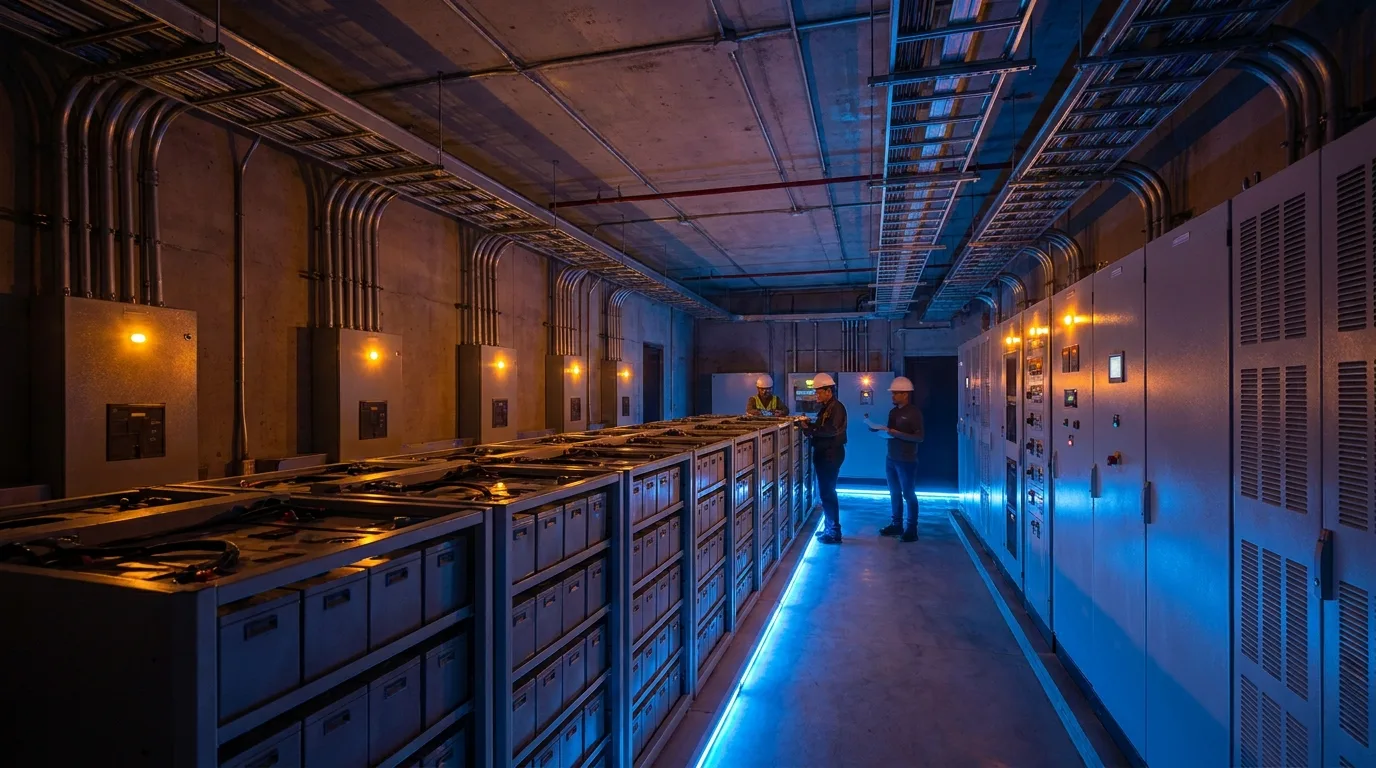
Batteries represent 30-40% of a UPS system's total cost and are the component most likely to cause UPS failure. The wrong battery choice can lead to unexpected downtime, premature replacements costing tens of thousands of dollars, and operational headaches that compound over years of operation.
Until recently, valve-regulated lead-acid (VRLA) batteries dominated data center UPS installations. But lithium-ion technology has matured rapidly, with adoption in data centers growing from under 5% in 2020 to an estimated 25-30% of new UPS installations in 2026. Understanding the tradeoffs between these two technologies is essential for any data center operator planning infrastructure investments.
VRLA Lead-Acid Batteries Explained
VRLA (valve-regulated lead-acid) batteries have been the backbone of data center power protection for over four decades. They come in two main variants: absorbed glass mat (AGM) and gel. AGM batteries dominate data center use because they handle high discharge rates better than gel cells, which makes them ideal for the short, high-power bursts that UPS systems demand during outages.
How VRLA Batteries Work
VRLA batteries use lead plates submerged in a sulfuric acid electrolyte. During discharge, a chemical reaction between the lead and acid produces electrical current. The "valve-regulated" design means the battery is sealed with a pressure-relief valve, eliminating the need to add water or check electrolyte levels. This makes them lower-maintenance than traditional flooded lead-acid batteries, though "maintenance-free" is somewhat misleading since they still require periodic testing and monitoring.
VRLA Strengths
- Low upfront cost: VRLA batteries cost $150-$300 per kWh of stored energy, making them the cheapest UPS battery option available
- Proven reliability: Decades of deployment data means failure modes are well-understood
- Wide availability: Every UPS manufacturer supports VRLA, and replacement batteries are available from multiple vendors
- Simple integration: No special battery management system required beyond basic monitoring
- Recyclability: Lead-acid batteries have the highest recycling rate of any consumer product at 99%
VRLA Limitations
- Short lifespan: 3-5 years in typical data center conditions (10-year rated life assumes ideal 25C temperature)
- Temperature sensitivity: Every 10C increase above 25C cuts battery life roughly in half
- Weight and space: VRLA batteries are heavy (30-70 lbs per module) and require significant floor space
- Limited cycle life: Only 200-400 discharge cycles before capacity drops below 80%
- Frequent replacement: Plan for 2-3 battery replacements over a typical UPS system's 15-year life
Lithium-Ion UPS Batteries Explained
Lithium-ion batteries for UPS applications primarily use lithium iron phosphate (LFP) chemistry, chosen for its thermal stability and safety profile over the lithium cobalt oxide chemistry used in consumer electronics. LFP cells are less energy-dense than cobalt-based cells but significantly more resistant to thermal runaway, which is critical in data center environments.
Lithium-Ion Strengths
- Long lifespan: 8-15 years in data center conditions, often matching the UPS system's own life expectancy
- Higher temperature tolerance: Operates effectively up to 40C with minimal life impact, reducing cooling requirements
- Compact footprint: 50-70% less floor space and 60-80% less weight than equivalent VRLA systems
- Superior cycle life: 3,000-5,000+ discharge cycles versus 200-400 for VRLA
- Faster recharge: Reaches full charge in 1-2 hours versus 8-12 hours for VRLA
- Built-in monitoring: Battery management system (BMS) provides cell-level voltage, temperature, and health data
Lithium-Ion Limitations
- Higher upfront cost: $400-$800 per kWh, roughly 2-3x the cost of equivalent VRLA
- Complex BMS requirements: The battery management system adds another potential failure point
- Fire codes and regulations: Some jurisdictions require additional fire suppression systems for lithium-ion installations
- Supply chain considerations: Lithium-ion battery availability can be affected by global demand from EV and grid-scale battery energy storage (BESS) markets
Head-to-Head Comparison Table
| Specification | VRLA Lead-Acid | Lithium-Ion (LFP) |
|---|---|---|
| Upfront cost per kWh | $150-$300 | $400-$800 |
| Expected lifespan | 3-5 years | 8-15 years |
| Cycle life | 200-400 cycles | 3,000-5,000+ cycles |
| Weight (per kWh) | 25-35 kg | 6-12 kg |
| Floor space required | Baseline | 30-50% of VRLA |
| Optimal temperature | 20-25C | 20-35C |
| Recharge time | 8-12 hours | 1-2 hours |
| Replacements over 15 years | 2-3 times | 0-1 times |
| Recycling rate | 99% | ~50% (improving) |
Total Cost of Ownership Analysis
The upfront price difference between VRLA and lithium-ion is significant, but it tells less than half the story. A proper TCO analysis over a 10-year period reveals a different picture.
10-Year TCO Example: 500 kW UPS System
VRLA scenario: Initial battery cost of $75,000. Two replacement cycles at years 4 and 8, each costing $75,000 plus $5,000 in installation labor. Annual maintenance and testing: $3,000. Cooling costs for battery room at 25C: $8,000 per year. Total 10-year TCO: approximately $315,000.
Lithium-ion scenario: Initial battery cost of $200,000. No replacements needed within 10 years. Annual maintenance: $1,500 (BMS monitoring, reduced manual testing). Cooling costs reduced by 40% due to higher temperature tolerance: $4,800 per year. Total 10-year TCO: approximately $263,000.
In this example, lithium-ion saves roughly $52,000 (17%) over 10 years despite costing 2.7x more upfront. The savings come primarily from eliminating two replacement cycles and reducing cooling costs. For facilities in hot climates like the UAE, where ambient temperatures push cooling costs higher, the lithium-ion advantage increases further.
Temperature and Environmental Factors
Temperature is the single biggest factor affecting UPS battery life. VRLA batteries follow the Arrhenius equation: every 10C increase above 25C halves their lifespan. A data center battery room running at 30C instead of 25C reduces VRLA battery life from 5 years to roughly 2.5 years, potentially adding an entire extra replacement cycle over the UPS system's lifetime.
Lithium-ion batteries tolerate higher temperatures far better. LFP chemistry maintains its rated cycle life up to 35-40C, which means facilities can set battery room temperatures 5-10C higher than VRLA requirements. For operations using advanced cooling strategies where waste heat management is already optimized, lithium-ion batteries integrate more naturally into the thermal architecture.
In the UAE's climate, where outdoor temperatures regularly exceed 45C, the cooling energy required to maintain VRLA batteries at 25C is substantial. Lithium-ion's higher temperature tolerance translates directly into reduced cooling costs and improved electricity cost optimization.
Safety and Fire Prevention
Both battery types present safety considerations, but the risks differ in nature. VRLA batteries can release hydrogen gas during overcharging, requiring proper ventilation in battery rooms. They also contain sulfuric acid, which presents spill risks if battery casings crack.
Lithium-ion batteries carry thermal runaway risk, though LFP chemistry is significantly more stable than consumer-grade lithium cobalt oxide. Modern lithium-ion UPS batteries include multiple safety layers: cell-level fuses, module-level disconnect switches, cabinet-level fire suppression, and BMS software that monitors temperature and voltage at every cell.
Building codes in many jurisdictions now require specific fire suppression systems for lithium-ion battery installations. NFPA 855 provides the standard for energy storage systems, and compliance may require clean agent suppression systems, thermal barriers, and enhanced ventilation. Factor these requirements into your lithium-ion deployment budget.
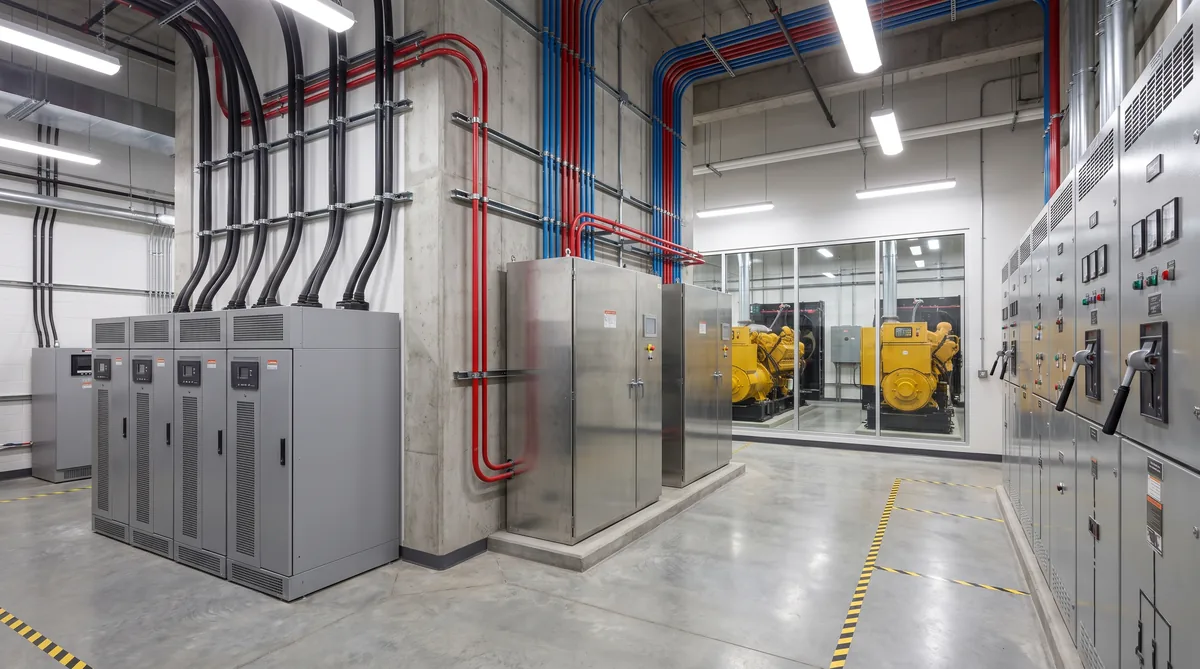
Rax facilities implement comprehensive power redundancy with both battery types, following Tier III and Tier IV standards that include redundant UPS paths regardless of battery chemistry.
Which Technology Should You Choose?
Choose VRLA Lead-Acid When:
- Your budget prioritizes low upfront capital expenditure over long-term savings
- The UPS deployment is temporary or will be replaced within 5 years
- Your battery room is already designed for VRLA with proper temperature control at 25C
- You need widely available, standardized replacement batteries from multiple vendors
- Local fire codes add significant cost to lithium-ion installations
Choose Lithium-Ion When:
- You plan to operate the UPS for 10+ years and want to minimize total cost of ownership
- Floor space is at a premium (lithium-ion uses 50-70% less space)
- Your facility operates at higher ambient temperatures or you want to reduce cooling costs
- You need fast recharge capability (critical for areas with frequent power disturbances)
- You value real-time battery health monitoring through integrated BMS
- You are building a new facility and can design the battery room for lithium-ion from the start
The Hybrid Approach
Some operators deploy a hybrid strategy: VRLA batteries for existing UPS systems where replacement is due, and lithium-ion for all new UPS installations. This lets you capture lithium-ion's long-term savings on new deployments while avoiding the cost of retrofitting existing systems prematurely. As VRLA batteries in existing systems reach end-of-life, evaluate whether to replace with VRLA again or upgrade to lithium-ion based on the TCO analysis for your specific environment.
Frequently Asked Questions
How much do lithium-ion UPS batteries cost compared to lead-acid?
Lithium-ion UPS batteries cost 2-3x more upfront than equivalent VRLA lead-acid batteries. However, lithium-ion lasts 8-15 years versus 3-5 years for lead-acid, meaning total cost of ownership over 10 years is typically 20-40% lower with lithium-ion when you factor in replacement cycles, cooling savings, and reduced maintenance.
Can you replace lead-acid UPS batteries with lithium-ion?
Yes, most modern UPS systems support lithium-ion battery cabinets as drop-in replacements for lead-acid. The UPS charging profile may need adjustment, and the battery management system (BMS) must be compatible. Consult your UPS manufacturer for approved lithium-ion battery options for your specific model.
What is the best UPS battery type for a Bitcoin mining facility?
For Bitcoin mining facilities, the choice depends on your cooling infrastructure and runtime requirements. Lithium-ion batteries perform better in higher-temperature environments common in mining facilities and require less space. However, many mining operations use minimal UPS runtime (just enough for orderly shutdown) where lead-acid's lower upfront cost may be sufficient.