Why Energy Storage Choice Matters
Every data center needs a strategy for what happens when utility power fails. The backup power system you choose determines how quickly your facility responds to an outage, how long it can sustain operations independently, what it costs to build and maintain, and what environmental footprint it carries.
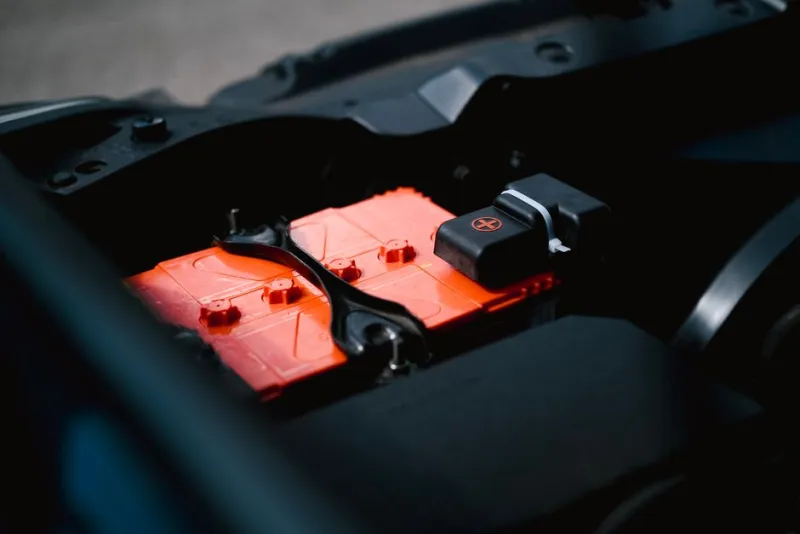
For decades, the standard approach was straightforward: lead-acid UPS batteries bridge the 10-15 second gap until diesel generators start, and generators run until utility power is restored. That model still works, but it is no longer the only viable architecture. Lithium-ion battery energy storage systems (BESS) have reached price points that make them competitive for short-duration backup, and flywheel kinetic energy storage offers a maintenance-light alternative to chemical batteries for bridging power.
This guide compares all three technologies across the factors that matter for data center operators: response time, runtime, capital and operating costs, physical footprint, emissions, maintenance burden, and how they combine in hybrid configurations. For a deeper look at BESS specifically, see our complete BESS guide.
The Three Technologies at a Glance
| Attribute | BESS (Li-ion) | Diesel Generator | Flywheel UPS |
|---|---|---|---|
| Response time | 5-20 ms | 8-15 seconds | <1 ms |
| Typical runtime | 5-30 minutes | Hours to days | 10-30 seconds |
| Emissions | Zero (operation) | CO2, NOx, PM | Zero (operation) |
| Maintenance cycle | Moderate (5-15 yr replace) | Frequent (weekly-monthly testing) | Low (20+ yr lifespan) |
| Footprint | Moderate | Large (+ fuel storage) | Small per kW |
| Fuel dependency | None | Diesel supply chain | None |
No single technology covers every requirement. The practical question is which combination of technologies best matches a given facility's reliability requirements, budget, site constraints, and sustainability goals.
Battery Energy Storage Systems (BESS)
How BESS Works in Data Centers
A BESS for data center backup typically consists of lithium-ion battery modules (most commonly lithium iron phosphate, or LFP, chemistry for its thermal stability and long cycle life), a battery management system (BMS), power conversion equipment (inverters/converters), and thermal management systems to keep cells within their operating temperature range.
When utility power drops, the BESS inverter detects the loss and begins discharging stored energy within milliseconds. This speed eliminates the need for a separate UPS in many configurations—the BESS itself serves as the UPS. The system sustains the IT load until either utility power returns or backup generators reach stable operating output.
Advantages
- Fast response: Millisecond-scale transfer with no mechanical startup delay.
- Zero operational emissions: No exhaust, no fuel combustion, no on-site emissions during discharge.
- Dual-use potential: BESS can participate in utility demand response programs, peak shaving, or energy arbitrage when not providing backup, generating revenue or reducing utility costs.
- Declining costs: Lithium-ion battery prices have fallen substantially over the past decade, and LFP costs have dropped particularly sharply, improving the economics of BESS deployment.
- Quiet operation: No noise from combustion engines, which matters in urban or noise-sensitive locations.
Limitations
- Limited runtime at scale: Sizing a BESS for hours of runtime at multi-megawatt scale remains expensive. Most data center BESS installations are sized for 5-30 minutes, sufficient to bridge to generators but not to replace them for extended outages.
- Degradation over time: Battery capacity declines with age and charge cycles. LFP batteries typically retain 70-80% of rated capacity after 10-15 years, but this degradation must be factored into long-term capacity planning.
- Thermal management: Batteries require active cooling to maintain safe operating temperatures, adding complexity and energy overhead. In hot climates, this is a significant design consideration. See our analysis of UPS battery chemistry selection for more on thermal characteristics.
- Fire risk: While LFP batteries have a much lower thermal runaway risk than older lithium-ion chemistries, any large battery installation requires dedicated fire suppression and monitoring. See our guide to fire suppression systems for current best practices.
Diesel Generators
How Diesel Generators Work in Data Centers
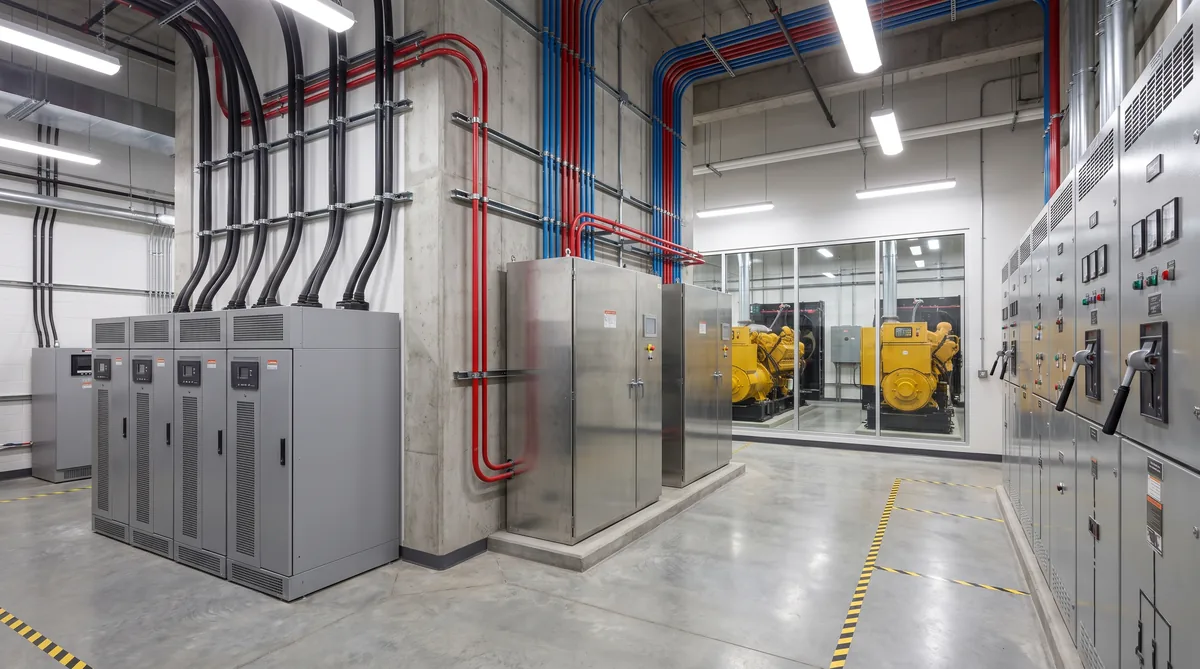
Diesel generators are internal combustion engines coupled to alternators. When utility power fails, an automatic transfer switch (ATS) signals the generators to start. The engine reaches operating speed and the alternator produces stable AC power, typically within 8-15 seconds. The ATS then transfers the facility load from the failed utility feed to the generator output.
Generators can run continuously as long as fuel is available, making them the only backup technology capable of sustaining a data center through extended outages lasting hours or days. Most facilities maintain on-site fuel storage for 24-72 hours of runtime at full load, with fuel delivery contracts for longer events.
Advantages
- Extended runtime: Limited only by fuel supply. No other technology matches diesel for sustained backup duration.
- Proven reliability: Decades of deployment history in critical facilities. Well-understood failure modes, maintenance procedures, and operational characteristics.
- Lower capital cost per hour of runtime: For extended backup durations (hours to days), diesel generators remain the most cost-effective solution per kWh of stored energy when accounting for fuel storage costs.
- Scalable: Generators can be paralleled to match any load requirement, from hundreds of kW to hundreds of MW.
Limitations
- Slow startup: The 8-15 second startup time means diesel generators cannot provide uninterrupted power on their own. They must always be paired with a bridging technology (batteries or flywheels) to maintain continuity during the transition.
- Emissions and regulation: Diesel combustion produces CO2, nitrogen oxides (NOx), particulate matter, and noise. Increasingly stringent air quality regulations in many jurisdictions limit testing hours, require emissions controls, and in some cases restrict new generator installations entirely.
- Maintenance burden: Generators require regular testing (typically weekly or monthly under load), oil and filter changes, coolant system maintenance, fuel quality management (diesel degrades over time and requires treatment or replacement), and periodic overhaul. For a comparison with natural gas alternatives, see our guide on diesel vs natural gas generators.
- Fuel supply chain dependency: Extended outages, particularly those caused by natural disasters, can disrupt fuel delivery precisely when generators are needed most.
- Physical footprint: Generators plus fuel storage, exhaust systems, and sound attenuation equipment require significant space, which is a constraint in dense urban environments.
Flywheel Energy Storage
How Flywheels Work in Data Centers
A flywheel UPS stores energy as rotational kinetic energy in a high-mass rotor spinning at high speed inside a vacuum enclosure. When utility power fails, the flywheel's rotational energy is converted to electrical energy through an integrated motor-generator. The conversion is essentially instantaneous—there is no chemical reaction to initiate and no engine to start. The flywheel decelerates as it discharges, and the available runtime depends on the rotor mass, rotational speed, and the load being served.
For a detailed examination of flywheel technology and its data center applications, see our dedicated flywheel energy storage guide.
Advantages
- Fastest response: Sub-millisecond transfer with zero power gap. This is the cleanest power transition available.
- Extremely long lifespan: Flywheel rotors have no chemical degradation. With periodic bearing replacement, a flywheel system can operate for 20+ years without the capacity fade that affects batteries.
- Minimal maintenance: No battery replacements, no fuel management, no oil changes. Maintenance is primarily bearing inspection and replacement on a multi-year cycle.
- Small footprint per kW: A single flywheel unit can provide significant bridging power in a compact package, with no fuel storage or exhaust system required.
- Temperature tolerant: Flywheels operate well across a wider temperature range than batteries, which is advantageous in hot climates or facilities with less precise thermal control.
- Zero emissions: No combustion, no chemical discharge, no exhaust.
Limitations
- Very short runtime: Flywheel systems typically provide 10-30 seconds of full-load runtime. This is sufficient to bridge to generator startup but not to sustain operations through any outage of meaningful duration. They cannot replace batteries or generators for extended backup.
- Higher upfront cost per kWh: While the cost per kW of bridging power is competitive, the cost per kWh of stored energy is high because of the inherently short discharge duration.
- Standby energy consumption: The flywheel must remain spinning continuously, consuming energy to maintain rotational speed against friction and air resistance (though vacuum enclosures minimize this). This parasitic load is small but non-zero.
- Mechanical complexity: High-speed rotating equipment requires precision engineering, and bearing failures, while rare, can be catastrophic. Redundancy (multiple flywheel units) is standard practice.
Head-to-Head Comparison
| Factor | BESS (Li-ion) | Diesel Generator | Flywheel UPS |
|---|---|---|---|
| Transfer time | 5-20 ms | 8-15 seconds | <1 ms |
| Runtime (typical sizing) | 5-30 minutes | 24-72+ hours | 10-30 seconds |
| Capex (relative, per kW) | Moderate-High | Moderate | Moderate-High |
| Opex (annual maintenance) | Low-Moderate | High | Very Low |
| System lifespan | 10-15 years (cells) | 20-30 years (engine) | 20+ years (rotor) |
| Replacement cycles | Battery cells every 10-15 yr | Major overhaul every 5-10 yr | Bearings every 5-7 yr |
| Emissions (operation) | None | CO2, NOx, PM, noise | None |
| Fuel dependency | None | Diesel supply chain | None |
| Space requirements | Moderate | Large | Small |
| Noise | Minimal | Significant (requires attenuation) | Minimal |
| Regulatory exposure | Low (fire code) | High (emissions, testing limits) | Low |
| Revenue potential | Yes (demand response, arbitrage) | Limited | Limited |
For facilities that need to understand how these systems fit within the broader power architecture, our guides on power redundancy configurations and UPS system fundamentals provide the framework context.
Hybrid Configurations
In practice, most data centers deploy a combination of these technologies rather than relying on any single system. The three most common hybrid architectures are:
BESS + Diesel (Most Common)
Lithium-ion BESS provides the immediate bridging function (replacing traditional lead-acid UPS batteries), sustaining the IT load during the 10-15 seconds it takes diesel generators to start and stabilize. Once generators reach stable output, the load transfers to generator power and the BESS begins recharging. This configuration eliminates the traditional UPS battery room, reduces cooling requirements (LFP cells tolerate higher temperatures than lead-acid), and the BESS can participate in utility demand response programs during normal operation.
Flywheel + Diesel
Flywheels provide the bridging function instead of batteries. The flywheel sustains the load for 15-30 seconds while generators start, then generators carry the extended load. This configuration eliminates all battery replacement cycles and chemical waste, with the trade-off of a shorter bridging window. It is well-suited to facilities where maintenance minimization is a priority and generator start times are reliable and well-tested.
BESS + Diesel (Extended BESS)
In this model, the BESS is deliberately oversized to handle most short outages entirely, without starting generators. Generators are reserved only for extended events beyond the BESS runtime. This reduces generator start cycles (which cause wear), eliminates generator emissions and noise during short disturbances, and can qualify for sustainability certifications. The trade-off is higher BESS capital cost.
Some forward-looking operators are exploring BESS-only configurations without any diesel backup, particularly in jurisdictions with strict emissions regulations or where grid reliability is high enough that extended outages are exceedingly rare. This remains uncommon for critical facilities but is technically viable where the BESS is sized for sufficient runtime and the risk tolerance allows it. For context on how next-generation power sources may factor in, see our analysis of hydrogen fuel cells for data center power.
Choosing the Right System
The optimal backup power architecture depends on facility-specific factors:
Choose BESS-primary when:
- Emissions reduction or elimination is a requirement (regulatory or corporate sustainability)
- The facility is in a noise-sensitive location where generator testing is problematic
- Grid reliability is high and most outages are brief (under 15 minutes)
- Utility demand response or energy arbitrage revenue can offset BESS capital cost
- Space for diesel fuel storage is limited
Choose diesel-primary when:
- Extended runtime (hours to days) is a hard requirement for business continuity
- The facility is in a region with unreliable grid power or frequent long outages
- Budget constraints favor the lower cost-per-hour-of-runtime economics of diesel
- Existing infrastructure is diesel-based and a full replacement is not justified
Choose flywheel-primary when:
- Maintenance minimization is the top priority
- Generator start reliability is well-established and the bridging window is short
- Battery disposal and replacement logistics are a concern
- Operating temperatures make battery thermal management challenging
- The facility prioritizes the cleanest possible power transition (zero-gap transfer)
For most new data center builds in 2026, a BESS + diesel hybrid represents the practical optimum: fast bridging, extended runtime capability, declining battery costs, and the option to reduce diesel dependency over time as BESS capacity expands. Facilities that prioritize sustainability goals should explore extended-BESS configurations that minimize generator runtime.
Regardless of the technology chosen, the backup power system must be integrated with the facility's overall redundancy architecture and tested regularly under realistic load conditions. A backup system that has never been tested under full load is not a backup system—it is a hope.
Frequently Asked Questions
Which backup power system has the fastest response time?
Flywheel UPS systems respond in under 1 millisecond. BESS responds in 5-20 milliseconds. Diesel generators require 8-15 seconds to start and stabilize, which is why they must always be paired with batteries or flywheels for continuous power.
How long can each system sustain a data center?
Diesel generators can run indefinitely with fuel supply (typically sized for 24-72+ hours on-site). BESS is typically sized for 5-30 minutes. Flywheel UPS provides 10-30 seconds of bridging power.
Are BESS systems replacing diesel generators in data centers?
BESS is increasingly replacing traditional UPS batteries for bridging power but has not widely replaced diesel for extended runtime due to cost. Hybrid BESS + diesel configurations are the most common modern approach, with some operators deploying oversized BESS to reduce generator runtime.
What is the capital cost comparison?
Diesel generators typically have the lowest upfront cost per kW for extended runtime. BESS costs have declined with lithium-ion price drops but remain higher per hour of stored energy. Flywheels have moderate-high upfront costs but very low lifetime maintenance costs over 20+ years.
What is the best hybrid backup power configuration?
The most common hybrid pairs lithium-ion BESS with diesel: BESS provides immediate bridging during the 10-15 seconds before generators stabilize, then generators carry extended outages. For sustainability-focused facilities, an oversized BESS absorbs most short outages entirely, reserving generators for extended events only.