Bitcoin Mining Power Procurement: How to Secure Low-Cost Electricity for ASICs
Published August 15, 2026 • 14 min read
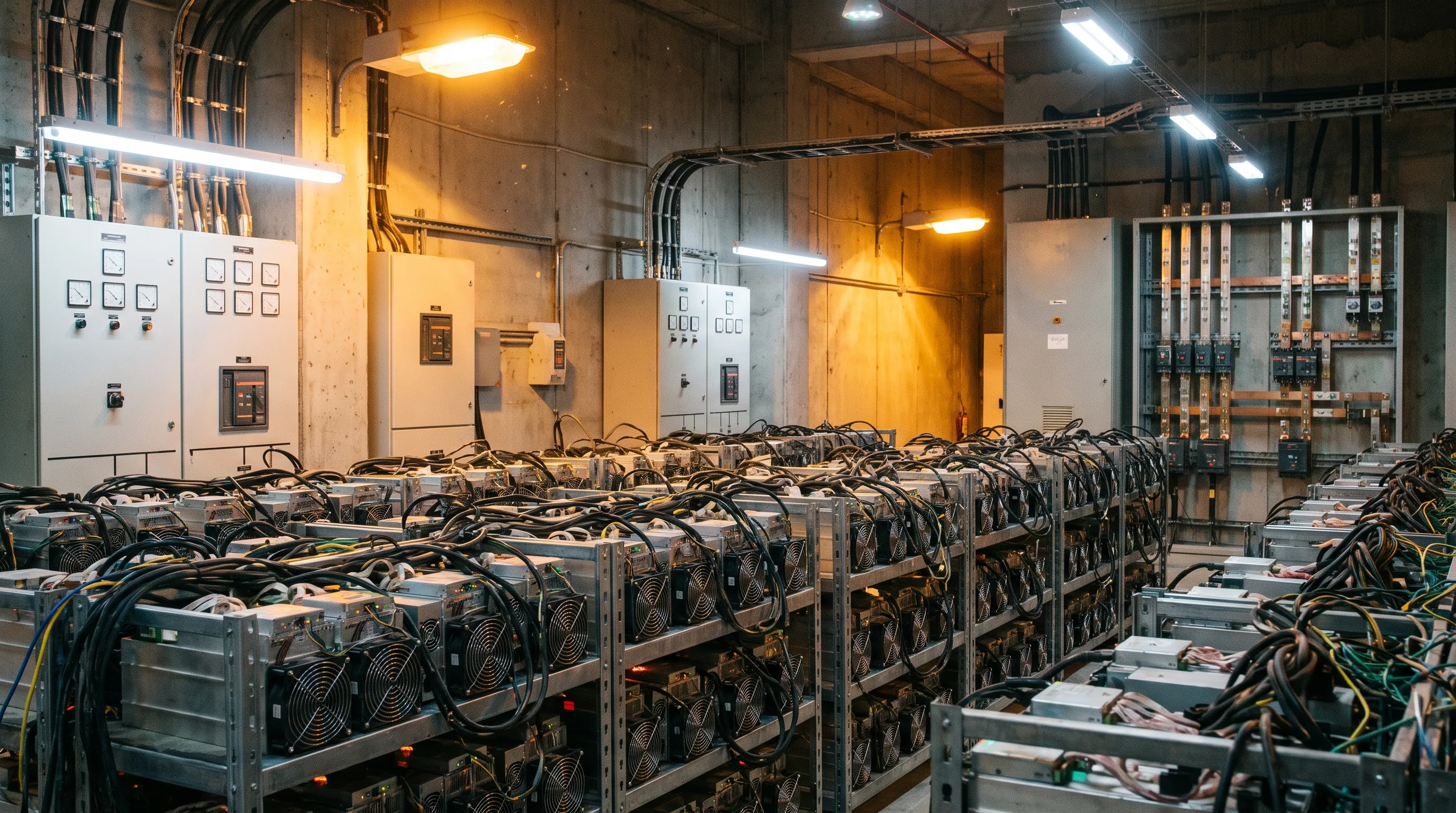
Electricity is the largest operating expense in Bitcoin mining. For a facility running 1,000 current-generation ASICs consuming approximately 3.5 MW, the difference between $0.04/kWh and $0.07/kWh is $92,000 per month -- or over $1.1 million per year. Power procurement strategy is what separates profitable mining operations from those that operate at or below breakeven.
This guide covers the primary mechanisms through which mining operators and hosting providers secure competitive electricity rates, and how individual miners can evaluate whether a hosting provider's rate structure reflects genuine procurement advantages.
The Components of Electricity Cost
Before discussing procurement strategies, it helps to understand what makes up the rate you pay. Retail electricity pricing typically includes:
- Energy charge: The wholesale cost of generating the electricity. Varies by fuel source, time of day, and market conditions. Wholesale energy in the U.S. ranges from $0.02-0.08/kWh depending on region and market conditions
- Transmission and distribution (T&D): Charges for moving electricity from the power plant to the point of consumption. Typically adds $0.01-0.04/kWh. T&D charges are often the largest hidden cost in mining electricity
- Demand charges: Monthly charges based on peak power draw (measured in kW), not total energy consumed (kWh). Can add $5-20 per kW per month. For a 3.5 MW mining facility, demand charges alone can exceed $35,000/month
- Regulatory fees and taxes: Renewable energy surcharges, grid reliability fees, local taxes. Typically $0.005-0.02/kWh
Professional mining operations target procurement strategies that minimize or eliminate T&D charges and demand charges, which together often exceed the raw energy cost itself.
Procurement Strategy 1: Industrial Tariffs
Most utilities offer industrial rate schedules for large power consumers (typically above 500 kW or 1 MW demand). These tariffs provide lower per-kWh rates than commercial or residential schedules but usually include significant demand charges and time-of-use pricing.
Key considerations for miners on industrial tariffs:
- Load factor optimization: Industrial tariffs reward consistent, high load factors (ratio of average demand to peak demand). Mining operations naturally run at nearly 100% load factor (24/7 operation), which maximizes the benefit of lower energy charges while minimizing per-kWh demand charge impact
- Time-of-use (TOU) management: Some tariffs offer substantially lower rates during off-peak hours (nights, weekends). While most miners prefer 24/7 operation, selectively curtailing during the highest-priced peak hours (typically 4-8 PM summer weekdays) can reduce the effective average rate
- Contract negotiation: For loads above 5 MW, utilities often negotiate custom contracts outside published tariff schedules. These contracts can include rate riders, economic development incentives, or interruptible service discounts
Industrial tariffs typically deliver all-in rates of $0.05-0.09/kWh, which is sufficient for current-generation hardware but leaves limited margin. Most institutional mining operations pursue more aggressive procurement strategies.
Procurement Strategy 2: Power Purchase Agreements (PPAs)
Power purchase agreements allow mining operators to contract directly with power generators for a fixed electricity price over a multi-year term. PPAs bypass the retail utility entirely (or partially), eliminating the T&D and regulatory markups that inflate retail rates.
Types of Mining PPAs
- Physical PPA: The mining facility is physically connected to the generator via dedicated transmission infrastructure. The generator delivers actual electrons to the mining site. This is the BTM (behind-the-meter) model that achieves the lowest rates ($0.02-0.04/kWh) but requires either co-location at the generation site or dedicated transmission buildout
- Virtual PPA (VPPA): A financial contract where the miner and generator agree on a fixed strike price. The generator sells into the wholesale market; if the market price exceeds the strike price, the generator pays the miner the difference, and vice versa. VPPAs provide rate certainty without physical co-location but do not eliminate T&D charges on the retail side
- Sleeved PPA: A utility or intermediary "sleeves" a physical PPA into the miner's existing utility account, converting the PPA energy into a credit against the retail bill. More complex to structure but avoids the need for direct physical connection to the generator
PPA Risks for Miners
- Term length: PPA terms of 5-15 years extend well beyond ASIC hardware lifecycles (3-5 years). Operators must plan for hardware refresh cycles within the PPA term
- Take-or-pay obligations: Most PPAs require the buyer to pay for a minimum volume of electricity regardless of consumption. If mining becomes unprofitable and operations scale down, the take-or-pay obligation persists
- Curtailment risk: If the generator cannot deliver contracted power (equipment failure, grid curtailment), the miner loses hashrate. Contracts should specify curtailment compensation or substitute power provisions
Procurement Strategy 3: Behind-the-Meter (BTM) Generation
BTM mining places ASIC hardware directly at or adjacent to a power generation site, consuming electricity before it enters the utility grid. This eliminates T&D charges, demand charges, and most regulatory fees, leaving only the raw cost of generation.
Common BTM configurations:
- Solar farms: Mining containers deployed on-site at utility-scale solar installations. Power is available during daylight hours at $0.02-0.03/kWh. Battery storage or grid supplementation covers nighttime operation
- Wind installations: Similar to solar but with less predictable generation patterns. Complementary to solar in regions where wind peaks at night (e.g., West Texas). Wind BTM rates range from $0.02-0.04/kWh
- Stranded gas: Natural gas wells that lack pipeline access can fuel on-site generators powering mining containers. Stranded gas is often free or near-zero cost; the economic value comes from eliminating the producer's flaring costs while generating electricity at $0.015-0.03/kWh
- Hydroelectric: Small and micro-hydro installations provide consistent baseload power at $0.02-0.04/kWh. Hydro's constant output makes it ideal for 24/7 mining operations
- Natural gas generators: Purpose-built gas-fired generation at industrial sites, typically achieving $0.035-0.055/kWh depending on local gas prices. Gas gensets can be sized to match mining load precisely
BTM generation achieves the industry's lowest electricity costs but requires significant capital investment in power infrastructure and site development. It is typically viable only for operations above 1 MW.
Procurement Strategy 4: Demand Response and Curtailment Programs
Grid operators and utilities run programs that pay large consumers to reduce demand during peak periods. Mining operations are exceptionally well-suited for demand response because ASICs can be powered down and restarted within minutes with no process damage or data loss.
Notable programs for miners:
- ERCOT 4CP (Texas): The four coincident peak program charges T&D costs based on a consumer's demand during the four highest-demand 15-minute intervals each summer. Miners who curtail during these peaks can reduce annual T&D charges by up to 80%
- PJM demand response (U.S. Mid-Atlantic/Midwest): Capacity performance payments for committed curtailment during emergency events. Payments range from $50-200 per kW-year
- Frequency regulation: Some grid operators pay for loads that can modulate power consumption on a second-by-second basis to help balance grid frequency. Newer ASIC firmware supports dynamic power adjustment that enables participation in these higher-paying ancillary service markets
By participating in demand response, a mining operation effectively earns revenue for not mining during short periods (typically 50-200 hours per year), which translates to a net reduction in effective electricity cost of $0.005-0.02/kWh when annualized.
Procurement Strategy 5: Hosting Provider Negotiated Rates
For individual miners without the scale to negotiate directly with utilities or generators, colocation hosting providers serve as power procurement intermediaries. The hosting provider aggregates demand from multiple clients, negotiates volume-based rates with utilities or generators, and passes through the benefit (plus a management margin) as an all-inclusive hosting rate.
When evaluating a hosting provider's electricity rate:
- All-inclusive vs. passthrough: All-inclusive rates (a single $/kWh covering power, cooling, facility, and monitoring) are simpler to evaluate. Passthrough models (electricity at cost plus a fixed management fee) offer transparency but require understanding the underlying tariff structure
- Rate guarantee duration: How long is the quoted rate guaranteed? 3 months, 12 months, the full contract term? Rates without term guarantees expose miners to mid-contract increases
- Volume discounts: Most providers offer tiered pricing: lower rates for larger deployments. Compare rates at your deployment scale, not headline minimum rates
- Cooling overhead: In hot climates, cooling energy adds to the effective electricity cost per mining unit. Ask about the facility's PUE -- a PUE of 1.3 means 30% of total power goes to cooling and infrastructure rather than mining. PUE optimization directly affects your effective mining cost
Rax facilities offer competitive all-inclusive hosting rates starting from $0.055/kWh, which reflects our underlying power procurement advantages and operational efficiency.
Electricity Rate Comparison by Source
| Procurement Method | Typical Rate Range | Minimum Scale |
|---|---|---|
| Retail industrial tariff | $0.05-0.09/kWh | 500 kW |
| Negotiated utility contract | $0.04-0.07/kWh | 5 MW |
| Physical PPA (BTM) | $0.02-0.04/kWh | 1 MW |
| Stranded gas BTM | $0.015-0.03/kWh | 500 kW |
| Colocation hosting | $0.04-0.08/kWh | 1 unit |
| With demand response credits | Net $0.005-0.02/kWh reduction | 1 MW |
Evaluating Your Power Cost Position
Use the electricity cost optimization framework to assess where your current operation sits relative to the market. Key metrics include:
- All-in cost per kWh: Include every charge that appears on the bill or invoice -- energy, demand, T&D, fees, taxes, cooling overhead. This is the only number that matters for profitability calculations
- Cost per terahash per day: Normalizes electricity cost against mining output. With current-generation hardware at 15 J/TH, the target is below $0.055 per TH per day for comfortable profitability
- Breakeven BTC price at current rate: At what BTC price does your operation stop being profitable? Lower electricity costs push the breakeven lower, providing more buffer against price drops
- Comparison to market hosting rates: If your self-operated facility costs more per kWh than third-party hosting, the procurement strategy needs to change -- or colocation may be the more rational choice
The most successful mining operations treat power procurement as an ongoing discipline, not a one-time decision. Market conditions, tariff structures, and regulatory environments change continuously, and operators who actively manage their power supply consistently outperform those on static retail tariffs.
Competitive Power for Your Mining Operation
Rax Data leverages strategic power procurement and Rax Energy infrastructure to deliver competitive all-inclusive hosting rates for ASIC mining and AI compute. Contact us to discuss your hosting needs and power requirements.
Get a Hosting Quote