Hot Aisle Cold Aisle Containment: Airflow Management for GPU Data Centers
Published August 15, 2026 • 12 min read
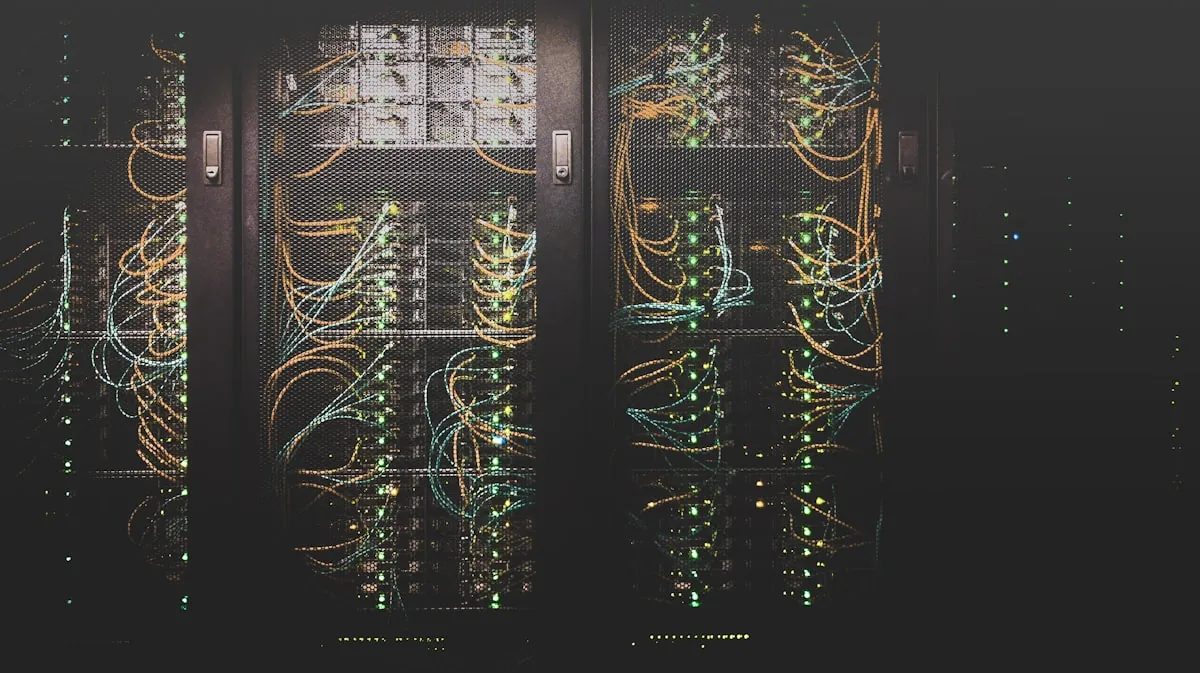
Airflow management is the single most impactful variable in data center cooling efficiency. In facilities hosting high-density GPU racks, uncontrolled air mixing between supply and exhaust streams can waste 30-60% of cooling capacity. Hot aisle and cold aisle containment systems solve this by physically separating intake air from exhaust air, improving PUE by 0.1 to 0.3 points and enabling higher supply air temperatures.
For operators running NVIDIA H200 or AMD MI300X GPU clusters, as well as ASIC mining operations, proper containment is not optional -- it is a prerequisite for reliable operation at scale.
The Problem: Bypass Airflow and Recirculation
In an open data center floor plan without containment, two types of airflow inefficiency dominate:
- Bypass airflow: Cold supply air that travels from CRAH/CRAC units to the return path without ever passing through IT equipment. Industry measurements consistently show that 50-60% of supply air bypasses servers in uncontained environments.
- Recirculation: Hot exhaust air from the rear of racks that loops back around to the front intake of the same or adjacent racks. This raises inlet temperatures above ASHRAE recommended ranges, triggering thermal throttling in GPUs and reducing compute throughput.
In a GPU data center running at 15-30 kW per rack, recirculation can raise server inlet temperatures by 5-15 degrees Celsius above the supply air temperature. For NVIDIA GPUs that begin thermal throttling at junction temperatures of 83-90 degrees Celsius, even a 5-degree elevation in inlet air temperature can reduce sustained compute performance by 10-20%.
Cold Aisle Containment (CAC)
Cold aisle containment encloses the cold aisle -- the space between two rows of racks where server intakes face each other -- with physical barriers. Typically this involves:
- Transparent polycarbonate or acrylic panels forming walls at the ends of the aisle
- A ceiling or roof structure (rigid panels, strip curtains, or sliding panels) that caps the aisle
- Blanking panels in all unused rack positions to prevent cold air leakage
- Brush grommets or cable pass-through seals on floor cutouts
With CAC, chilled supply air (typically delivered through a raised floor plenum or overhead duct) is contained within the enclosed aisle until it enters server intakes. After passing through the equipment, warm exhaust disperses into the general data hall and returns to cooling units via ceiling plenums or directed return paths.
Advantages of Cold Aisle Containment
- Simpler implementation: CAC can be retrofitted to existing raised-floor environments with minimal structural changes
- Fire suppression compatibility: Exhaust air remains in the open data hall, simplifying fire detection and suppression system placement
- Lower initial cost: CAC systems typically cost $1,500-3,000 per rack position versus $2,000-4,500 for HAC
Limitations
- The general data hall ambient temperature rises because hot exhaust disperses freely -- this can reduce personnel comfort and limit the deployment of non-contained equipment nearby
- At rack densities above 15-20 kW, CAC alone may struggle to prevent localized hot spots without supplemental in-row cooling
Hot Aisle Containment (HAC)
Hot aisle containment encloses the hot aisle -- the space where server exhausts face each other. Physical barriers (walls, ceiling panels, doors) capture exhaust air and channel it directly to return air plenums or back to CRAH/CRAC units. The rest of the data hall remains at or near the supply air temperature.
Why HAC Is Preferred for GPU and Mining Deployments
For GPU colocation and ASIC hosting operations, HAC offers several advantages over CAC:
- Higher exhaust temperature capture: GPU servers exhaust air at 40-50 degrees Celsius; ASIC miners at 60-70 degrees Celsius. Containing this exhaust prevents it from contaminating the supply air stream
- Economizer enablement: With hot exhaust isolated, the data hall can operate at higher supply temperatures (25-27 degrees Celsius), extending the hours during which free cooling and economizer systems can operate
- Better PUE: HAC consistently delivers 0.05-0.1 points lower PUE than CAC in high-density environments because it enables CRAH fans to run at lower speeds
- Comfortable data hall: Personnel working in the data hall experience ambient temperatures near the supply air setpoint rather than a mix of supply and exhaust
Design Considerations for HAC
- Return air path: HAC requires a well-designed return air plenum above the hot aisle, typically connecting to overhead ductwork or a ceiling return plenum that feeds CRAH/CRAC units. Undersized return paths create back-pressure that degrades airflow through IT equipment
- Fire suppression: Enclosed hot aisles are treated as separate fire zones. Smoke detection must be installed inside the containment, and suppression nozzle placement must account for the enclosed space. Most fire codes require automatic release doors or drop-away ceiling panels to allow suppression agents to reach the contained area
- Emergency ventilation: In the event of a fire suppression discharge or HVAC failure, the hot aisle must be able to open to prevent dangerous heat buildup. Spring-loaded roof panels and magnetically held end doors that release on fire alarm activation are standard solutions
Containment at Scale: Density Thresholds
The effectiveness of air-based containment depends on rack density. Here is how the industry approaches different power ranges:
| Rack Density | Cooling Approach | Containment Role |
|---|---|---|
| 1-8 kW/rack | Perimeter CRAC/CRAH | CAC or HAC sufficient alone |
| 8-20 kW/rack | In-row + perimeter CRAH | HAC strongly recommended |
| 20-30 kW/rack | In-row + rear-door HX (RDHx) | HAC + RDHx; containment captures residual heat |
| 30-60 kW/rack | Rear-door HX + direct liquid | Containment supports air-cooled components; liquid cooling handles GPUs |
| 60+ kW/rack | Immersion cooling | Traditional containment not applicable; entire rack submerged |
For facilities operating in the 8-30 kW range -- which covers most ASIC hosting colocation and moderate GPU deployments -- HAC combined with in-row cooling and supplemental rear-door heat exchangers represents the most cost-effective approach.
Computational Fluid Dynamics (CFD) Modeling
Before implementing containment, CFD modeling identifies airflow patterns, hot spots, and optimal containment placement. A CFD analysis for a GPU data center typically evaluates:
- Rack layout and density distribution: Non-uniform density (some racks at 5 kW, others at 25 kW) creates pressure imbalances that containment must accommodate
- Perforated tile placement: In raised-floor environments, the open area percentage and distribution of perforated tiles directly determines airflow delivery. CFD identifies where tiles need to be added, removed, or replaced with higher-flow variants
- Containment leakage: Even with containment, practical installations leak 5-15% of airflow through cable cutouts, door gaps, and panel joints. CFD models this leakage to right-size cooling capacity
- Failure scenarios: What happens to inlet temperatures if one CRAH unit trips offline? CFD quantifies thermal risk under N-1 or N-2 cooling redundancy scenarios
Major colocation providers run CFD simulations before approving any tenant deployment above 10 kW per rack. Site selection should include verifying that the provider performs this analysis.
Containment and ASHRAE Guidelines
ASHRAE Technical Committee 9.9 defines recommended and allowable environmental ranges for IT equipment. With containment:
- Recommended inlet temperature: 18-27 degrees Celsius (class A1). Containment makes it practical to operate at the upper end of this range, enabling economizer hours
- Allowable inlet temperature: 15-32 degrees Celsius (class A1). This wider range provides margin during cooling transients or partial failures
- Relative humidity: 8-80% non-condensing at recommended inlet temperatures
Our ASHRAE thermal guidelines for hot climates article covers how these ranges apply to operations in the UAE and Gulf region, where outdoor temperatures regularly exceed 45 degrees Celsius.
Blanking Panels and Cable Management
Containment is only as effective as the sealing of individual racks. Two critical components:
- Blanking panels: Every unused U position in a rack must be sealed with blanking panels. A single open U position can allow 30-50 CFM of bypass airflow, raising inlet temperatures on adjacent servers by 2-5 degrees Celsius. In a GPU rack where every degree matters for sustained boost clocks, this is not negligible
- Cable management: Cables routed through the hot aisle obstruct exhaust airflow and create turbulence. Overhead cable trays, under-floor cable routing, and structured cabling practices prevent airflow disruption within the containment
ROI of Aisle Containment
The economic case for containment is straightforward. For a 500-rack facility at an average of 10 kW per rack (5 MW total IT load):
- Without containment: PUE of 1.5-1.7, meaning 2.5-3.5 MW of cooling and infrastructure overhead. At $0.055/kWh, cooling alone costs $720,000-1,008,000 per year
- With HAC: PUE of 1.25-1.4, reducing overhead to 1.25-2.0 MW. Cooling cost drops to $360,000-576,000 per year
- Net annual savings: $360,000-432,000
- Implementation cost: $750,000-1,500,000 for 500 racks (HAC)
- Payback period: 2-4 years
For GPU facilities at higher densities (20-30 kW per rack), the savings scale proportionally, and the payback period shortens to 12-18 months.
Containment for Bitcoin Mining Facilities
Bitcoin mining hosting facilities have unique containment requirements compared to enterprise IT. ASIC miners operate at much higher exhaust temperatures and have simpler airflow patterns (front-to-back, high volume). Key design adaptations include:
- Direct exhaust ventilation: Many mining facilities in cooler climates exhaust hot air directly outdoors through wall louvers during 8-10 months of the year, eliminating mechanical cooling entirely during those periods
- Variable speed exhaust fans: Large-diameter exhaust fans in the hot aisle plenum modulate based on outdoor temperature, reducing energy consumption during shoulder seasons
- Evaporative pre-cooling: In hot climates like the UAE, inlet air can be pre-cooled with evaporative media before entering the cold aisle, reducing mechanical cooling load by 30-40%
- Simplified containment: Mining containers and purpose-built facilities often use channel-based airflow (wall-to-wall) rather than traditional aisle containment, with the entire facility designed as a single thermal zone
Rax facilities are designed with airflow management optimized for both ASIC mining and AI compute workloads, adapting containment strategies to each deployment's specific thermal profile.
Implementation Checklist
Before deploying containment in a new or existing facility:
- Run CFD modeling to identify current airflow patterns and optimal containment configuration
- Audit all racks for blanking panels -- fill every open U position
- Seal cable cutouts with brush grommets or foam seals
- Verify fire suppression compatibility with containment (detection inside containment, automatic release mechanisms)
- Install temperature sensors at both inlet and exhaust of each contained aisle (minimum 3 sensors per aisle: top, middle, bottom)
- Right-size CRAH/CRAC capacity based on contained airflow modeling, not legacy oversized calculations
- Establish DCIM monitoring thresholds for inlet temperature, delta-T across racks, and containment leakage indicators
- Plan for N+1 cooling redundancy within the contained environment
Optimized Airflow for Every Workload
Rax Data facilities use advanced airflow management and containment strategies designed for the thermal demands of GPU AI compute and ASIC mining operations. Contact us to discuss your cooling requirements and hosting density needs.
Discuss Your Cooling Needs