Data Center Bandwidth and Network Peering for AI Workloads
Published August 15, 2026 • 13 min read
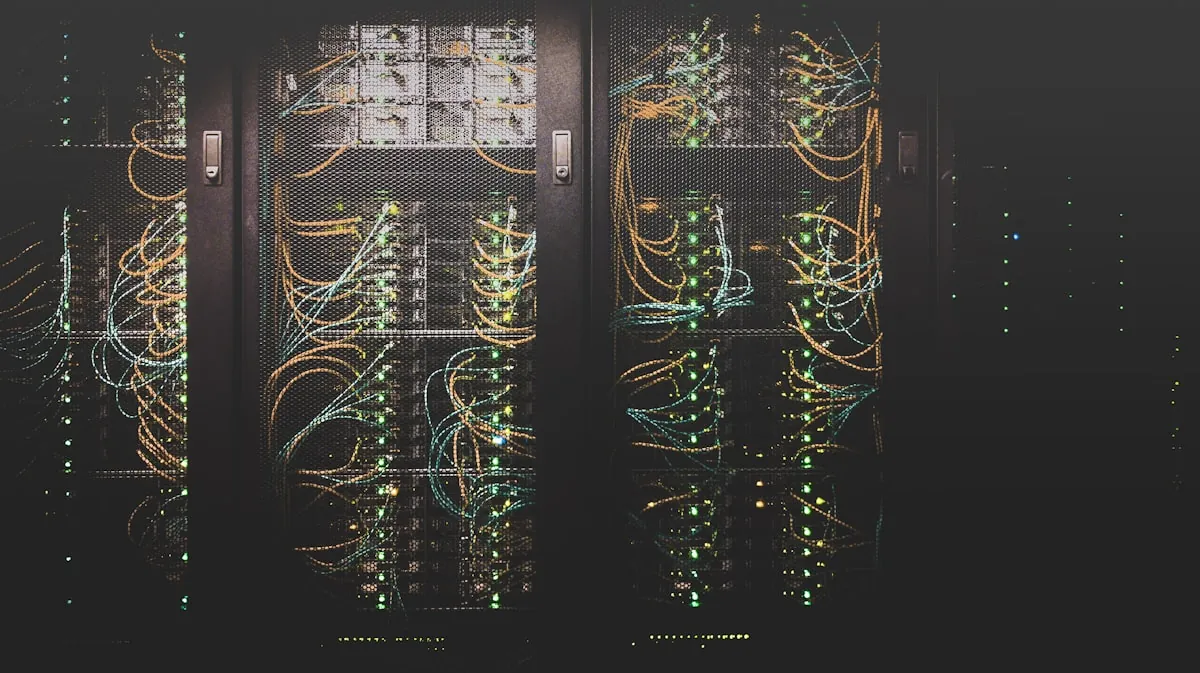
GPU clusters for AI training and inference generate distinctive network traffic patterns that differ fundamentally from traditional enterprise workloads. While the internal cluster fabric handles the bulk of GPU-to-GPU communication, the external network -- WAN bandwidth, internet transit, and peering -- determines how quickly data enters the cluster, how efficiently models are served, and how much connectivity costs per month.
For operators selecting a colocation facility or evaluating their existing data center's network capabilities, bandwidth and peering strategy directly affects both operational cost and workload performance.
Understanding AI Workload Bandwidth Phases
AI workloads move through distinct bandwidth phases, each with different requirements:
Phase 1: Data Ingestion
Before training begins, datasets must be loaded into cluster-local storage. Modern training datasets range from hundreds of gigabytes (fine-tuning) to tens of terabytes (pre-training). A 10 TB dataset transferred over a 10 Gbps link takes approximately 2.2 hours; over a 100 Gbps link, about 13 minutes. When datasets are stored on cloud object stores (S3, GCS, Azure Blob) accessed via the public internet, WAN bandwidth becomes the bottleneck.
Facilities with cloud on-ramps and direct peering to hyperscalers can deliver 10-40 Gbps sustained throughput to cloud storage, compared to 1-5 Gbps through general internet transit during peak hours.
Phase 2: Training (Internal)
During active training, the bandwidth-intensive communication stays within the cluster. GPU-to-GPU gradient synchronization traffic runs over the internal network fabric (InfiniBand NDR at 400 Gbps per port, or RoCEv2 at 100-400 Gbps). External WAN traffic during training is typically limited to checkpoint uploads (every few hours, 10-50 GB per checkpoint) and logging/monitoring telemetry.
However, distributed training across geographically separated clusters -- increasingly common for large-scale LLM pre-training -- requires high-bandwidth, low-latency dedicated circuits between sites, typically 100+ Gbps wavelength services or dark fiber.
Phase 3: Inference Serving
For inference workloads, the bandwidth requirement shifts to egress. Each inference request involves a relatively small input (prompt, image, or audio clip) but generates variable-length output. A busy LLM inference endpoint serving 1,000 concurrent users streaming responses might sustain 200-500 Mbps. Scale that to a multi-model, multi-tenant serving platform, and sustained egress can reach 10-40 Gbps.
Latency matters more than raw bandwidth for inference. Users expect sub-second first-token latency, and network path quality (jitter, packet loss, routing efficiency) directly affects perceived performance.
Transit vs Peering: Economics for AI Facilities
Data centers connect to the internet through two primary mechanisms, and the balance between them significantly impacts monthly network costs.
IP Transit
Transit is a paid service from a carrier (such as Lumen, NTT, Telia, or Zayo) that provides full internet routing. The carrier announces the facility's IP prefixes to the global internet and routes all incoming and outgoing traffic through their backbone.
- Pricing: $0.50-5.00 per Mbps/month at scale (95th percentile billing). A facility with 10 Gbps committed transit might pay $5,000-15,000/month
- Advantages: Simple to deploy, provides global reachability, a single contract covers all destinations
- Limitations: Traffic routes through the carrier's backbone, adding latency. During carrier congestion, performance degrades for all destinations simultaneously. No control over routing path
Peering
Peering is a direct traffic exchange between two networks, typically at an internet exchange point (IXP). Settlement-free peering means neither network pays the other for the traffic exchange -- both benefit from shorter, faster paths.
- Pricing: IXP port fees range from $500-5,000/month for 10-100 GE ports. The actual traffic exchange is free. A single IX port can reach hundreds of networks
- Advantages: Lower latency (1-3 hops instead of 5-10), free traffic exchange, improved performance to frequently accessed networks
- Limitations: Only reaches networks present at the same exchange. Requires active peering relationship management. Does not provide full internet reachability on its own
For AI facilities, the optimal approach combines both: transit for baseline global reachability, and peering at one or more IXPs for low-latency, cost-efficient connectivity to cloud providers, CDNs, and major networks that handle the majority of traffic.
Internet Exchange Presence for AI Colocation
An internet exchange point is a physical location where multiple networks connect to exchange traffic. Major IXPs include DE-CIX (Frankfurt, Dubai), AMS-IX (Amsterdam), LINX (London), and Equinix IX (multiple cities). UAE facilities benefit from access to UAE-IX and DE-CIX Dubai.
IX presence is particularly valuable for AI workloads because:
- Cloud peering: AWS, Google Cloud, and Azure maintain peering presence at major IXPs. Direct peering to these providers reduces latency and bandwidth costs for dataset transfers and hybrid cloud deployments
- CDN access: For AI inference serving end users, peering with CDN networks (Cloudflare, Akamai, Fastly) reduces egress costs and improves response times
- Research networks: Academic and research networks (GEANT, Internet2) peer at IXPs, enabling high-speed connectivity for collaborative AI research projects
- Redundancy: Multiple IX connections from different carriers provide path diversity that pure transit cannot match
Bandwidth Capacity Planning
Planning bandwidth for a GPU colocation deployment requires analyzing each traffic flow:
| Workload Type | Bandwidth Need | Recommended Capacity |
|---|---|---|
| Small training cluster (8-32 GPUs) | Dataset ingest + checkpoints | 1-10 Gbps committed |
| Large training cluster (100-1000 GPUs) | Dataset ingest + multi-site sync | 10-100 Gbps committed |
| Inference serving (100 GPUs) | Client request/response egress | 10-40 Gbps committed |
| Model distribution hub | Large model file transfers | 10-100 Gbps burstable |
| ASIC mining | Pool stratum + monitoring | 100 Mbps per 1,000 units |
ASIC mining operations require minimal bandwidth compared to AI workloads -- stratum protocol traffic is lightweight. A 1,000-unit mining operation consumes less than 100 Mbps, making bandwidth a negligible cost factor for mining hosting.
Network Redundancy and Resilience
For AI workloads where downtime means wasted GPU hours (at $2-4 per GPU-hour for H200-class hardware), network resilience is critical:
- Dual-homed transit: Connections from two independent carriers with diverse physical paths. If one carrier experiences an outage, traffic automatically failovers to the other. Most colocation SLAs specify this as a requirement
- Diverse fiber entry: Physical fiber should enter the facility from at least two separate conduit routes. A single fiber cut (construction accident, natural disaster) should not isolate the facility
- BGP failover: For facilities with their own ASN and IP space, BGP multihoming enables automatic route failover between carriers in seconds. The site selection process should verify that the provider supports BGP sessions and prefix announcements
- Out-of-band management: A separate, low-bandwidth management network (4G/5G cellular backup) ensures administrators can access infrastructure even during a complete WAN outage
Bandwidth Cost Optimization Strategies
Network connectivity is a significant recurring cost for AI facilities. Strategies to optimize bandwidth spending include:
- Commit-and-burst pricing: Negotiate committed information rate (CIR) for baseline traffic and burstable capacity for peaks. Pay the committed rate monthly and burst charges only when exceeded. This aligns cost with actual usage patterns
- Peering-first architecture: Route as much traffic as possible through settlement-free peering, using paid transit only for destinations not reachable via peering. Mature facilities achieve 50-80% of traffic through peering
- Local caching: Cache frequently accessed datasets and model weights locally rather than re-downloading from cloud storage. A local NVMe storage tier reduces repeated ingress bandwidth
- Shared storage: A high-performance parallel filesystem (Lustre, GPFS, WekaFS) shared across the cluster reduces the need for per-node dataset downloads. The dataset is fetched once and accessed by all nodes via the internal network
- Inference result caching: For inference workloads with repeated queries, semantic caching of common request-response pairs reduces both compute and egress bandwidth
Evaluating a Colocation Provider's Network
When selecting a facility for GPU colocation, evaluate the network infrastructure with the same rigor applied to power and cooling:
- Carrier diversity: How many independent carriers serve the facility? Minimum two, preferably four or more. Request a carrier list
- IX connectivity: Which internet exchanges are accessible via cross-connect from the facility? What port speeds are available?
- Cloud on-ramps: Are AWS Direct Connect, Azure ExpressRoute, and Google Cloud Interconnect available as direct connections within the facility?
- Bandwidth pricing model: Is bandwidth included in the colocation rate, or billed separately? What is the per-Mbps cost at the volumes you need?
- Latency benchmarks: Request measured latency from the facility to your primary endpoints (cloud regions, end-user markets, partner sites). Published latency data shows network quality more accurately than marketing claims
- DDoS protection: AI inference endpoints are internet-facing and therefore DDoS targets. Verify that the provider offers upstream scrubbing capacity proportional to the facility's total bandwidth
Rax data center facilities are designed with carrier-diverse connectivity, IX access, and the bandwidth capacity that AI and HPC workloads demand. Our network architecture supports both high-bandwidth training clusters and latency-sensitive inference deployments.
Enterprise-Grade Connectivity for AI Workloads
Rax Data provides carrier-diverse, IX-connected colocation infrastructure built for the bandwidth and latency requirements of GPU AI compute and ASIC mining. Contact us to discuss your connectivity needs.
Discuss Your Bandwidth Needs