AI Inference Hosting in the Middle East: Why UAE Data Centers Are Critical for Real-Time AI
The Inference Problem: Training Is Global, Inference Is Local
The AI industry has spent the last four years solving the training problem. Massive GPU clusters in the US, Europe, and East Asia train foundation models on hundreds of thousands of GPUs. That problem is largely solved — or at least well-understood.
The next challenge is inference: running those trained models in production, at scale, for real users. And inference has a constraint that training does not: latency.
When a user in Dubai asks a chatbot a question, the response needs to arrive in under 200 milliseconds to feel instant. When a fraud detection system in Riyadh evaluates a transaction, it needs a decision in under 50 milliseconds. When an autonomous logistics platform in Mumbai routes a delivery, it cannot wait 300 milliseconds for a round trip to a server in Virginia.
Training can happen anywhere. Inference must happen close to the user.
Why the UAE Is the Inference Hub for 3 Billion People
Draw a circle with a 5,000 km radius centred on the UAE. Inside that circle live more than 3 billion people — across the Middle East, North Africa, South Asia, Central Asia, and East Africa. This is one of the fastest-growing digital populations on earth, and it has been chronically underserved by AI infrastructure.
Geographic Latency Advantage
| Destination | From UAE (Dubai) | From US East (Virginia) | From Europe (Frankfurt) |
|---|---|---|---|
| Riyadh, Saudi Arabia | ~8 ms | ~180 ms | ~120 ms |
| Mumbai, India | ~25 ms | ~220 ms | ~140 ms |
| Cairo, Egypt | ~35 ms | ~160 ms | ~60 ms |
| Nairobi, Kenya | ~45 ms | ~250 ms | ~130 ms |
| Karachi, Pakistan | ~20 ms | ~240 ms | ~160 ms |
| Istanbul, Turkey | ~50 ms | ~150 ms | ~30 ms |
For the majority of these markets, the UAE offers 3x to 10x lower latency than US-based data centers. For real-time AI applications, this is not an incremental improvement — it is the difference between usable and unusable.
Network Infrastructure
The UAE sits at the intersection of major submarine cable systems connecting Europe, Asia, and Africa. Dubai and Abu Dhabi are connected to FLAG, SEA-ME-WE 5, AAE-1, and multiple other cable systems, providing diverse and redundant international connectivity. This submarine cable density means that UAE data centers can serve as a global hub with low-latency paths to multiple continents simultaneously.
Power and Cooling Infrastructure
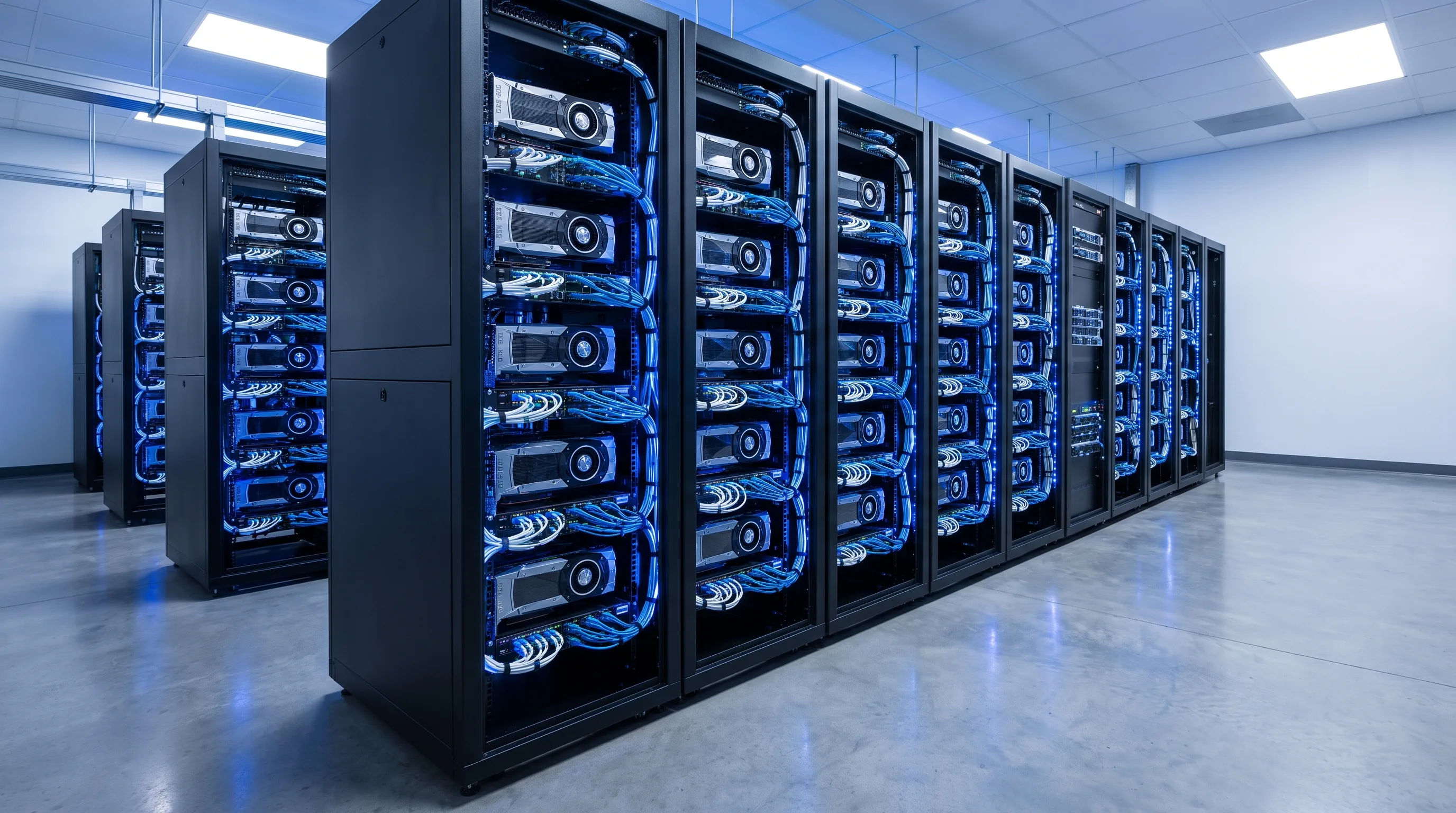
AI inference GPUs — particularly the NVIDIA H100 and H200 — draw 700W to 1,000W per card. A rack of 8 GPUs requires 6 to 10 kW of power plus cooling overhead. The UAE's investment in data center infrastructure over the past decade means facilities are available with the power density, cooling capacity, and electrical infrastructure to support high-density GPU deployments.
Advanced liquid cooling systems — including direct-to-chip and rear-door heat exchangers — are increasingly deployed in UAE facilities to handle the thermal demands of modern GPU hardware in the region's warm climate.
Inference Workloads That Demand Low Latency
Not every AI workload needs to run in the UAE. Batch processing, model fine-tuning, and offline analytics can run anywhere. But these inference categories require geographic proximity:
Conversational AI and Chatbots
Large language model (LLM) inference generates tokens sequentially. Each token takes 20 to 50 milliseconds to generate, and a typical response involves 100 to 500 tokens. Network latency adds to every token's delivery time, making the total response time highly sensitive to distance. An LLM hosted in the UAE responding to a user in Riyadh adds ~8 ms of network latency. The same model in Virginia adds ~180 ms — turning a 3-second response into a 5-second one.
Real-Time Fraud Detection
Financial institutions across the GCC process millions of transactions daily. AI-powered fraud detection must evaluate each transaction in under 50 ms to avoid blocking legitimate payments. When the inference model runs in Virginia and the transaction originates in Abu Dhabi, the 180 ms round-trip alone exceeds the latency budget.
Autonomous Systems and Robotics
The UAE is investing heavily in autonomous logistics, smart city infrastructure, and industrial automation. These systems require edge or near-edge inference with single-digit millisecond latency. While some processing happens on-device, many models are too large for edge deployment and rely on nearby data center GPUs for inference.
Content Personalisation and Recommendation
E-commerce platforms, streaming services, and digital media companies serving Middle Eastern audiences need real-time recommendation engines. Every 100 ms of latency in product recommendations reduces conversion rates by approximately 1%. For platforms serving tens of millions of users across the MENA region, inference proximity directly impacts revenue.
GPU Hardware for Inference: What to Deploy
Inference workloads have different hardware requirements than training. While training demands maximum compute throughput (FLOPS), inference prioritises memory capacity (to hold model weights), memory bandwidth (to stream weights during generation), and power efficiency (cost per inference).
| GPU | Memory | TDP | Best For |
|---|---|---|---|
| NVIDIA H200 | 141 GB HBM3e | 700W | Large LLM inference (70B+ parameters) |
| NVIDIA H100 | 80 GB HBM3 | 700W | General-purpose AI inference |
| NVIDIA L40S | 48 GB GDDR6X | 350W | Cost-efficient inference, multimodal AI |
| AMD MI300X | 192 GB HBM3 | 750W | Memory-intensive models, large batch inference |
The H200's 141 GB of HBM3e memory is particularly relevant for inference because it can hold a 70B-parameter model entirely in GPU memory without model parallelism — reducing inference latency and simplifying deployment. For operators comparing options, our AMD MI300X vs NVIDIA H100 comparison covers the trade-offs.
Data Sovereignty and Compliance
Many enterprises and government organisations in the Middle East have data sovereignty requirements that prohibit sending data outside the country or region for processing. This is not merely a preference — it is a legal and regulatory mandate in sectors including:
- Financial services: Central bank regulations in Saudi Arabia, UAE, and Bahrain require transaction data to be processed within national borders
- Healthcare: Patient data in the UAE must comply with MOHAP and DHA regulations on data residency
- Government: The UAE's sovereign AI initiatives require AI models serving government functions to run on domestic infrastructure
- Defence and critical infrastructure: All processing must occur in-country on accredited facilities
For these organisations, offshore inference is not an option regardless of cost. UAE-based GPU hosting is the only compliant path to production AI.
Colocation vs. Cloud for Inference in the UAE
Companies deploying AI inference in the UAE face a choice between cloud GPU instances and colocation (bringing their own hardware to a data center). Each has trade-offs:
Cloud GPU (AWS, Azure, GCP Middle East regions)
- Pros: Fast deployment, no hardware procurement, flexible scaling
- Cons: Limited GPU availability in Middle East regions, premium pricing ($3 to $5+ per GPU-hour), potential data sovereignty concerns with non-local providers, long wait lists for H100/H200 instances
GPU Colocation
- Pros: Lower long-term cost ($0.08 to $0.15/kWh all-in), full hardware control, no GPU availability constraints, clear data sovereignty (your hardware, your facility)
- Cons: Capital expenditure for hardware, longer deployment timeline (weeks vs. hours), hardware lifecycle management responsibility
For sustained inference workloads — the kind that run 24/7 serving production applications — colocation typically delivers 40 to 60% lower cost compared to cloud over a 24-month period. For a deeper comparison, see our guide on GPU cloud vs. colocation for AI workloads.
Getting Started with AI Inference Hosting in the UAE
Deploying inference infrastructure in the UAE follows a straightforward process:
- Define your latency budget: Determine the maximum acceptable round-trip latency for your application. This dictates whether UAE hosting (sub-30 ms to MENA) meets your requirements or whether edge deployment is needed.
- Size your GPU fleet: Calculate the number of GPUs needed based on your model size, throughput requirements, and concurrent user load. Our team can help model this based on your specific workload.
- Choose colocation or managed hosting: If you have hardware procurement capability and in-house DevOps, colocation offers the best economics. If you need turnkey deployment, managed AI hosting provides a fully operated solution.
- Plan for scaling: Inference demand is rarely static. Choose a facility that can accommodate growth from initial deployment to full-scale production without migration.
Frequently Asked Questions
Why does AI inference need low latency?
AI inference — running trained models in production — requires sub-100ms response times for real-time applications like chatbots, recommendation engines, fraud detection, and autonomous systems. Every additional millisecond of network latency degrades user experience. Hosting inference GPUs close to end users (within 10-30ms round trip) ensures responsive AI applications. For the 3+ billion people across the Middle East, South Asia, and East Africa, UAE data centers provide the nearest high-quality GPU infrastructure.
What GPU hardware is best for AI inference?
NVIDIA H100 and H200 GPUs are the current standard for high-throughput AI inference. The H200 offers 141 GB of HBM3e memory, enabling larger model serving without multi-GPU splits. For cost-sensitive inference, the NVIDIA L40S provides strong performance at lower power consumption. AMD MI300X is also gaining traction for inference workloads with its 192 GB HBM3 memory capacity.
How much does AI inference hosting cost in the UAE?
AI inference GPU hosting in the UAE typically costs $2.50 to $4.50 per GPU-hour for on-demand capacity, or $1.50 to $3.00 per GPU-hour for reserved 12-month commitments. Colocation (bringing your own hardware) reduces costs further to $0.08 to $0.15 per kWh all-in, plus rack space fees. Actual costs depend on GPU model, power density, cooling requirements, and contract terms.
Deploy AI Inference Infrastructure in the UAE
Rax Data & Energy provides GPU colocation and managed AI hosting in the UAE with sub-20ms latency to major Middle Eastern markets. Enterprise-grade power, cooling, and network connectivity for production AI workloads.
Get in Touch