InfiniBand vs Ethernet (RoCE) for AI Cluster Networking: A Data Center Operator's Guide
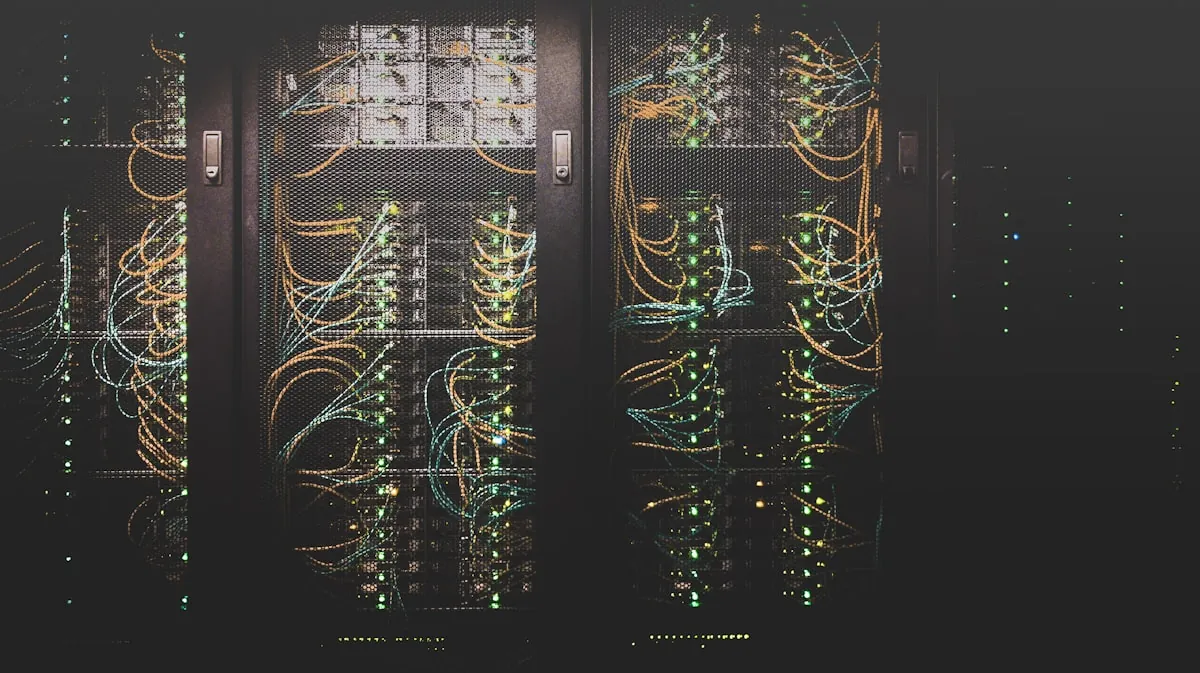
The network fabric connecting GPUs in a training cluster is one of the most consequential infrastructure decisions a data center operator makes. A GPU that can perform 2,000 teraflops of computation is only as fast as the network that feeds it data from other GPUs during distributed training. Choose the wrong interconnect, and expensive GPU silicon sits idle waiting for gradients to arrive from across the cluster.
The primary choice is between two technologies: InfiniBand, a purpose-built high-performance computing interconnect dominated by NVIDIA (via its Mellanox acquisition), and RoCE (RDMA over Converged Ethernet), which brings RDMA capabilities to standard Ethernet switches and adapters. This article compares both technologies across the dimensions that matter for AI training and inference infrastructure, with practical guidance for data center operators evaluating their options.
Why AI Clusters Need RDMA Networking
Before comparing InfiniBand and RoCE, it is important to understand why both exist. Traditional TCP/IP networking is inadequate for AI training cluster communication. The reasons are specific and measurable.
The Problem with Traditional Networking for AI
Distributed AI training uses collective communication patterns -- primarily all-reduce -- where every GPU must exchange gradient data with every other GPU after each training step. For a 70-billion-parameter model trained across 256 GPUs, each all-reduce operation moves approximately 140 GB of gradient data across the network. This happens once per training step, and training runs execute millions of steps.
TCP/IP networking introduces multiple sources of overhead for this pattern:
- Kernel involvement: Every send and receive operation passes through the operating system kernel, requiring context switches between user space and kernel space. Each context switch costs 1-5 microseconds, and a single all-reduce operation involves thousands of individual send/receive pairs.
- Data copying: TCP requires data to be copied from application memory to kernel buffers, then to the network adapter. For GPU-resident data, this means an additional GPU-to-CPU memory copy before the network stack can process it.
- Protocol overhead: TCP's reliability mechanisms (acknowledgments, retransmissions, congestion control) add latency and consume CPU cycles that would otherwise be available for data preprocessing.
- Serialization: The CPU must process network packets sequentially, creating a serialization bottleneck that limits throughput regardless of the network adapter's raw bandwidth.
How RDMA Solves These Problems
RDMA (Remote Direct Memory Access) eliminates these bottlenecks by allowing the network adapter to read from and write to application memory directly, without involving the CPU or operating system kernel. The key properties of RDMA that matter for AI workloads are:
- Zero-copy data transfer: Data moves directly from GPU memory to the network adapter (via GPUDirect RDMA) and from the network adapter to remote GPU memory, with no intermediate copies through CPU DRAM.
- Kernel bypass: Applications post send and receive operations directly to the network adapter's hardware queues, bypassing the kernel networking stack entirely. This reduces per-operation latency from microseconds to hundreds of nanoseconds.
- CPU offload: The network adapter handles all protocol processing in hardware, freeing the CPU to perform data preprocessing, I/O, and orchestration tasks instead of processing network packets.
Both InfiniBand and RoCE provide RDMA capabilities. The difference lies in how they implement the underlying transport, and the operational and performance trade-offs that result.
InfiniBand: The HPC Heritage
InfiniBand is a network architecture designed from the ground up for high-performance computing. It predates the AI training era, with origins in the early 2000s scientific computing community, and has been the dominant interconnect for supercomputers for over two decades. NVIDIA acquired Mellanox, the primary InfiniBand vendor, in 2020, making InfiniBand a first-party component of NVIDIA's AI infrastructure stack.
Current InfiniBand Generations
| Generation | Per-Port Bandwidth | Typical GPU Platform | Availability |
|---|---|---|---|
| HDR (High Data Rate) | 200 Gbps | NVIDIA A100 | Widely deployed |
| NDR (Next Data Rate) | 400 Gbps | NVIDIA H100, H200 | Current generation |
| XDR (Extended Data Rate) | 800 Gbps / 1.6 Tbps | NVIDIA B200, GB200 | Shipping 2025-2026 |
InfiniBand's Technical Advantages
Lossless transport by design. InfiniBand uses credit-based flow control at the link layer, which prevents packet drops entirely within the fabric. Each switch port tracks available buffer space on the receiving end and only transmits when credits are available. This eliminates the packet loss and retransmission overhead that plagues Ethernet under heavy load.
Adaptive routing. InfiniBand switches can route packets across multiple paths dynamically, based on real-time congestion information. When one path through the fabric becomes congested, subsequent packets are automatically rerouted to less-loaded paths. This spreads traffic evenly across the fabric without requiring application-level awareness of network topology.
Hardware-level collective operations. NVIDIA's SHARP (Scalable Hierarchical Aggregation and Reduction Protocol) technology performs all-reduce operations directly in the InfiniBand switch hardware. Instead of every GPU sending its gradients to every other GPU, each GPU sends its data to the nearest switch, the switches perform partial aggregation as data traverses the fabric, and the final result is delivered to all GPUs. SHARP can reduce all-reduce network traffic by up to 2x and latency by 4-7x for large clusters.
Sub-microsecond latency. InfiniBand delivers end-to-end RDMA latency below 1 microsecond in most configurations. For AI training, where the all-reduce latency directly adds to the per-step training time, this translates to higher GPU utilization. At 256+ GPUs, every microsecond of collective communication latency is multiplied across thousands of operations per second.
InfiniBand's Limitations
- Vendor lock-in: NVIDIA is effectively the sole vendor for InfiniBand switches, adapters, and cables. This means a single source for pricing, supply, and roadmap. Organizations that value multi-vendor strategies find this concentration of dependency concerning.
- Specialized operations team: InfiniBand requires fabric management skills (Subnet Manager configuration, partition management, QoS policies) that differ from Ethernet operations. Most data center teams have deep Ethernet expertise but limited InfiniBand experience. Hiring InfiniBand-skilled engineers is more difficult and more expensive than hiring Ethernet engineers.
- Higher unit cost: InfiniBand switches and adapters carry a price premium over equivalent-bandwidth Ethernet equipment. An NDR InfiniBand switch costs approximately 2-3x more than a comparable 400G Ethernet switch. For large fabrics, this premium represents a significant capital expenditure difference.
- Separate management plane: InfiniBand runs a distinct management infrastructure (Subnet Manager, fabric monitoring, diagnostics) that does not integrate with existing Ethernet-based network management tools. Operators must maintain parallel management systems.
RoCE Ethernet: The Converged Alternative
RoCE (RDMA over Converged Ethernet) brings RDMA capabilities to standard Ethernet by encapsulating InfiniBand transport protocol frames inside Ethernet and UDP/IP packets. RoCEv2, the current standard, uses UDP port 4791 to carry RDMA traffic over any IP-routable Ethernet network.
How RoCE Works
RoCE uses the same RDMA verbs API as InfiniBand -- applications written for InfiniBand can run on RoCE with minimal or no code changes. The NVIDIA NCCL library (the standard collective communication library for multi-GPU training) supports both InfiniBand and RoCE transparently. From the application's perspective, the RDMA operations look identical; the difference is in how packets are carried across the physical network.
The critical requirement for RoCE performance is a lossless Ethernet configuration. Unlike InfiniBand, standard Ethernet does not guarantee lossless delivery. Switches will drop packets when buffers overflow. For RoCE, packet drops trigger expensive retransmissions that destroy RDMA latency. To prevent this, RoCE deployments use Priority Flow Control (PFC) and Explicit Congestion Notification (ECN) to create a lossless traffic class within the Ethernet fabric.
RoCE's Advantages
Ethernet operational model. Network engineers who manage Ethernet fabrics can operate RoCE networks with additional training on lossless Ethernet configuration. The underlying switches, cables, optics, and management tools are standard Ethernet components. This reduces the operational learning curve compared to deploying a completely new technology stack.
Multi-vendor ecosystem. RoCE adapters are available from NVIDIA (ConnectX), Broadcom, Intel, and others. Ethernet switches supporting PFC and ECN are available from Arista, Cisco, Broadcom (Memory White Box), and NVIDIA (Spectrum). This vendor diversity provides pricing competition and supply chain resilience.
Converged infrastructure. A single Ethernet fabric can carry both RDMA storage traffic and GPU-to-GPU training traffic alongside conventional TCP/IP management traffic, using QoS priorities to isolate traffic classes. This reduces the total number of switch ports, cables, and management interfaces compared to running separate InfiniBand and Ethernet networks.
Scaling with standard IP routing. RoCEv2 packets are UDP/IP, which means they can be routed across L3 boundaries using standard BGP or OSPF routing protocols. InfiniBand routing (using InfiniBand routers, not IP routers) is more limited in topology flexibility. For multi-site or campus-scale GPU clusters, IP routing simplifies the network design.
RoCE's Challenges
- Lossless configuration complexity: Configuring PFC, ECN, and DCQCN (Data Center Quantized Congestion Notification) correctly is non-trivial. Misconfigured PFC can cause head-of-line blocking, PFC storms, or deadlocks that bring down the entire fabric. These failure modes are subtle and difficult to diagnose.
- No in-network compute: RoCE Ethernet does not have an equivalent of InfiniBand's SHARP technology. All-reduce operations must be performed entirely at the endpoints, generating more network traffic and higher latency for large collective operations.
- Higher tail latency: While RoCE median latency approaches InfiniBand levels (1-2 microseconds), tail latency (99th and 99.9th percentile) is typically higher and more variable. PFC backpressure, ECN-triggered rate reduction, and Ethernet's store-and-forward switching model all contribute to latency jitter that InfiniBand's cut-through, credit-based design avoids.
- Performance gap at scale: For clusters above 256-512 GPUs, the cumulative effect of higher latency, no in-network reduction, and congestion control imperfections makes RoCE measurably slower than InfiniBand. NVIDIA's own benchmarks show 10-15% lower training throughput on RoCE compared to InfiniBand for large-scale distributed training jobs.
Head-to-Head Comparison
| Dimension | InfiniBand (NDR/XDR) | RoCE Ethernet (400G/800G) |
|---|---|---|
| RDMA latency (median) | 0.5-1.0 us | 1.0-2.0 us |
| RDMA latency (p99) | 1-3 us | 3-10 us |
| Lossless transport | Native (credit-based) | Configured (PFC/ECN) |
| In-network compute | SHARP (all-reduce in switches) | Not available |
| Adaptive routing | Hardware-based, per-packet | ECMP (per-flow hash) |
| Switch cost (400G, 64-port) | $30,000-$50,000 | $12,000-$25,000 |
| Vendor options | NVIDIA only | Arista, Cisco, Broadcom, NVIDIA |
| Operational complexity | Specialized (Subnet Manager) | Ethernet + lossless config |
| Optimal cluster size | 256-100,000+ GPUs | 32-512 GPUs |
| GPUDirect RDMA support | Full (first-party) | Full (via NCCL) |
Topology Considerations for Both Technologies
The network topology -- how switches are arranged and connected -- affects performance for both InfiniBand and Ethernet fabrics. The two most common topologies for AI clusters are fat-tree and rail-optimized.
Fat-Tree Topology
A fat-tree (or folded Clos) network provides full bisection bandwidth: any GPU can communicate with any other GPU at full line rate simultaneously. This is the standard topology for general-purpose AI training clusters where workload placement is dynamic and any GPU might need to communicate with any other GPU. Fat-tree topologies require more switches and cables (a 256-GPU cluster might need 40+ leaf and spine switches) but provide maximum flexibility.
Rail-Optimized Topology
NVIDIA's DGX systems use a rail-optimized topology where GPUs at the same position across multiple servers are connected to the same network rail. GPU 0 in every server connects to rail switch 0, GPU 1 to rail switch 1, and so on. This topology reduces the total switch count (a 256-GPU cluster might need only 16-32 switches) but requires that workloads are placed to minimize cross-rail communication. Rail-optimized topologies work well with NVIDIA's NCCL library, which is aware of the rail structure and optimizes communication patterns accordingly.
Both topologies work with InfiniBand and RoCE. The choice depends on workload diversity (fat-tree for mixed workloads, rail-optimized for dedicated training clusters) and budget (rail-optimized uses fewer switches).
Practical Decision Framework for Data Center Operators
The InfiniBand vs. RoCE decision should be driven by three factors: cluster scale, workload profile, and organizational capabilities.
Choose InfiniBand When:
- The cluster exceeds 256 GPUs and will be used primarily for large-scale distributed training.
- Training throughput is the primary metric, and even a 5-10% performance difference justifies the infrastructure cost.
- The organization is deploying NVIDIA DGX or HGX systems, which are designed for InfiniBand and include ConnectX adapters by default.
- Budget allows for the switch and adapter premium, and the organization accepts single-vendor dependency.
- The workload involves very large models (hundreds of billions of parameters) where all-reduce communication is the dominant bottleneck and SHARP provides a measurable advantage.
Choose RoCE Ethernet When:
- The cluster is under 256 GPUs and focused on fine-tuning, inference serving, or moderate-scale training.
- The organization has strong Ethernet operational expertise and prefers to leverage existing skills and tools.
- Multi-vendor sourcing is a procurement requirement (risk mitigation, competitive pricing, supply chain resilience).
- The GPU cluster shares physical infrastructure with storage, management, and other Ethernet-based services, and converging onto a single fabric reduces total infrastructure cost.
- The organization plans to use cloud-native orchestration tools (Kubernetes, Slurm) that integrate more naturally with IP-based networking.
Consider a Hybrid Approach When:
- The cluster has both training and inference partitions with different networking requirements.
- InfiniBand is used for the GPU-to-GPU training fabric, while Ethernet handles storage access, management traffic, and inference serving.
- The organization is transitioning from Ethernet to InfiniBand incrementally, adding InfiniBand to new GPU nodes while maintaining Ethernet for existing infrastructure.
The UAE and GCC Market Perspective
Data center operators in the UAE building sovereign AI infrastructure face specific considerations when selecting a network fabric.
Regional Talent and Support
InfiniBand expertise is even scarcer in the UAE than in North American or European markets. Most regional network engineers have Ethernet backgrounds (Cisco, Arista, Juniper certifications). Organizations deploying InfiniBand in the UAE typically require NVIDIA professional services or specialized contractors for initial deployment and ongoing fabric management. RoCE deployments can be staffed more easily from the existing regional talent pool, reducing dependency on imported or contracted expertise.
Supply Chain Considerations
InfiniBand's single-vendor supply chain means all switches, adapters, and cables come through NVIDIA's distribution network. During periods of GPU supply constraint (which have been persistent since 2023), InfiniBand networking components can also face allocation limits. Ethernet components are available from multiple manufacturers through diverse distribution channels, providing more procurement flexibility for UAE-based operators who may face longer lead times for specialized hardware.
Scale of Regional Deployments
Most current AI deployments in the UAE are in the 32-256 GPU range, which falls within the zone where RoCE Ethernet is competitive with InfiniBand. As the region's largest deployments scale to 1,000+ GPUs for pre-training sovereign foundation models, InfiniBand's performance advantages will become more decisive. Operators planning for both current and future scale might deploy RoCE for near-term projects while designing infrastructure (power, cooling, cabling pathways) to support an InfiniBand upgrade path.
Power and Cooling Implications
Network switches and adapters contribute to data center power consumption and heat load. An InfiniBand NDR switch consumes approximately 600-800W, compared to 300-500W for a typical 400G Ethernet switch. For a 256-GPU fat-tree fabric, the difference in switch power alone can reach 10-15 kW. In Gulf climates where every watt of IT load generates additional cooling overhead, this difference affects both operating cost and rack power budget.
Future Outlook: Converging or Diverging?
The InfiniBand vs. Ethernet debate has persisted for over twenty years, and the AI training wave has intensified it. Several trends are shaping the future landscape:
- Ultra Ethernet Consortium (UEC): A consortium including AMD, Broadcom, Cisco, Google, Intel, Meta, and Microsoft is developing an AI-optimized Ethernet standard that addresses RoCE's limitations. UEC aims to deliver native lossless transport, in-network collective operations, and adaptive routing within the Ethernet framework. If successful, UEC Ethernet could close much of InfiniBand's performance gap while preserving Ethernet's multi-vendor ecosystem.
- NVIDIA Spectrum-X: NVIDIA's Spectrum-X platform is an Ethernet-based networking solution with AI-specific optimizations (adaptive routing, RoCE performance enhancements, NCCL-aware traffic engineering). Spectrum-X represents NVIDIA offering an Ethernet alternative alongside InfiniBand, acknowledging that not all customers want InfiniBand's operational model.
- 800G and 1.6T speeds: Both InfiniBand (XDR at 800G-1.6T) and Ethernet (800GbE, 1.6TbE) are scaling to higher speeds. The raw bandwidth gap between the two technologies is closing; the performance differences increasingly stem from protocol behavior (lossless transport, adaptive routing, in-network compute) rather than raw link speed.
- Scale continues to grow: As frontier AI models approach and exceed 1 trillion parameters, training clusters will grow to 10,000-100,000 GPUs. At this scale, InfiniBand's lossless transport, SHARP in-network reduction, and adaptive routing provide advantages that are difficult to replicate in Ethernet without fundamental protocol changes.
For data center operators making decisions now, the practical advice is: choose the technology that matches your current scale and operational capabilities, but design your physical infrastructure (fiber pathways, power capacity, cooling headroom) to support a technology transition if your requirements evolve.
Build Your AI Cluster Network
Rax designs and deploys GPU cluster infrastructure with both InfiniBand and RoCE Ethernet fabrics across our UAE data center facilities. Our team helps you select the right interconnect for your workload, scale, and operational requirements.
Discuss Your Cluster Requirements