AI Managed Hosting: How It Works, Pricing Models, and Why It Matters
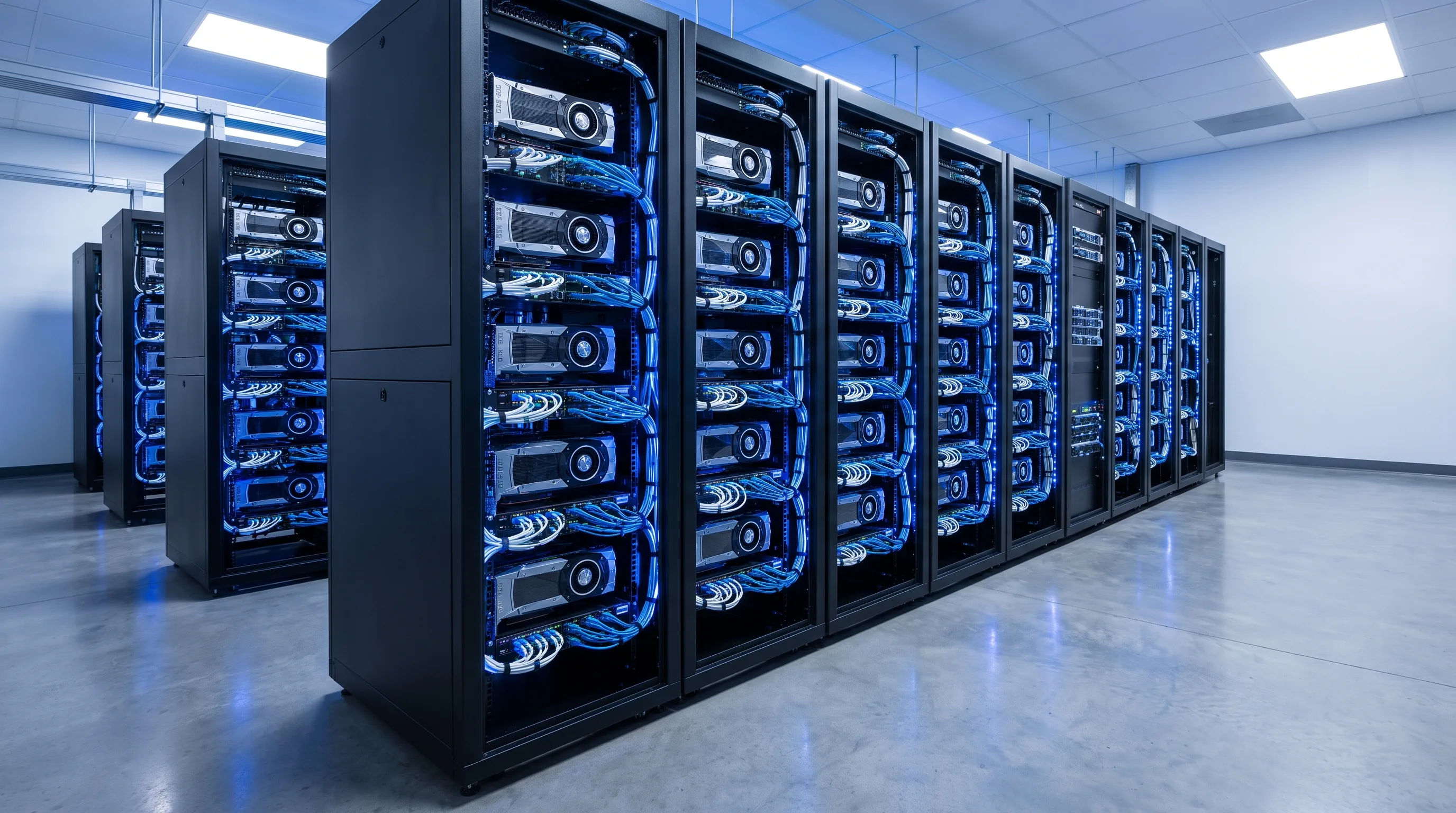
Building AI infrastructure from scratch demands significant capital, specialized engineering talent, and months of lead time. AI managed hosting eliminates those barriers by providing fully operational GPU compute environments where a provider handles the hardware, power, cooling, networking, and ongoing maintenance while the client focuses on training models and running inference workloads.
This guide explains how AI managed hosting works as a service model, how it compares to GPU colocation and public cloud, the pricing structures used across the industry, and why UAE-based data centers are emerging as a compelling destination for managed AI infrastructure.
What AI Managed Hosting Includes
AI managed hosting is a service model where the hosting provider owns and operates the GPU server infrastructure. The client accesses dedicated, bare-metal GPU compute without purchasing or managing hardware. A typical managed hosting agreement covers the following responsibilities:
- Hardware procurement and deployment: The provider sources GPU servers (NVIDIA H100, H200, GB200 NVL72, or AMD MI300X platforms), racks them, cables power and network connections, and configures BIOS, firmware, and drivers.
- Power and cooling: The provider delivers conditioned power (typically dual-feed with UPS backup) and manages cooling infrastructure including liquid cooling systems for high-density GPU racks that exceed 40 kW.
- Network infrastructure: Upstream connectivity (1-100 Gbps), InfiniBand or RoCE fabric for multi-node training, firewall and DDoS protection, and optional private interconnects to cloud providers or enterprise WANs.
- Ongoing operations: Hardware health monitoring, failed component replacement (typically under 4-hour SLA for GPU and NVLink failures), firmware and driver updates, security patching, and 24/7 NOC support.
- Management interface: A portal or API providing real-time visibility into GPU utilization, power consumption, thermal status, and job scheduling.
The client retains full control over the software stack: operating system, container runtime, ML frameworks, model code, and data. Managed hosting is bare-metal, not virtualized, which means there is no hypervisor overhead and GPU performance matches the specifications published by NVIDIA or AMD.
Managed Hosting vs. Colocation vs. Cloud
These three models occupy distinct positions on the spectrum between full ownership and full abstraction:
GPU Colocation
In colocation, the client owns the hardware and the facility provides space, power, cooling, and physical security. The client handles procurement (8-16 week lead times for GPU servers), installation, maintenance, and eventual hardware disposal. Colocation is the most cost-effective model for stable, long-term deployments -- the breakeven against managed hosting typically occurs at 18-24 months of continuous operation. However, colocation requires dedicated hardware engineering staff and exposes the client to hardware depreciation risk as newer GPU generations arrive.
Public Cloud GPU Instances
Cloud providers (AWS, Azure, GCP, Oracle, CoreWeave) offer GPU instances on a per-hour basis with no hardware commitment. Cloud is the fastest path to GPU compute (minutes to provision) but the most expensive at scale. Cloud GPU pricing for H100 instances ranges from $3.00-4.50 per GPU-hour on-demand, and availability during peak demand periods is unreliable. Multi-node training on cloud infrastructure also introduces variable network performance from shared fabric and noisy-neighbor effects that can extend training times by 15-30% compared to dedicated bare-metal infrastructure.
AI Managed Hosting
Managed hosting sits between colocation and cloud. The client avoids capital expenditure and hardware management (like cloud) while getting dedicated bare-metal performance with predictable pricing (like colocation). Managed hosting contracts typically run 6-36 months, with pricing that decreases as commitment length increases.
The decision framework depends on three factors: time horizon (under 18 months favors managed hosting; over 18 months favors colocation), technical capability (organizations without hardware engineering teams lean toward managed hosting), and workload predictability (stable workloads favor longer commitments at lower rates; variable workloads benefit from shorter terms or on-demand options).
Pricing Models for AI Managed Hosting
Managed hosting providers use several pricing structures. Understanding these models is essential for accurate cost comparison and budget planning.
Per-GPU-Hour (On-Demand)
The most flexible but most expensive option. Pricing reflects the provider's need to recoup hardware costs over uncertain utilization periods. Current market rates for managed bare-metal H100 80GB SXM hosting range from $2.00-3.50 per GPU-hour on-demand, depending on provider and geography. UAE-based providers typically price 10-20% below US and European equivalents due to lower energy costs.
Monthly Reserved
A fixed monthly fee for dedicated GPU access, regardless of utilization. Monthly reserved pricing for H100 SXM typically ranges from $1,200-2,000 per GPU per month (equivalent to $1.67-2.78 per GPU-hour at 100% utilization). This model works well for continuous training workloads where GPU utilization exceeds 70%, as the effective per-GPU-hour cost drops below on-demand rates.
Annual Committed
The lowest per-GPU-hour rate, reflecting the provider's certainty of revenue over the contract period. Annual commitments for H100 SXM typically range from $900-1,400 per GPU per month ($1.25-1.94 per GPU-hour at full utilization). Annual contracts often include additional benefits: priority access to next-generation GPUs when available, dedicated support engineering, and custom network configurations at no additional charge.
Consumption-Based (Hybrid)
Some providers offer a hybrid model with a base commitment (minimum guaranteed spend) plus on-demand overflow capacity. This suits organizations with a baseline training workload supplemented by periodic burst requirements -- for example, a large language model training pipeline that uses 64 GPUs continuously but needs 256 GPUs for final training runs every quarter.
What to Evaluate in a Managed Hosting Provider
Not all managed hosting services deliver equivalent value. The following evaluation criteria separate premium providers from commodity operators:
GPU Fleet Composition and Refresh Cycle
Confirm the exact GPU model, memory capacity, and interconnect topology. An "H100 cluster" can mean air-cooled PCIe cards with Ethernet networking (suitable for inference) or liquid-cooled SXM modules with NVSwitch and InfiniBand (required for large-scale training). The performance difference between these configurations is substantial -- NVLink bandwidth alone is 900 GB/s for SXM versus 128 GB/s for PCIe. Ask about the provider's GPU refresh roadmap: when will Blackwell and next-generation hardware be available, and what migration options exist for current contract holders.
Network Architecture
For multi-node training, the network fabric is as important as the GPUs themselves. Evaluate the InfiniBand or RoCE topology (fat-tree, rail-optimized, or dragonfly), the oversubscription ratio, and the maximum cluster size supported without performance degradation. A provider running 400 Gbps InfiniBand NDR with 1:1 bandwidth ratio between GPU nodes can support efficient training across hundreds of GPUs, while a provider using 100 Gbps Ethernet with 4:1 oversubscription will bottleneck at 16-32 GPU training jobs.
Power and Cooling Infrastructure
GPU servers are the most power-dense IT equipment deployed today. A single H200 server draws 5-10 kW; a GB200 NVL72 rack exceeds 120 kW. Verify that the facility has the power capacity and redundancy to support your deployment at full load, and that liquid cooling is available for configurations above 30 kW per rack. Underpowered or under-cooled facilities force thermal throttling that reduces GPU performance by 10-25%.
SLA and Support Structure
Key SLA metrics include uptime guarantee (99.9% minimum for production workloads), hardware replacement time (4 hours or less for GPU failures), network availability (99.99% for production traffic), and the escalation path for non-standard issues. Premium providers offer a named support engineer and quarterly business reviews; commodity providers offer ticket-based support with 24-hour response times.
Data Sovereignty and Compliance
For organizations subject to data sovereignty requirements or industry-specific regulations (financial services, healthcare, government), verify that the managed hosting provider operates in a jurisdiction that satisfies your compliance needs. UAE data centers operate under TDRA regulations and offer data residency guarantees that satisfy many MENA-region compliance frameworks.
Why the UAE for AI Managed Hosting
Several structural factors make the UAE an increasingly attractive location for managed AI infrastructure:
- Energy cost advantage: Electricity rates for large-scale data center operations in the UAE range from $0.04-0.07 per kWh, compared to $0.08-0.15 per kWh in the US and $0.10-0.25 per kWh in Europe. Since power constitutes 30-40% of the total cost of operating GPU infrastructure, this translates directly to lower managed hosting rates for UAE-based providers.
- Geographic position: The UAE sits at the intersection of Europe, Asia, and Africa, with sub-50ms latency to major population centers across these regions. For AI inference workloads serving users across the Eastern Hemisphere, UAE-hosted infrastructure provides lower latency than US-based alternatives.
- Government support: The UAE National AI Strategy and Dubai's AI Agenda position the country as a regional AI hub, with government investment in data center power infrastructure, subsea cable connectivity, and regulatory frameworks designed to attract AI workloads.
- No data export restrictions: Unlike some jurisdictions that restrict AI model weights or training data from crossing borders, the UAE's free zone framework allows data movement while still providing data residency guarantees for clients that need them.
- Cooling efficiency in managed environments: While the UAE's ambient temperatures are high, managed hosting providers with immersion cooling and district cooling infrastructure achieve PUE values of 1.1-1.2, competitive with the best facilities globally. The client benefits from this efficiency through lower operating costs without managing the cooling infrastructure themselves.
Getting Started with AI Managed Hosting
Organizations evaluating managed hosting should follow a structured procurement process:
- Define workload requirements: Document the GPU model and quantity needed, interconnect topology for multi-node training, storage capacity and throughput, network bandwidth, and expected utilization pattern (continuous versus burst).
- Request proposals from 3-5 providers: Include your workload specifications, target deployment timeline, contract length preferences, and compliance requirements. Compare on total cost of ownership, not just per-GPU-hour rate -- networking, storage, support, and egress fees can add 20-40% to the base GPU cost.
- Conduct a proof of concept: Before committing to a long-term contract, run a representative training job on the provider's infrastructure. Measure actual GPU utilization, inter-node communication bandwidth, training throughput (samples per second), and compare against your baseline on existing infrastructure or cloud.
- Negotiate contract terms: Key negotiation points include GPU refresh options (ability to upgrade to next-generation hardware mid-contract), scaling provisions (add capacity without renegotiating the entire contract), exit terms (data migration assistance and timeline), and pricing tiers that automatically reduce the per-GPU-hour rate as your deployment grows.
Explore AI Managed Hosting with Rax
Rax provides fully managed GPU hosting infrastructure from our UAE data center facilities. NVIDIA H100, H200, and GB200 platforms with InfiniBand networking, liquid cooling, and 24/7 support -- deployed and operational in as little as two weeks.
Request a Managed Hosting Quote