AI Data Center Power Density Trends 2026: From 10 kW to 120 kW Per Rack
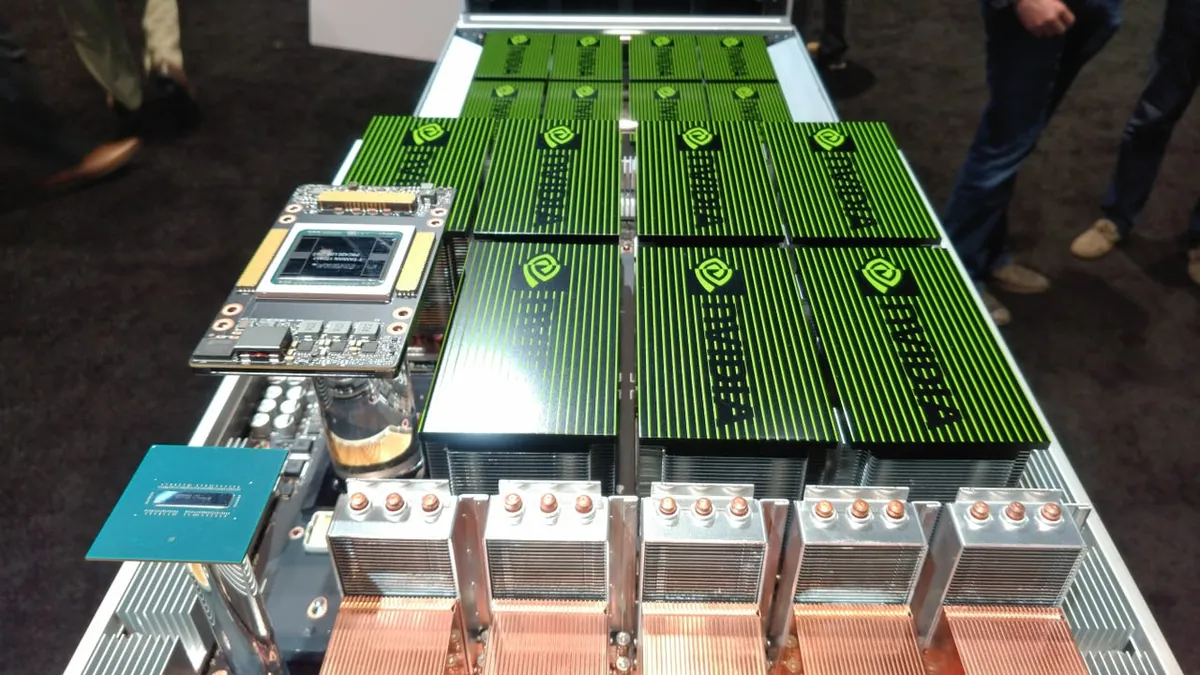
The gap between what traditional data centers were built to deliver and what AI workloads demand has become the defining infrastructure challenge of 2026. A standard enterprise data center rack draws 7-12 kW. An AI training rack with NVIDIA H100 GPUs draws 40-50 kW. An NVIDIA GB200 NVL72 rack-scale system draws 120 kW. That is a 10x density increase within the same 42U form factor, and it changes everything about how data centers are designed, powered, cooled, and operated.
This article examines the forces driving power density growth, the GPU platforms that define each density tier, and the infrastructure implications for operators, colocation providers, and enterprises planning AI hosting deployments.
The Power Density Timeline: How We Got to 120 kW
Data center power density has followed GPU silicon development with a roughly 18-month lag (the time needed to design, build, and deploy the supporting infrastructure):
- 2018-2020 (5-8 kW/rack average): The era of CPU-dominant workloads. Most data center designs targeted 5-8 kW per rack with hot/cold aisle containment and raised-floor cooling. GPU usage was limited to HPC clusters and early deep learning research.
- 2021-2022 (8-15 kW/rack): NVIDIA A100 (400W TDP) drove the first wave of GPU-dense deployments. An 8-GPU A100 DGX server drew approximately 6.5 kW. Racks with 2-3 DGX servers plus networking ran at 15-20 kW -- manageable with enhanced air cooling and in-row cooling units.
- 2023-2024 (20-50 kW/rack): The H100 (700W TDP) arrived alongside the generative AI explosion. An 8-GPU H100 SXM server draws approximately 10.2 kW. Racks with 4 servers hit 40-44 kW -- beyond the practical limits of air cooling. Direct-to-chip liquid cooling became a deployment requirement, not an option.
- 2025-2026 (40-120 kW/rack): The NVIDIA Blackwell B200 (1,000W TDP) and the GB200 NVL72 rack-scale platform pushed densities to 120 kW per rack. Simultaneously, the H200 (700W TDP but with higher memory bandwidth) maintained the 40-50 kW tier as the volume deployment standard. Liquid cooling is now universal for AI-focused builds.
GPU Platforms and Their Power Profiles
Understanding the power consumption of current GPU platforms is essential for infrastructure planning. The following table reflects production deployments, not peak theoretical TDP:
NVIDIA GPU Server Power Consumption (Typical Production)
- 8x H100 SXM server: 10.2 kW (GPUs: 5.6 kW, CPUs: 0.7 kW, memory/NVLink/storage/fans: 3.9 kW). 4 servers per rack = 40.8 kW rack power.
- 8x H200 SXM server: 10.5 kW (same GPU TDP as H100, slightly higher memory power for 141 GB HBM3e). 4 servers per rack = 42 kW rack power.
- 8x B200 SXM server: 13.5 kW (GPUs: 8 kW at 1,000W each, CPUs/memory/NVLink: 5.5 kW). 4 servers per rack = 54 kW rack power.
- GB200 NVL72 rack: 120 kW (72 B200 GPUs + 36 Grace CPUs in a single liquid-cooled rack, including NVLink switch trays and power distribution). This is a factory-integrated rack-scale system, not a standard server-in-rack deployment.
- 8x AMD MI300X server: 10.0 kW (GPUs: 5.6 kW at 750W each, CPUs/memory: 4.4 kW). 4 servers per rack = 40 kW rack power. Comparable to H100 in density characteristics.
These numbers exclude top-of-rack networking (typically 0.5-1.5 kW per switch) and power distribution unit losses (2-5% depending on PDU type and load factor).
Infrastructure Implications of High-Density AI Racks
Power Distribution
Traditional data center power distribution is designed around 5-10 kW per rack. Scaling to 40-120 kW requires fundamental changes at every level of the power chain:
- PDU capacity: A standard metered PDU delivers 5-8 kW (single-phase 30A at 208V). A 40 kW rack requires three-phase 60A or 100A PDUs, or multiple PDUs per rack. The 120 kW GB200 NVL72 uses custom busbar-based power distribution integrated into the rack chassis -- standard PDUs cannot serve it.
- Whip sizing: The power whips (cables from overhead busway or underfloor distribution to the rack) must be sized for the total rack current. A 40 kW rack at 208V three-phase draws approximately 111A -- requiring 4 AWG or larger conductors. A 120 kW rack draws approximately 333A, requiring parallel feeds or 480V distribution with rack-level transformation.
- Redundancy architecture: 2N (fully redundant) power at 120 kW per rack means provisioning 240 kW of UPS and generator capacity per rack. At scale (100 racks), this translates to 24 MW of redundant power infrastructure -- a capital commitment that fundamentally changes the project economics.
- UPS scaling: Rotary and lithium-ion UPS systems designed for 5-10 MW campus loads are efficient and cost-effective. Scaling to 50-100 MW for high-density AI campuses introduces new engineering challenges around switchgear ratings, fault current levels, and generator synchronization timing.
Cooling Architecture
The cooling transition driven by AI density follows a clear progression. Each tier requires progressively more specialized infrastructure:
- Air cooling (up to ~25-30 kW/rack): Hot/cold aisle containment with in-row or overhead precision cooling units. Effective and well-understood, but reaches practical limits where the air volume and fan energy required to remove heat exceeds the available space and power budget. Most existing data centers were built for this tier.
- Rear-door heat exchangers (25-45 kW/rack): Chilled water coils mounted on the rear door of each rack, capturing waste heat directly at the source before it enters the room. Can supplement or replace room-level air cooling. Retrofit-friendly -- they mount on existing racks and connect to building chilled water loops.
- Direct-to-chip liquid cooling (40-120 kW/rack): Cold plates mounted directly on GPU and CPU die packages, with a coolant distribution unit (CDU) managing fluid circulation. Removes 70-85% of total server heat via the liquid loop; the remaining 15-30% (memory, VRMs, NVLink switches, storage) is handled by residual airflow. This is the standard for all new H100/B200 deployments.
- Immersion cooling (40-200+ kW/rack): Servers submerged in dielectric fluid that absorbs heat from all components simultaneously. Eliminates fans entirely, reduces noise to near-zero, and can achieve PUE values below 1.05. Strongest fit for ASIC mining deployments and ultra-dense GPU clusters in hot climates where ambient air temperatures limit the effectiveness of air-assisted cooling.
Structural and Physical Design
High-density AI racks impose physical constraints that traditional data center designs did not anticipate:
- Floor loading: A fully populated 120 kW GB200 NVL72 rack weighs approximately 1,400-1,600 kg (3,100-3,500 lbs). Standard raised-floor systems are rated for 500-750 kg/m². Slab-on-grade (ground-level) construction with reinforced concrete is now standard for high-density AI halls.
- Row spacing: High-density racks with rear-door heat exchangers or liquid cooling manifolds require 1.2-1.5 meter clear space behind each row for maintenance access, pipe routing, and airflow. This is 30-50% more than the 0.9-1.0 meter spacing in traditional designs.
- Cable routing: 120 kW racks with 400G+ networking and multiple liquid cooling connections generate dense cable bundles. Overhead cable tray systems must be sized for both fiber density and the weight of liquid cooling hoses (which are significantly heavier than network cables when filled with coolant).
- Overhead clearance: The combination of overhead power busway, cable trays, liquid cooling piping, and fire suppression requires minimum floor-to-ceiling heights of 3.5-4.5 meters in AI data center halls. Many existing facilities have 3.0-3.3 meter clearances that cannot accommodate the infrastructure density.
Economic Reality: The Cost of Density
The economics of high-density AI data centers differ fundamentally from traditional enterprise facilities. The capital cost per rack position increases with density, but the cost per GPU -- the metric that matters for AI workload economics -- typically decreases:
- Traditional enterprise (8 kW/rack): Build cost of $15,000-25,000 per rack position (power, cooling, space, fit-out). At 8 kW, this translates to $1,875-3,125 per kW of IT capacity.
- AI-ready air-cooled (30 kW/rack): Build cost of $40,000-60,000 per rack position, but $1,333-2,000 per kW. Higher absolute cost, lower unit cost.
- AI-optimized liquid-cooled (50 kW/rack): Build cost of $60,000-90,000 per rack position, $1,200-1,800 per kW. The cooling infrastructure adds cost but delivers better per-kW economics.
- Ultra-high-density (120 kW/rack): Build cost of $120,000-180,000 per rack position, $1,000-1,500 per kW. The highest density delivers the lowest per-kW infrastructure cost -- but requires purpose-built facilities with liquid cooling, reinforced floors, and three-phase high-amperage power distribution.
For colocation tenants, the pricing model also shifts. Traditional colocation charges per kW of committed power, with rates of $100-200/kW/month. High-density AI colocation commands a premium (often $150-250/kW/month) due to the specialized infrastructure required, but the total cost per GPU-hour is typically lower than cloud alternatives for sustained workloads. See our pricing page and GPU-as-a-Service economics guide for detailed cost analysis.
Designing for Tomorrow: Future Density Trajectories
Current GPU roadmaps suggest power density will continue climbing:
- NVIDIA Rubin (expected 2027): Next-generation GPU architecture with rumored TDPs exceeding 1,200W per GPU. Rack-scale systems may approach 150-180 kW. All-liquid cooling will be mandatory.
- AMD MI400 series: Following the MI300X trajectory of competitive power density with NVIDIA, AMD's next-generation data center GPUs will likely match or exceed 1,000W TDP.
- Custom silicon (Google TPUs, Amazon Trainium, Microsoft Maia): Hyperscaler custom AI chips are designed for specific power envelopes within custom-designed data centers, often pushing density even further than merchant GPU solutions.
For operators building or retrofitting data centers today, the planning horizon should target at least 80 kW per rack with the ability to scale to 150 kW per rack through additional cooling infrastructure. Building for 30-40 kW and planning to "upgrade later" is increasingly a stranded investment -- the structural, power, and cooling changes required for true high-density are difficult to retrofit economically.
Implications for the UAE and Gulf Region
The UAE's data center market faces a particular version of the power density challenge. High ambient temperatures (regularly exceeding 45 degrees Celsius in summer months) eliminate many air-side economizer strategies that temperate-climate facilities rely on for efficiency. However, this constraint has driven early adoption of liquid cooling technologies that are now becoming universal for AI workloads.
UAE facilities that invested in liquid cooling infrastructure for efficiency reasons are now better positioned for AI workloads than many temperate-climate facilities that optimized for air cooling. The district cooling infrastructure present in cities like Dubai provides an additional advantage: high-capacity chilled water is available from centralized plants, reducing the need for each data center to operate its own chiller plant at full capacity.
Combined with the UAE's sovereign AI initiatives, competitive power pricing, and favorable free zone regulations, the region is well-positioned to capture a growing share of global AI compute demand -- provided its data center operators continue investing in high-density infrastructure.
Build High-Density AI Infrastructure with Rax
Rax designs and operates high-density data center infrastructure purpose-built for AI training, GPU inference, and cryptocurrency mining. Our facilities support power densities from 30 kW to 120+ kW per rack with integrated liquid cooling, redundant power, and 24/7 operations.
Discuss Your AI Infrastructure Needs