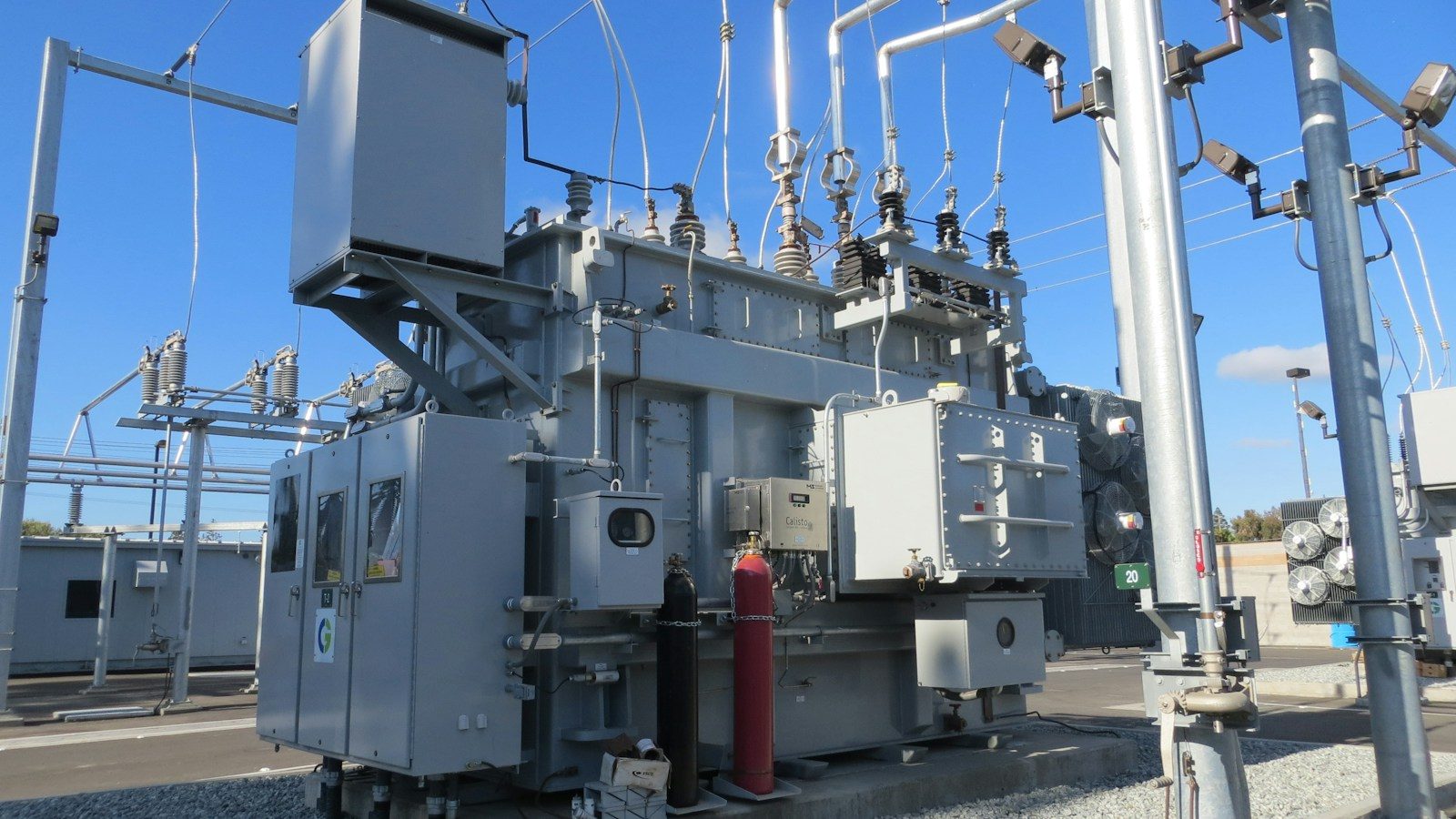
In short: Delivery voltage is usually treated as an electrical detail and settled by whoever is drawing the one-line. It is actually a commercial boundary. It sets which rate schedule you are billed under, how much capital you spend before you energise a single rack, who owns the equipment that fails, and who is standing in the yard at three in the morning when it does.
The Point of Delivery Is a Commercial Boundary
Every utility connection has a point of delivery: a defined physical location where the utility's ownership ends and the customer's begins. Everything upstream is the utility's to build, maintain, insure and restore. Everything downstream is yours. The meter usually sits at or near that point, and where it sits determines which service classification in the tariff you fall into.
This is not primarily an engineering question, because almost any load can be served at almost any of the available voltages if you are willing to pay for the equipment. It is a question about which side of a boundary you want a particular transformer to sit on, and the answer has a rate attached, a capital number attached, a schedule attached, and an operating obligation attached. Those four things do not point the same way, which is what makes it a decision rather than a calculation.
Secondary, Primary, Subtransmission, Transmission
Secondary service means the utility delivers at utilisation voltage, typically 480Y/277 volts in a North American commercial or industrial building, or 208Y/120 volts for smaller loads. The utility owns the step-down transformer. You own a switchboard and nothing upstream of it. It is the simplest arrangement and the most expensive per kilowatt, and it has a hard practical ceiling.
That ceiling is set by current, not by principle. At 480 volts three-phase and a 0.95 power factor, one megawatt is roughly 1,270 amperes. Ten megawatts would be around 12,700 amperes, which is many sets of paralleled conductors, an enormous switchboard, very large fault currents and a bus structure that is difficult to build and worse to maintain. Secondary service stops making sense somewhere in the low single-digit megawatts, and the physics pushes you up before the tariff does.
Primary service means you take delivery at distribution voltage and own the step-down transformation yourself. In North America that is commonly 12.47, 13.2, 13.8, 24.9 or 34.5 kilovolts. The current falls in proportion: at 13.8 kilovolts, the same ten megawatts is about 440 amperes, which is an ordinary medium-voltage cable and a conventional switchgear lineup. This is where the majority of mid-sized data centers sit.
Subtransmission and transmission service mean taking delivery at 69, 115, 138 or 230 kilovolts and above, and owning a substation. The arithmetic repeats one tier up: at 138 kilovolts, one hundred megawatts is again about 440 amperes. The current that sizes your copper at 100 megawatts on transmission service is roughly the same as at 10 megawatts on primary service. That symmetry is the whole reason transmission service exists as a commercial product.
Why the Higher Voltage Is Cheaper Per Kilowatt
Utility tariffs are structured by service classification, and the higher-voltage classes carry lower demand and energy charges. The discount is not goodwill. It reflects costs the utility no longer bears on your behalf.
When you take primary or transmission service, the utility stops owning the transformation that steps power down for you. It stops owning the associated losses. It stops maintaining that equipment, testing it, and replacing it at end of life. It stops carrying it in rate base for your account. The voltage discount is the utility handing back the share of its revenue requirement that corresponded to the assets you have now agreed to own yourself.
Which means the discount is not free money and should never be modeled as such. It is a transfer of cost from an operating line to a capital line, plus a transfer of risk. Whether that trade is good depends entirely on your cost of capital, your horizon at the site, and your tolerance for owning equipment with a long replacement lead time.
Losses: Small in Percent, Large in Dollars
Where the meter sits relative to your transformer decides who pays for the losses in it. If revenue metering is on the high side, the utility bills everything that passes the meter and the losses in your transformer and your feeders are yours. If metering is on the low side, tariffs typically apply a loss adjustment, a percentage uplift to metered quantities intended to account for the transformation the utility still owns.
The percentage always looks negligible and the dollars never are. A large liquid-filled power transformer loaded near its rating is better than 99 percent efficient, so take combined no-load and load losses at half a percent of throughput as an illustrative figure. On 100 megawatts of continuous load that is 500 kilowatts, running all the time. Over a year it is about 4,380 megawatt-hours, and at 40 dollars a megawatt-hour it is roughly 175,000 dollars annually, every year, for the life of the asset.
None of those inputs are a quotation; substitute your own transformer efficiency and energy price. The point is the shape of the number. A line item that reads as a rounding error in percentage terms is a six-figure annual cost at scale, and it belongs in the comparison between service options rather than in a footnote. Precise metering practice matters for the same reason it does on the tenant side of a facility, where submetering accuracy quietly decides who pays for what.
What You Have to Build, and How Long It Takes
Transmission service means building a substation. The scope is larger than most first estimates, and the long items are long.
At minimum: a graded and fenced yard with a designed ground grid; a high-side circuit breaker or circuit switcher; one or more power transformers sized with their ONAN and ONAF ratings understood rather than assumed; surge arresters; revenue metering with instrument transformers to the utility's specification; protective relaying coordinated with and approved by the utility; a communications path and remote terminal unit so the utility can see and if necessary trip your interface; oil containment sized to the largest tank; an access road that a transformer can actually arrive on; and a spares position for the items you cannot buy quickly.
That last point now dominates the schedule. Large power transformers and medium-voltage switchgear have moved from being procurement details to being the critical path on new capacity, and the lead times involved are long enough that ordering has to happen before many design decisions feel settled. A service-voltage decision taken late is not just a design change; it can be a schedule event, because it changes what you must order and when.
Set against that, the interconnection process itself is often the larger constraint. The studies and queue position that determine when a utility can energise you at all frequently outrun equipment lead times, and at transmission voltage the study scope is usually broader than at distribution. A site that could be served from an existing distribution feeder next year and from a new transmission tap in three years is not really presenting you with a voltage choice. It is presenting you with a schedule choice wearing a voltage costume.
Standby Service If You Generate Your Own
Sites with meaningful on-site generation, whether gas engines, turbines or a renewable installation, run into a tariff category that surprises people: standby, supplemental and maintenance service.
The logic from the utility's side is straightforward. If you self-supply most of the time but expect the grid to be there when your generation is not, the utility has to hold capacity available for you continuously. Holding capacity costs money whether or not it is used. So standby tariffs typically combine a reservation or contract demand charge billed every month regardless of consumption with an as-used demand charge applied on the days you actually draw, and often a maintenance service provision at better rates for outages you schedule in advance and off-peak.
The practical consequence is that the saving from behind-the-meter generation is not the full retail rate you avoid. It is the retail rate less the standby charges you now pay for the privilege of still being connected. Projects that model self-generation against the undiscounted retail rate overstate the benefit, sometimes by a wide margin, and the error is invisible until the first standby invoice arrives.
Ratchets, Power Factor and the Other Tariff Fine Print
Two tariff mechanisms catch new large loads often enough to be worth naming.
The first is the demand ratchet. Many utility tariffs set billing demand as the greater of the current month's measured peak and a defined percentage of the highest peak in the preceding eleven months. A single excursion therefore sets a floor on the bill for the following year. Commissioning is exactly when a facility is most likely to produce an excursion that never recurs in service, as load banks and burn-in testing push the site well past its steady-state draw. The same trap exists one layer down in colocation contracts between operator and tenant, and the defence is the same at both levels: establish how billing demand is calculated, and negotiate the commissioning period explicitly rather than hoping the clause is applied generously.
The second is power factor. Tariffs commonly require a power factor at or above 0.95 lagging and impose a penalty or a separate reactive demand charge below it. Modern data center loads are usually well behaved here because the power supplies correct for it, but the assumption should be measured rather than inherited, particularly on sites with large motor loads in the mechanical plant.
Redundancy: Two Feeders Is Not Two Sources
A dual feed is worth exactly as much as the independence behind it, and that independence is frequently less than the single-line diagram implies.
Two feeders from the same substation bus share that bus. Two feeders from different buses in the same substation share the transformer bank, the yard, the protection scheme and the physical site. Two feeders from genuinely different substations, fed from different transmission sources, are a real second source, and are correspondingly harder and more expensive to obtain. The question to ask a utility is not whether a second feed is available but what the two paths have in common upstream, traced back until they diverge.
The same applies inside your own fence once you own the substation. A single transformer serving the whole site is a single point of failure with a replacement lead time measured in quarters at best. Two units sized so that either can carry the site, or two half-rated units with a bus tie and a load-shed scheme, are the usual answers, and both cost real money. The redundancy topology you choose on the customer side should be decided with the same discipline applied to the rest of the power chain.
Who Shows Up at Three in the Morning
The ownership boundary is also a response boundary, and this is the consequence operators underestimate most.
On secondary service, a fault in the transformer serving you is the utility's problem, and their crews, spares and mutual-aid arrangements are behind it. Once you own the substation, their obligation ends at the point of delivery. A relay misoperation, a bushing failure, a transformer that trips and will not reclose are all yours to diagnose and clear, at whatever hour they happen.
Meeting that obligation requires either in-house personnel qualified to switch medium or high voltage and to work on protective relaying, or a contracted service provider with a guaranteed response time and the test equipment to match. It requires a spares strategy, since the parts that fail are rarely stocked locally. It requires your relay settings to be documented, coordinated and retrievable by somebody other than the engineer who commissioned them. The voltage discount in the tariff is, in part, payment for taking this on. If the capability is not resourced, the discount has been taken without the cost being incurred, and the shortfall shows up as downtime.
A Test for Choosing
Four questions settle most cases.
- How much load, and how firm is the number? Below a few megawatts the question answers itself as secondary service. Between roughly 5 and 50 megawatts, primary service is the default and the burden of proof is on anything else. Above that, transmission service becomes the normal answer rather than the ambitious one.
- How long will you be at this site, and do you own it? A substation is a twenty-year asset on land you must control. A ten-year lease with no renewal certainty is a poor match for one, almost regardless of the rate advantage.
- Which constraint is actually binding, rate or schedule? Compute the annual saving from the voltage discount and compare it against the cost of the capital and the months added to energisation. A project whose revenue depends on a date will usually find that the discount loses to the delay.
- Can you operate what you would own? If the answer requires hiring people who are not yet hired or signing a service contract that has not been priced, that cost belongs in the comparison before the decision, not after it.
The failure mode worth avoiding is not choosing wrongly. It is not choosing at all: letting the service voltage be settled by whoever drew the first one-line, and discovering the rate consequence after the interconnection agreement has been signed and the equipment ordered.
Frequently Asked Questions
What is the difference between primary and transmission service for a data center?
Both mean the customer owns the step-down transformation, but at different voltage levels and different scales. Primary service takes delivery at distribution voltage, commonly 12.47 to 34.5 kilovolts in North America, and suits loads from a few megawatts to several tens of megawatts. Transmission or subtransmission service takes delivery at 69 kilovolts and above and requires the customer to build and own a substation. The higher class carries lower demand and energy charges because the utility no longer owns the transformation or the losses associated with serving you, but it comes with substantially more capital, a longer interconnection process and a full operating obligation on the equipment.
At what load size does transmission service start to make sense?
There is no fixed threshold because it depends on the tariff, the site and the horizon, but the practical ranges are reasonably consistent. Below a few megawatts, secondary service is normal and the current involved makes anything else impractical to justify. From roughly 5 to 50 megawatts, primary service is the default. Above that, transmission service becomes the usual answer, and at 100 megawatts the current at 138 kilovolts is about 440 amperes, which is the same order as 10 megawatts at 13.8 kilovolts. The binding question is usually not the load but whether you will be at the site long enough to amortise a substation and whether the interconnection schedule at transmission voltage fits your revenue date.
Who owns the substation if a data center takes transmission service?
The customer does, from the point of delivery downstream, and the scope is larger than most first estimates. It typically includes the fenced yard and ground grid, a high-side breaker or circuit switcher, the power transformers, surge arresters, revenue metering to the utility's specification, protective relaying coordinated with and approved by the utility, a communications path and remote terminal unit so the utility can monitor and if necessary trip the interface, oil containment, an access road a transformer can arrive on, and a spares position. Ownership also means the restoration obligation: a relay misoperation or a transformer trip downstream of the point of delivery is yours to clear, at any hour.
Does a higher service voltage actually lower the total bill?
It lowers the tariff rate, which is not the same thing. The discount in the higher-voltage service class corresponds to costs the utility no longer bears for you: the transformation it no longer owns, the losses in it, and the maintenance and replacement of that equipment. You are taking those costs onto your own balance sheet and your own operations, so the correct comparison is the annual rate saving against the amortised capital, the operating and maintenance cost, the losses you now absorb, and the risk of owning equipment with a long replacement lead time. For a large long-horizon site that comparison usually favours the higher voltage. For a smaller or shorter-term one it frequently does not.
What is standby service and why am I billed for power I did not use?
Standby service is the tariff category that applies when a site self-supplies from its own generation but expects the grid to be available when that generation is not. The utility must hold capacity for you continuously, and holding capacity costs money whether or not it is drawn, so standby tariffs typically pair a reservation or contract demand charge billed every month regardless of consumption with an as-used demand charge on the days you actually take power, plus a maintenance service provision at better rates for outages scheduled in advance. The consequence for a behind-the-meter project is that the saving is the avoided retail rate less the standby charges, not the full retail rate, and models that ignore this overstate the benefit.
Power Delivered, Not Just Space Rented
Rax Data & Energy builds and operates powered capacity in the United States and the UAE, including sites served at medium and high voltage. Tell us your load and your date, and we will tell you what is actually energisable.
Contact Us See Pricing