Why Fire Suppression Matters More in 2026
Data center fires remain rare, but the consequences are severe: a single event can destroy millions of dollars in hardware, disrupt services for thousands of customers, and generate liability exposure that threatens the business. As rack densities climb past 40 kW to support GPU clusters and AI training infrastructure, the thermal load per square meter has increased dramatically, raising the stakes for fire protection design.
Modern high-density colocation environments concentrate more electrical energy in smaller spaces than ever before. Combined with lithium-ion battery backup systems and the shift toward liquid cooling, fire suppression strategy must evolve beyond the designs that served traditional 5-10 kW racks. This buyer's guide compares every major suppression technology available, with a focus on what works for today's GPU-dense facilities.
For a deeper look at suppression fundamentals and system components, see our companion article on data center fire suppression systems.
Clean-Agent Suppression: FM-200 and FK-5-1-12
Clean-agent systems discharge a gaseous chemical that extinguishes fire without leaving residue. They are the most common primary suppression technology in enterprise data centers because they protect energized electronics without causing secondary damage.
FM-200 (HFC-227ea)
FM-200 has been the industry workhorse for over two decades. It suppresses fire in under 10 seconds by interrupting the chemical chain reaction of combustion. Storage is compact (liquid under pressure), and discharge times of 10 seconds or less meet the fast-response requirements of IT environments.
The drawback is environmental: HFC-227ea carries a global warming potential (GWP) of 3,220. While no current regulations ban its use in data centers, F-gas phase-down programs in the EU and increasing ESG reporting pressure are pushing operators toward lower-GWP alternatives for new builds. Existing FM-200 systems remain maintainable and legally compliant, and refill cylinders are readily available.
FK-5-1-12 (Fluoroketone, Formerly Novec 1230)
FK-5-1-12 offers suppression performance comparable to FM-200 but with a GWP of 1, making it the preferred clean agent for operators with sustainability commitments. 3M ceased manufacturing its branded Novec 1230 product in late 2025, but the FK-5-1-12 molecule is now produced by other chemical companies. Supply chains have stabilized, and multiple OEMs offer listed systems.
Key consideration: FK-5-1-12 requires approximately 40% more agent by weight than FM-200 to achieve the same design concentration, which means larger storage cylinders. For facilities with limited mechanical room space, this trade-off matters during design.
Inert Gas Systems: IG-55 (Argonite) and IG-541
Inert gas suppression works by displacing enough oxygen to halt combustion (reducing O2 from ~21% to ~12-14%) while keeping the atmosphere breathable for personnel evacuation. These systems use naturally occurring gases with zero GWP and zero ozone depletion potential.
IG-55 (Argonite)
IG-55 blends 50% nitrogen and 50% argon. It is well-suited to large, open server halls where clean-agent concentrations would require prohibitively large volumes of chemical agent. Discharge is slower than clean agents (60 seconds typical vs. 10 seconds), which is acceptable because inert gases suppress by sustained atmosphere modification rather than rapid chemical interruption.
IG-541 (Inergen)
IG-541 adds 8% CO2 to the nitrogen/argon blend. The carbon dioxide stimulates breathing, which helps occupants evacuate safely from oxygen-reduced environments. Some AHJs (Authorities Having Jurisdiction) prefer IG-541 in continuously occupied spaces for this reason.
The principal trade-off with all inert gas systems is storage footprint. Because the agent is stored as compressed gas rather than liquefied chemical, cylinder banks are physically large. A protected zone that requires 4 FM-200 cylinders may need 20-30 inert gas cylinders. Facilities with constrained mechanical space should factor this into layout planning.
Water Mist Suppression
High-pressure water mist systems generate extremely fine droplets (typically under 100 microns) that cool the fire, displace oxygen locally, and absorb radiant heat. The water volume used is a fraction of conventional sprinkler discharge: roughly 90% less water per minute. This dramatically reduces the risk of water damage to IT equipment compared to traditional sprinklers.
Water mist has gained traction in data centers where operators want suppression that can be refilled from building water supply rather than requiring specialized chemical agent refills. It is particularly popular in European facilities and in jurisdictions moving away from fluorinated chemicals.
Limitations include higher installation cost than pre-action sprinklers and the need for specialized high-pressure pumps. Water mist also requires careful nozzle placement engineering to ensure droplet coverage reaches below raised floors and above suspended ceilings where fires may originate.
Pre-Action Sprinkler Systems
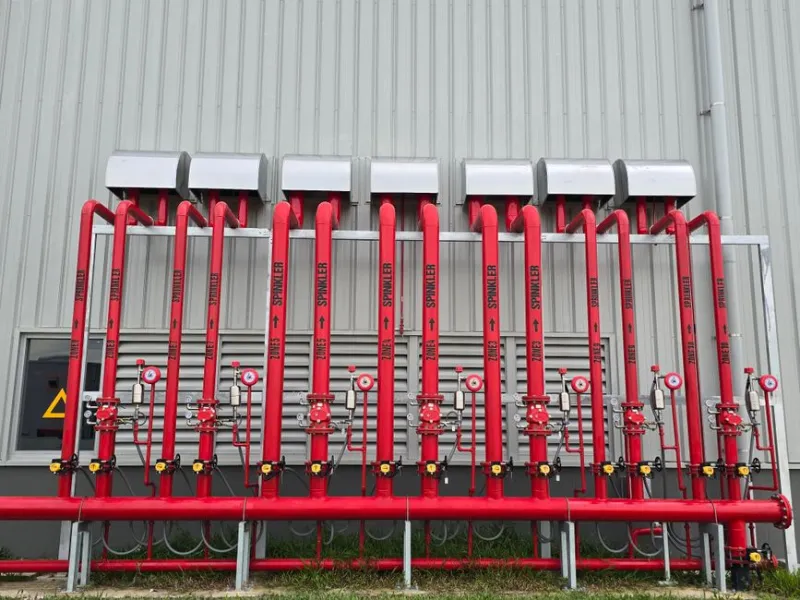
Pre-action systems add a safety layer over standard wet-pipe sprinklers: pipes remain dry until a detection system confirms a fire, at which point a valve opens to charge the pipes with water. Individual sprinkler heads must then activate thermally before water discharges. This double-interlock design virtually eliminates accidental water release from pipe leaks or broken heads.
Many data centers deploy pre-action sprinklers as a secondary suppression layer behind a clean-agent or inert gas primary system. Insurance underwriters and building codes in some jurisdictions require sprinkler coverage regardless of what gaseous system is installed. Pre-action systems satisfy this requirement without the risk profile of wet pipe.
For facilities with N+1 or 2N power redundancy, the suppression architecture should match the redundancy philosophy: independent suppression zones per power distribution path to prevent a single fire event from taking down the entire facility.
VESDA and Early Detection
VESDA (Very Early Smoke Detection Apparatus) is an aspirating smoke detection system that continuously draws air samples through a network of pipes and analyzes them with a laser-based particle counter. It can detect smoke at concentrations 1,000 times below what conventional spot-type detectors register, providing minutes of advance warning before a fire develops.
In practice, VESDA buys time. Early alert enables operators to locate the source (often an overheating cable, failing capacitor, or thermal runaway in a battery cell), shut down affected circuits, and intervene before suppression discharge is even needed. Data from major colocation operators suggests that the majority of fire events are resolved at the detection and intervention stage without ever triggering suppression.
VESDA is not a suppression system itself. It integrates with whichever suppression technology is installed and provides the detection input that initiates the discharge sequence. For AI facilities with dense GPU clusters running at high thermal loads, VESDA is considered essential rather than optional.
NFPA 75/76 Compliance and Commissioning
NFPA 75 (Standard for the Fire Protection of Information Technology Equipment) and NFPA 76 (Standard for the Fire Protection of Telecommunications Facilities) define the baseline fire protection requirements for data centers in jurisdictions that adopt these codes.
Key NFPA Requirements
- Compartmentalization: Fire-rated separation between IT spaces and non-IT spaces (1-hour minimum, 2-hour where required by AHJ)
- Detection: Smoke detection below raised floors, above suspended ceilings, and within the room volume
- Suppression: Automatic suppression required; type selected based on risk assessment and occupancy
- HVAC integration: Automatic shutdown of air handling on suppression activation to maintain agent concentration
- Emergency power off (EPO): Accessible disconnect for fire department use
Commissioning Process
Fire suppression commissioning verifies that the entire protection system works as designed before the facility goes live. This is not a visual inspection; it is a functional test of every component and integration point.
The commissioning sequence typically includes: room integrity testing (door fan test to confirm the protected space will hold agent concentration for the required 10-minute soak time), cross-zone detection logic verification (confirming that two independent detectors must alarm before discharge initiates), HVAC damper closure confirmation, EPO integration testing, abort station functionality, and notification system verification.
For facilities undergoing full data center commissioning, fire suppression testing is one component of a broader acceptance testing program that also covers power, cooling, and security systems.
What AI and High-Density Facilities Need
AI training facilities running GPU clusters at 40-70 kW per rack introduce fire protection challenges that differ from traditional data centers:
- Higher thermal load density: More concentrated heat means a fire can escalate faster. Detection speed matters more, making VESDA non-negotiable.
- Liquid cooling infrastructure: Direct-to-chip cooling introduces dielectric coolant, water, or two-phase fluids into the server environment. Suppression system design must account for the presence of these fluids and their interaction with fire and suppression agents.
- Lithium-ion battery risk: UPS systems and facility infrastructure increasingly use lithium-ion batteries, which can undergo thermal runaway. Traditional gaseous suppression cannot extinguish a lithium-ion cell fire; containment, cooling, and isolation strategies are required alongside conventional suppression.
- High-value hardware: A single 8-GPU node may represent over $200,000 in hardware value. Clean-agent suppression that avoids residue and secondary damage is strongly preferred over any water-based system as the primary defense.
- Continuous uptime requirements: AI training runs can span weeks. Suppression system maintenance windows must be planned around workload scheduling, and redundant zoning ensures that one zone can be serviced while adjacent zones remain protected.
The recommended approach for high-density AI colocation combines VESDA aspirating detection, zoned clean-agent primary suppression (FK-5-1-12 or FM-200), and double-interlock pre-action sprinklers as a code-compliant secondary layer. For operators evaluating facility readiness, our UAE fire protection compliance guide covers regional requirements in detail.
System Comparison at a Glance
| System Type | Suppression Speed | IT Equipment Risk | GWP | Storage Footprint | Best For |
|---|---|---|---|---|---|
| FM-200 | Under 10 sec | None (residue-free) | 3,220 | Compact | Enclosed server rooms, retrofit |
| FK-5-1-12 | Under 10 sec | None (residue-free) | 1 | Moderate | New builds with ESG goals |
| IG-55 (Argonite) | 60 sec | None | 0 | Large | Large halls, occupied spaces |
| IG-541 (Inergen) | 60 sec | None | 0 | Large | Occupied spaces (CO2 breathing aid) |
| Water Mist | 30-60 sec | Minimal (fine droplet) | 0 | Moderate + pumps | EU facilities, chemical-free zones |
| Pre-Action Sprinkler | 60-120 sec | Moderate (water) | 0 | Standard | Secondary/code-compliance layer |
Frequently Asked Questions
What is the best fire suppression system for a data center?
The best system depends on the facility. Clean-agent systems like FK-5-1-12 or FM-200 provide fast, residue-free suppression ideal for enclosed server rooms. Inert gas systems such as IG-55 (Argonite) are preferred for large, continuously occupied spaces. High-density AI facilities increasingly combine VESDA aspirating detection with zoned clean-agent or water mist suppression for layered protection.
What is data center fire suppression commissioning?
Fire suppression commissioning is the formal process of verifying that every component of the suppression system functions correctly as an integrated system. It includes room integrity testing, discharge concentration verification, cross-zoning logic checks, and integration testing with HVAC shutdown and EPO sequences. NFPA 75 and NFPA 76 require commissioning before occupancy.
Is FM-200 still used in data centers?
Yes. FM-200 (HFC-227ea) remains widely deployed and available. Its high GWP (3,220) has led many operators to prefer FK-5-1-12 for new installations, but existing FM-200 systems can be maintained and refilled without restriction.
Does Novec 1230 still exist after 3M discontinued it?
3M ceased manufacturing Novec 1230 (FK-5-1-12) in late 2025, but the molecule is now produced by other chemical manufacturers. Systems designed for FK-5-1-12 remain viable, and refill supply is available from alternative producers.