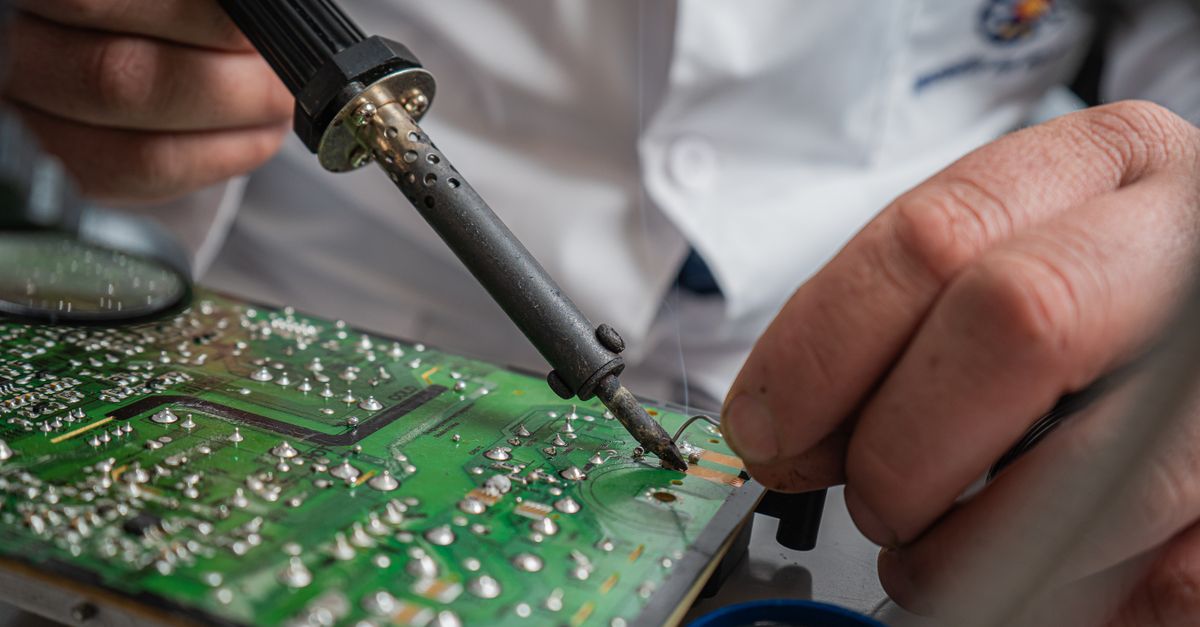
ASIC miner hardware failures are inevitable in large-scale mining operations. Hash boards degrade from thermal stress, power supplies fail from voltage fluctuations, and control boards corrupt from firmware bugs. The difference between profitable mining and losses often comes down to how quickly you can diagnose issues and make smart repair-versus-replace decisions.
This guide covers the complete lifecycle of ASIC repair from failure diagnosis through parts sourcing to cost-benefit analysis. Whether you run a small home operation or a multi-megawatt mining facility, understanding hardware repair economics directly impacts your bottom line.
Common ASIC Hardware Failures and Root Causes
Most ASIC failures fall into five categories, each with distinct symptoms and repair approaches.
Hash Board Chip Failures
Hash board failures account for 30-40% of all ASIC issues. Symptoms include zero hashrate on one or more boards, error codes in kernel logs, or gradual hashrate degradation over days or weeks. Root causes include:
- Thermal stress: Repeated heat cycles cause solder joints to crack and chips to separate from PCB traces. This is the most common failure mode in air-cooled facilities with poor temperature control.
- Electromigration: Atoms migrate through conductors under high current density, eventually causing open circuits. Particularly common in units running at overclocked power levels beyond spec.
- Manufacturing defects: Some batches ship with marginal chips that fail within 6-12 months under normal operating conditions.
Hash board diagnosis requires checking voltage rails with a multimeter, thermal imaging to identify hot-running chips, and correlation with kernel error logs that show specific chip positions reporting errors.
Power Supply Unit (PSU) Failures
PSU failures represent 25-30% of issues and often present as complete unit shutdown or unstable operation with frequent reboots. Common failure modes:
- Capacitor degradation: Electrolytic capacitors dry out over time, leading to voltage ripple that can damage hash boards.
- Fan failure: PSU cooling fans wear out, causing thermal shutdown or component damage.
- Voltage regulation failure: The DC-DC converter modules fail, producing over-voltage or under-voltage conditions.
PSU diagnosis involves checking output voltage under load, inspecting for bulging capacitors, and measuring voltage ripple with an oscilloscope. Many facilities keep spare PSUs on hand to swap-test suspected failures.
Control Board Issues
Control board failures (15-20% of issues) manifest as network connectivity problems, inability to configure the miner, or complete unresponsiveness. Common causes include:
- SD card corruption: The embedded Linux system runs from an SD card or eMMC module that can fail from write cycles or power loss during writes.
- Network chip failures: Ethernet controllers fail from ESD events or voltage spikes.
- Firmware corruption: Interrupted firmware updates or malware can brick the control board.
Many control board issues can be resolved by reflashing firmware or replacing the SD card. Hardware failures typically require full control board replacement.
Cooling Fan Degradation
Fan failures (10-15% of issues) often go unnoticed until thermal shutdown occurs. Bearing wear, debris accumulation, and power connector corrosion are the primary causes. Modern miners monitor fan RPM via tachometer outputs, making early detection easier.
Replacement fans should match the original CFM rating and static pressure specifications. Using undersized fans leads to inadequate cooling and accelerated hash board degradation.
Connector and Cable Issues
Connector corrosion and cable failures (5-10% of issues) are particularly common in facilities with high humidity. PCI-e power connectors, ribbon cables between boards, and temperature sensor cables all degrade over time. Visual inspection often reveals green corrosion on pins or burn marks from arcing.
Diagnostic Procedures and Tools
Systematic diagnosis reduces repair time and prevents replacing good components. A structured approach includes:
Initial Triage
- Visual inspection: Check for physical damage, burnt components, bulging capacitors, and connector corrosion.
- Power-on test: Verify the unit powers up, fans spin, and LEDs indicate normal operation.
- Network connectivity: Confirm the control board gets an IP address and responds to web interface access.
- Kernel log review: Examine error messages in the system log for chip errors, temperature alerts, or communication failures.
Advanced Diagnostics
When initial triage doesn't isolate the problem, advanced tools provide deeper insight:
- Thermal imaging: FLIR cameras identify overheating chips, failed thermal pads, or hotspots indicating electrical shorts.
- Multimeter testing: Measure voltage rails on hash boards (typically 12V input, 0.9V or 1.8V chip supply), PSU outputs, and control board power.
- Oscilloscope analysis: Check for voltage ripple, switching noise, and clock signal integrity on hash boards.
- Hashrate test fixtures: Specialized test equipment verifies hash board function outside the complete miner assembly.
Pro Tip: Build a test bench with a known-good PSU and control board. Swap suspected components one at a time to isolate failures. This prevents diagnosing multiple simultaneous failures incorrectly.
Parts Sourcing and Inventory Management
Rapid repair requires maintaining critical spare parts inventory. For facilities with 100+ miners, recommended stock levels include:
| Component | Recommended Inventory | Lead Time |
|---|---|---|
| Hash board chips (by model) | 100-200 chips per 500 units | 3-6 weeks from China |
| Complete hash boards | 2-5% of fleet size | 1-2 weeks |
| Power supplies | 5-8% of fleet size | 1-3 weeks |
| Control boards | 3-5% of fleet size | 1-2 weeks |
| Cooling fans | 10-15% of total fans | 1-2 weeks |
Parts sourcing options include manufacturer direct (highest cost, genuine parts), authorized distributors (moderate cost, warranty support), and third-party aftermarket suppliers (lowest cost, variable quality). For high-value units like Antminer S21 Hydro or WhatsMiner M63S, OEM parts justify the premium.
Cryptocurrency mining hardware supply chains experience volatility based on Bitcoin price. During bull markets, parts become scarce and expensive. Strategic buyers stock critical components during bear market price troughs.
Repair vs Replace Decision Framework
Not every failed miner justifies repair investment. Use this framework to make economically sound decisions:
Factors Favoring Repair
- Unit efficiency is competitive (under 25 J/TH for SHA-256 miners as of 2026)
- Repair cost is less than 30% of replacement cost for equivalent hashrate
- Parts are in stock with less than 5 days downtime
- The unit is less than 24 months old and under warranty coverage
- Current Bitcoin network difficulty supports profitable operation of this model
Factors Favoring Replacement
- Unit is 3+ generations old with efficiency above 35 J/TH
- Multiple hash boards have failed, indicating systemic stress or poor thermal management
- Repair cost exceeds 50% of a new current-generation unit
- Parts availability requires 2+ weeks lead time
- Downtime cost (lost revenue) during repair exceeds unit salvage value
Example Calculation
Consider an Antminer S19j Pro (104 TH/s, 29.5 J/TH) with one failed hash board. New S21 Pro units deliver 234 TH/s at 17.5 J/TH for $5,400. Hash board replacement costs $350 including labor.
At $0.06/kWh electricity and current network difficulty, the S19j Pro generates approximately $4.80/day in revenue. A new S21 Pro generates $10.80/day. The efficiency delta is $6/day favoring the S21 Pro, or $2,190/year.
Repair payback period: $350 / $4.80 = 73 days. But the opportunity cost of not upgrading is $2,190/year. If you have capital available, replacing with S21 Pro delivers better returns. If capital is constrained or the S19j Pro is already paid off, repair extends useful life.
Preventive Maintenance Reduces Failures
Proactive maintenance extends hardware lifespan and reduces unexpected downtime. Recommended schedules:
Monthly Tasks
- Visual inspection for dust accumulation and airflow obstructions
- Fan RPM monitoring via miner web interface or monitoring systems
- Kernel log review for early warning signs (temperature alerts, occasional chip errors)
- Spot check hashrate consistency across the fleet
Quarterly Tasks
- Compressed air cleaning of heat sinks and fan intakes (power off units first)
- Thermal paste reapplication on high-hour units (5,000+ operating hours)
- Connector inspection and cleaning with contact cleaner
- Firmware updates if security patches or performance improvements are available
Annual Tasks
- Complete teardown and cleaning of hash boards
- Thermal pad replacement on older units
- Preventive fan replacement on units approaching 12,000 operating hours
- Voltage regulation calibration and PSU output verification
Facilities using fleet monitoring systems can automate alerting for temperature anomalies, hashrate drops, and fan failures, catching issues before they cause catastrophic damage.
In-House Repair vs Third-Party Services
Facilities must decide between building in-house repair capability and outsourcing to specialized repair shops.
In-House Repair Economics
Building in-house capability requires initial tooling investment ($5,000-8,000 for basic setup, $15,000-25,000 for comprehensive micro-soldering station), training technicians, and maintaining parts inventory. Break-even typically occurs at 500+ unit fleet size when monthly repair volume justifies dedicated labor.
Advantages include faster turnaround time (no shipping delays), lower per-unit repair costs for bulk repairs, and intellectual property retention (understanding your hardware deeply helps optimize operations).
Third-Party Repair Services
Specialized ASIC repair shops offer lower capital requirements and access to expert technicians with experience across multiple miner models. Typical pricing ranges from $60-150 for hash board repair (depending on complexity), $80-200 for control board replacement, and $100-300 for PSU replacement.
Disadvantages include shipping logistics, longer turnaround time (typically 1-2 weeks round-trip), and variable quality between service providers. Always verify warranty terms and ask for references before committing to a repair shop.
Warranty Considerations and Manufacturer Support
Manufacturer warranties typically cover 180 days to 12 months from purchase date. Understanding warranty terms prevents costly mistakes:
- Warranty void conditions: Opening the miner chassis, overclocking beyond recommended settings, operating outside specified temperature ranges, and water damage all void most warranties.
- RMA process: Most manufacturers require advance RMA approval before accepting returns. Expect 2-4 week turnaround times for warranty repairs.
- Proof of purchase: Always retain original purchase receipts and serial number documentation. Some manufacturers refuse warranty service without proof of authorized purchase.
- Extended warranty options: Some hosting providers and equipment dealers offer extended warranty coverage for 12-24 additional months. Costs typically range from 5-10% of unit value.
For units still under warranty, always pursue manufacturer RMA before attempting DIY repair. Opening the chassis voids warranty coverage even if you don't modify anything.
Future-Proofing Your Repair Strategy
As ASIC miners continue advancing, repair strategies must evolve:
Hydro-cooled miners: Units like the Antminer S21 Hydro introduce liquid cooling complexity. Repair requires understanding coolant chemistry, leak detection, and specialized tools for working with sealed cooling systems.
3nm and smaller process nodes: Next-generation chips using advanced process nodes are more sensitive to voltage variations and thermal stress. Repair tolerances tighten, requiring better diagnostic tools and more skilled technicians.
Integrated firmware monitoring: Modern miners report detailed telemetry including per-chip voltage, temperature, and error rates. Facilities that leverage this data can predict failures before they occur, reducing emergency repair situations.
For facilities operating large fleets, consider establishing relationships with professional ASIC repair specialists who can provide training, tooling recommendations, and bulk parts sourcing. Companies like Rax Data & Energy offer comprehensive hosting services including on-site repair capabilities, eliminating the need for miners to manage repairs independently.
Professional ASIC Hosting with Full Maintenance
Eliminate repair headaches with Rax's managed hosting. Our facilities include on-site repair teams, spare parts inventory, and 24/7 monitoring. Focus on mining while we handle hardware maintenance.
Get Hosting Quote