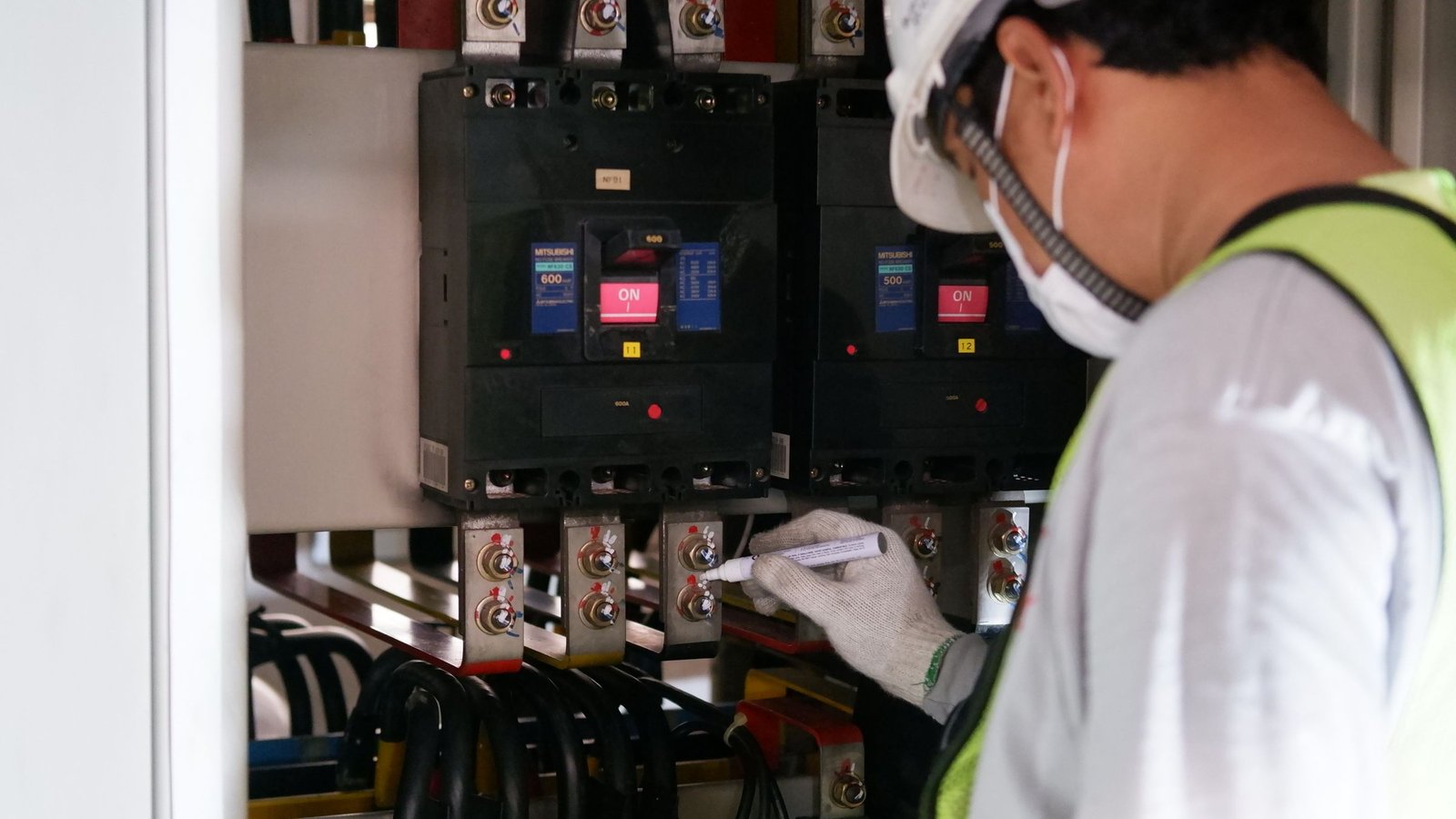
In short: A data center drawing tens of megawatts cannot be energized the way a 500 kW facility is — closing every breaker at once. Every transformer and every GPU power supply draws a brief surge of inrush current when it is switched on, and summed across a multi-megawatt site that surge can trip protective relays that were never meant to see it, or sag voltage on the utility feeder enough for neighboring customers to notice. Staggered energization — bringing the load online in defined blocks rather than one step — is the standard answer, and it needs to be planned before commissioning day, not improvised on it.
Why Simultaneous Energization Doesn't Scale
A single server rack, or even a single row, can be powered on without anyone downstream noticing. The current it draws at the instant of switch-on is a rounding error against the capacity of the feeder serving it. A multi-megawatt AI data center is a different proposition. Its load is not one rack; it is dozens of transformers, hundreds of power distribution units, and thousands of GPU server power supplies, all capable of being switched on in the same few seconds if nobody has planned otherwise. The question an energization plan answers is not whether the site can eventually carry its full contracted load — it can, that is what it was designed for — but whether the transition from off to on can be made without tripping something that was sized for steady-state operation, not for the moment of start-up.
What Cold-Load Pickup Actually Means
Utility engineers have a name for this problem that predates data centers by decades: cold-load pickup. When a distribution feeder that has been out of service is re-energized, every load on it tries to draw power at once, and the diversity that normally exists between hundreds of individual customers — some devices running, most idle — temporarily disappears. Thermostats that have all drifted past their setpoint during the outage call for heating or cooling simultaneously. Motors that would normally start at staggered times all attempt to start together. The result is a demand spike well above the feeder's normal peak, immediately followed by a decay back toward normal as the loads settle into their usual diversity pattern.
A new multi-megawatt data center recreates the same dynamic on a smaller, more concentrated physical footprint, and for a different underlying reason. The loads are not diverse to begin with — a commissioning team bringing a facility online for the first time has every practical incentive to switch things on in large blocks to save time, which is exactly the condition cold-load pickup describes. The fix the utility industry has used on distribution feeders for decades — restoring load in stages rather than all at once — is the same fix that applies inside the fence.
Where the Inrush Comes From: Transformers and GPU Power Supplies
Two separate physical mechanisms stack on top of the cold-load pickup effect, and both scale with the size of a modern AI buildout.
The first is magnetizing inrush in the power transformers themselves. A transformer's core is designed to operate within a defined magnetic flux range once energized, but the instant it is switched on, if that switching happens near a voltage zero-crossing, the flux can transiently exceed its steady-state value by a large margin before settling. The primary current required to drive that transient flux can reach several times the transformer's rated full-load current for the first several cycles, decaying over a period that typically runs from under a second to several seconds depending on the transformer's size and the residual flux left in its core from the last time it was de-energized. A single transformer's inrush is a well-understood, bounded event. A site's worth of transformer banks all closing within the same window is not a single event anymore; it is the sum of several of them, on the same feeder, at the same moment.
The second mechanism is specific to the IT load itself. Modern GPU server power supplies use active power-factor-correction front ends, and the bulk capacitors in that front end present a very low impedance to the supply the instant AC power is applied, before the capacitors have charged. A single server's inrush is milliseconds and is absorbed without incident by the branch circuit feeding it. A data hall's worth of servers energized in the same instant — the scenario a commissioning team creates when every rack PDU is switched on together to finish a milestone on schedule — reproduces the same cold-load pickup pattern one layer downstream of the utility feeder, inside the building's own distribution system.
When Inrush Looks Like a Fault: Protective Relay Coordination
The practical consequence of inrush current is not that it damages equipment on its own — transformers and switchgear are designed to tolerate it as a normal part of energization. The practical consequence is that protective relays, whose entire job is to distinguish normal operation from a fault and trip a breaker when they see one, can misread a large inrush transient as the fault current they exist to detect. A differential relay protecting a transformer compares current in and current out; magnetizing inrush is, momentarily, current that goes in without an equivalent amount coming out the other side, which is also what a winding fault looks like from the relay's perspective. An overcurrent relay set with too little time delay can see the magnitude of an inrush transient and trip before it has had a chance to decay.
The standard answer on the relay side is harmonic restraint: magnetizing inrush is rich in second-harmonic content in a way that genuine fault current is not, and a differential relay configured to block or restrain tripping when it detects a significant second-harmonic component is specifically designed to tell the two apart. Overcurrent relays, separately, are typically given a short time-delay setting precisely so a transient that decays within a few cycles does not trigger a trip meant for a sustained fault. Neither of these settings is exotic — they are standard relay functions on modern protective devices. What a commissioning plan needs to confirm, specifically for the site's own transformer sizes and relay models, is that those settings have actually been applied and coordinated, not left at a factory default that assumes a much smaller load being switched in.
The Utility's Side: Voltage Dips and Block-Loading Notification
Inrush current does not stay inside the fence. The voltage drop it produces propagates back through the service transformer and onto the feeder serving the site, and depending on the size of the step and the stiffness of the feeder at that point, that drop can be large enough for neighboring customers on the same feeder to notice as a momentary dim of their lights — the phenomenon utilities call flicker. This is precisely the concern behind the block-loading or step-loading notification requirements that a number of utilities attach to large new interconnections: a customer bringing on a defined block of load above a stated size, whether at initial energization or at any later expansion, is asked to notify the utility in advance of the timing and magnitude of the step, so system operators can watch for the voltage impact and, where it is a concern, coordinate the timing of the switching operation itself.
This sits downstream of the interconnection study and the large-load tariff conversation, which decide whether and under what commercial terms the utility will serve the load at all. Block-loading notification is a narrower, more operational requirement: it governs how the already-approved load is actually switched on, step by step, not whether it can be connected in the first place. A project that has cleared interconnection and signed its tariff can still create a real problem for the utility's system operators if the commissioning team energizes the full contracted capacity in one step without ever raising the question.
A Staggered Commissioning Sequence
The practice that addresses both the relay-coordination risk and the utility voltage-flicker concern is the same practice applied twice, at two different scales: bring the load on in defined blocks, verify the system's behavior at each step, and only then proceed to the next block.
- Energize one transformer bank at a time, not the full substation in a single switching operation, with a deliberate pause between banks to let inrush decay and to confirm no protective device has operated unexpectedly.
- Stagger the closing instant where the switchgear allows it, rather than closing multiple breakers simultaneously on a single command, since even a few hundred milliseconds of separation prevents two transformers' inrush transients from summing on the same cycle.
- Hold at each step until the criteria are met: no relay operation, voltage recovery within the expected band, and no unexplained alarm, before authorizing the next block. A commissioning schedule that treats this as a gate rather than a formality is the difference between catching a misconfigured relay setting during a planned test and discovering it during a real fault six months later.
- Notify the utility of the block-loading schedule in advance where the interconnection agreement or local practice calls for it, and treat that notification as a scheduling input, not paperwork to complete after the fact.
- Sequence IT load onto an energized bus in blocks as well, rather than switching every rack PDU on the bus the moment power is available, for the reasons covered below.
The Same Problem Inside the Data Hall: Cluster Power-On
Cold-load pickup is usually framed as a utility-interconnection problem, but the identical dynamic recurs one layer downstream, inside the building, whenever a large block of GPU servers is powered on together. The scenario is common: a planned maintenance window or a utility outage de-energizes a data hall's PDUs, and when power is restored, every server in the hall attempts to draw inrush current and complete its boot sequence at the same moment. The branch circuits and busway taps feeding that hall were sized for the steady-state draw of a fully populated, fully diverse rack row, not for the simultaneous power-on transient of every server in the row.
The same staggering principle applies, scaled down. Rack PDUs can be sequenced to energize in groups rather than all together, either through a facility power-sequencing controller or through a documented manual procedure for smaller sites. Server BIOS and baseboard management controllers on many platforms support a configurable power-on delay specifically to spread this load across a window of seconds rather than concentrating it in milliseconds. A cluster that is restarted this way after an outage recovers more slowly than one that is switched on all at once — and that slower, deliberate recovery is the entire point, because the alternative is risking a second, self-inflicted trip on top of the outage that already happened.
A Checklist for the Energization Plan
- Confirm the transformer and relay vendor's published inrush magnitude and decay time for the specific units being installed, rather than assuming a generic rule of thumb applies.
- Verify harmonic-restraint settings on transformer differential relays and time-delay settings on overcurrent relays have been coordinated for the site's actual inrush profile, not left at factory default.
- Confirm with the utility whether a block-loading or step-loading notification threshold applies to the interconnection, and build that notice period into the commissioning schedule.
- Write the energization sequence as a formal procedure with hold points and pass/fail criteria at each block, not as an informal understanding among the commissioning team.
- Extend the same staggering principle to IT load: define a rack or row energization order and, where the platform supports it, a server power-on delay setting, before the first full-hall restart is attempted.
- Keep records of relay operations and voltage readings at each energization step, since the same sequence will be repeated at every future expansion phase and after every planned or unplanned outage.
Frequently Asked Questions
What is cold-load pickup?
Cold-load pickup is the demand spike that occurs when a de-energized electrical system is restored and every connected load tries to draw power at the same time, because the normal diversity between loads — some running, most idle — has temporarily disappeared. The term originated in utility distribution engineering but applies equally inside a data center whenever a large block of transformers or servers is energized together.
Why does a large transformer draw more inrush current than a small one?
Inrush current scales with the transformer's rated capacity and with how close to a voltage zero-crossing the switching operation occurs. A large transformer serving a multi-megawatt load has a correspondingly large rated current, so its inrush transient, typically several times rated current for the first few cycles, is proportionally larger in absolute terms than the inrush from a small distribution transformer, even though both follow the same underlying physics.
How does a protective relay tell inrush current apart from a real fault?
The most common method is harmonic restraint: magnetizing inrush current contains a large second-harmonic component that genuine fault current does not, so a differential relay configured to detect that harmonic content can block or restrain a trip during inrush while still tripping promptly for an actual fault. Overcurrent relays are separately given a short time delay so a transient that decays within a few cycles does not trigger a trip meant for a sustained condition.
Does staggered energization slow down commissioning?
It adds time to the single day a site is first energized, since blocks are brought on in sequence with hold points between them rather than all at once. It does not meaningfully slow the overall commissioning program, and the time spent confirming each block's behavior before proceeding is the mechanism that catches a misconfigured relay setting or an undersized breaker during a planned, low-consequence test rather than during an unplanned trip later.
Is block-loading notification to the utility always required?
It depends on the specific utility and interconnection agreement; it is common at larger facilities but is not a universal requirement. The project's interconnection agreement, large-load tariff, or direct conversation with the utility's system operations group is the authoritative source for whether a notification threshold applies to a given site, and should be confirmed well before the commissioning schedule is finalized rather than assumed either way.
Power Infrastructure That's Already Been Through This
Rax Data & Energy operates AI and GPU colocation capacity that has already been through commissioning and energization. Tell us your buildout timeline, and we'll walk through what a new block of capacity actually takes to bring online.
Contact Us AI Compute