Dark Fiber vs Lit Services for Data Centers: Connectivity Guide [2026]
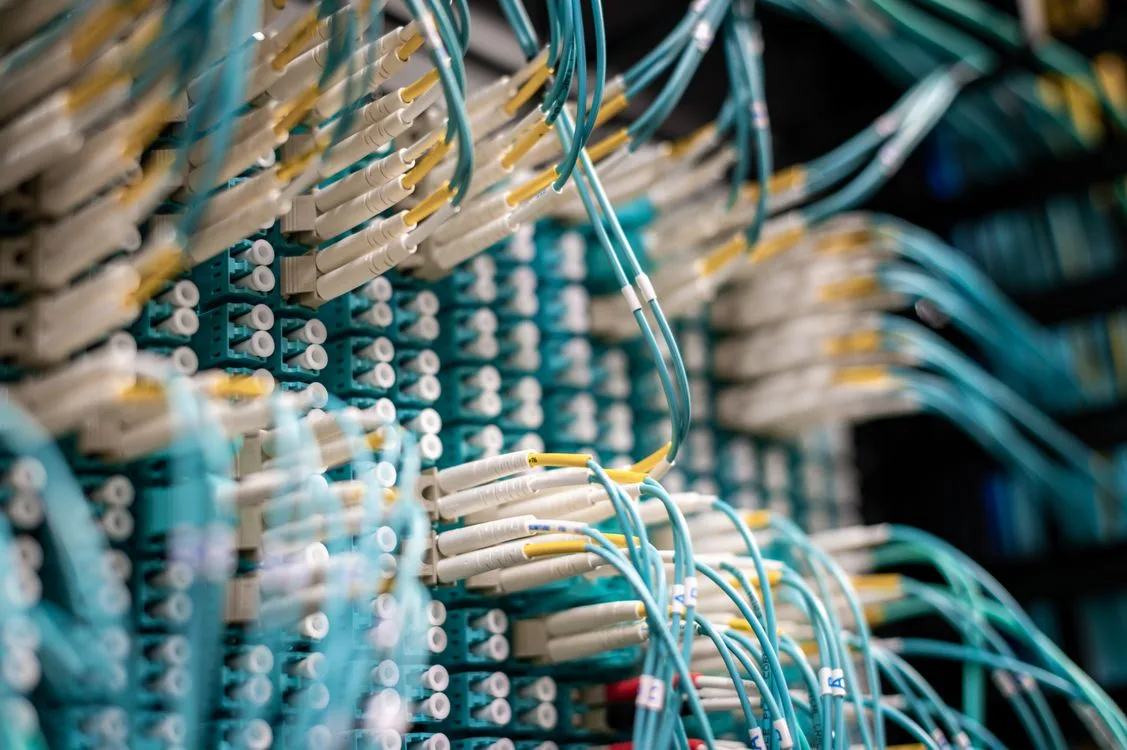
Data center connectivity decisions between dark fiber and lit services fundamentally shape cost structures, operational control, and scalability for years to come. Dark fiber delivers raw infrastructure and maximum flexibility at the expense of technical complexity, while lit services provide managed connectivity with predictable pricing but limited customization.
Understanding the economic and technical trade-offs determines which approach aligns with your capacity requirements, growth trajectory, and in-house expertise.
Dark Fiber: Definition and Architecture
Dark fiber refers to unused or unlit fiber optic cable infrastructure that organizations lease from carriers or build as dedicated point-to-point links. The provider delivers only the physical fiber strand between locations—no active transmission equipment, no managed services, no bandwidth guarantees.
Customers install and operate their own optical transmission systems, including:
- Optical transceivers — SFP/QSFP modules that convert electrical signals to light pulses
- DWDM systems — Dense wavelength division multiplexing equipment that transmits multiple wavelengths over a single fiber pair
- Optical amplifiers — EDFAs (erbium-doped fiber amplifiers) that boost signal strength over long distances
- Network switches and routers — Layer 2/3 devices that terminate the optical connections
This model shifts capital expenditure to the customer (optical equipment) while converting recurring bandwidth costs into a fixed fiber lease. Monthly fiber lease rates typically range from $500 to $2,000 per fiber pair per route kilometer, independent of utilization or capacity.
Lit Services: Managed Connectivity Models
Lit services deliver fully provisioned connectivity where the carrier installs, maintains, and monitors all transmission equipment. Customers purchase bandwidth as a service through several product models:
Dedicated Wavelength Services
Carriers provision exclusive optical wavelengths (lambdas) on their DWDM infrastructure, delivering 10 Gbps, 100 Gbps, or 400 Gbps of dedicated capacity between data center locations. Customers control the full wavelength but share the underlying fiber infrastructure with other subscribers on different wavelengths.
Wavelength services cost $1,500 to $8,000 per month per 10 Gbps depending on route distance and market competitiveness. A 100 Gbps wavelength between Dubai and Abu Dhabi runs $12,000 to $18,000 per month on competitive routes.
Ethernet Private Line (EPL)
Layer 2 Ethernet services provide point-to-point connectivity with guaranteed bandwidth and low latency. EPL circuits include SLAs covering uptime (typically 99.9 to 99.99 percent), round-trip latency, packet loss, and mean time to repair.
EPL pricing reflects the managed service model, with 10 GigE circuits costing $2,500 to $6,000 per month and 100 GigE ranging from $15,000 to $35,000 monthly depending on distance and provider.
IP Transit and Internet Connectivity
Carriers deliver internet access via lit circuits connecting data centers to the provider's network backbone. IP transit includes routing, DDoS mitigation, and global peering, with pricing based on committed data rate (CDR) or burstable 95th percentile billing.
Enterprise IP transit costs $0.50 to $3.00 per Mbps per month in major UAE markets, with volume discounts reducing costs below $0.30 per Mbps for multi-gigabit commits.
Cost Comparison: Break-Even Analysis
Dark Fiber Economics
Dark fiber requires significant upfront capital investment but delivers lower total cost of ownership at high bandwidth utilization. Consider a 20-kilometer fiber route between two data centers:
| Component | Cost |
|---|---|
| Fiber lease (2 pairs, 5-year term) | $1,200/month × 60 months = $72,000 |
| 100G coherent optics (2 × $15,000) | $30,000 |
| DWDM mux/demux equipment | $18,000 |
| Installation and commissioning | $8,000 |
| 5-Year Total Cost | $128,000 |
| Effective monthly cost (100 Gbps) | $2,133 |
The same 100 Gbps lit wavelength service might cost $15,000 per month ($900,000 over 5 years), making dark fiber 85 percent less expensive at sustained high utilization.
Lit Services Economics
Lit services eliminate capital expenditure and technical overhead but accumulate higher operational costs over time. They excel for:
- Variable bandwidth needs that change seasonally or annually
- Multi-site connectivity where deploying dark fiber to every location is impractical
- Organizations lacking optical networking expertise
- Short-term projects or pilot deployments with uncertain growth
- Circuits under 10 Gbps where dark fiber equipment costs dominate savings
Break-Even Thresholds
Dark fiber achieves cost parity with lit wavelength services at approximately 20 to 40 Gbps of sustained bandwidth for metro routes under 50 kilometers. At 100 Gbps and above, dark fiber delivers 50 to 70 percent cost savings over 5 years. The exact break-even point depends on fiber lease rates, equipment pricing, and competitive lit service offerings.
For enterprise customers evaluating dark fiber, calculate total 5-year cost including fiber lease, optical equipment, maintenance, and technical labor, then compare to equivalent lit service quotes. Most find dark fiber economically compelling above 40 to 50 Gbps.
Technical Control and Flexibility
Dark Fiber Advantages
Dark fiber provides complete control over the transmission layer, enabling:
- Protocol flexibility — Run any protocol including Fibre Channel, proprietary optical formats, or next-generation coherent optics without carrier approval
- Encryption control — Deploy inline optical encryption (MACsec, OTN encryption) with customer-managed key infrastructure
- Latency optimization — Select precise fiber routes and eliminate protocol overhead from carrier DWDM systems, reducing round-trip time by 5 to 15 percent
- Capacity upgrades — Scale from 100 Gbps to 400 Gbps or 800 Gbps by replacing transceivers only, no renegotiation or circuit reprovisioning
- Network visibility — Direct access to optical power levels, signal quality metrics, and performance telemetry
Organizations with specialized requirements—ultra-low latency trading systems, quantum key distribution, or classified government networks—often mandate dark fiber for security and performance control.
Lit Services Advantages
Lit services trade control for operational simplicity:
- Zero capital investment — No optical equipment to purchase, deploy, or maintain
- SLA guarantees — Contractual uptime commitments with financial penalties for provider failures
- 24/7 carrier NOC support — Network operations center monitoring and troubleshooting included
- Geographic reach — Instant connectivity to hundreds of carrier PoPs and data centers globally
- Rapid provisioning — New circuits activated in 30 to 90 days versus 6+ months for dark fiber builds
Capacity Scaling and Technology Evolution
Dark Fiber Scalability
Dark fiber capacity scales by upgrading endpoint equipment only, with no changes to the fiber infrastructure. A fiber pair initially lit at 10 Gbps can later support 100 Gbps, 400 Gbps, or 800 Gbps coherent optics by replacing transceivers—typically a 2 to 4 hour maintenance window with zero fiber construction.
Modern single-mode fiber installed in the 1990s still supports cutting-edge 800G coherent transmission over metro distances. This longevity makes dark fiber a future-proof investment, as capacity increases require only software-defined optics upgrades costing $20,000 to $40,000 per endpoint versus multi-year carrier circuit renegotiations.
Lit Services Scaling
Capacity increases with lit services require new circuit orders and incremental recurring costs. Upgrading from 10 Gbps to 100 Gbps might involve:
- New circuit contract negotiation (30 to 90 days)
- Carrier equipment installation and testing (60 to 120 days)
- Monthly costs increasing by 8× to 12× for 10× bandwidth
- Potential early termination fees on the original 10G circuit
However, lit services enable granular bandwidth increments—upgrading from 1 Gbps to 2 Gbps or 10 Gbps to 20 Gbps—that dark fiber cannot match without deploying entirely new transceivers.
Latency Considerations
Dark fiber typically delivers 5 to 15 percent lower latency than lit wavelength services over identical physical routes due to reduced protocol overhead. Carrier DWDM systems introduce optical-electrical-optical (OEO) conversions at intermediate amplifier sites, adding 10 to 50 microseconds per conversion.
For latency-sensitive applications like high-frequency trading, real-time AI inference, or distributed database replication, dark fiber with direct optical transmission eliminates these delays. A 20-kilometer dark fiber link might achieve 100 microseconds round-trip latency compared to 125 to 150 microseconds for an equivalent lit wavelength.
For most enterprise applications, this difference is negligible. But for financial services data centers or AI training clusters requiring sub-millisecond synchronization, dark fiber's latency advantage justifies the operational complexity.
Availability and Redundancy
Dark Fiber Resilience
Dark fiber resilience requires customer-provisioned diversity. Organizations deploy:
- Diverse fiber routes — Lease separate fiber paths through physically distinct conduits to avoid single points of failure
- Active-active configurations — Run traffic across both routes simultaneously with load balancing
- Automatic failover — Sub-second switchover when optical loss-of-signal is detected
Diverse dark fiber pairs add 50 to 100 percent to fiber lease costs but deliver carrier-grade resilience under customer control.
Lit Services SLAs
Lit services include uptime guarantees typically ranging from 99.9 percent (8.76 hours downtime annually) to 99.99 percent (52.6 minutes annually). Carriers provide route diversity as a standard feature for wavelength services, with automatic protection switching that restores service in under 50 milliseconds during fiber cuts.
SLAs specify financial credits for outages—commonly 25 to 100 percent of monthly fees for extended downtime—but do not compensate for business impact, making diverse connectivity essential for mission-critical data center links regardless of service type.
Deployment in Colocation Facilities
Cross-Connect vs Dark Fiber
Colocation providers offer both local cross-connects (short fiber jumpers within the data center) and external dark fiber or lit circuits to remote locations. Internal cross-connects cost $200 to $500 per month for 1G/10G, while dark fiber between colocation facilities in the same metro area runs $800 to $2,500 per month per fiber pair.
Many colocation customers deploy hybrid architectures: local cross-connects for intra-data-center connectivity to cloud on-ramps and internet exchanges, plus dark fiber for private links to owned data centers or other colocation sites.
Carrier-Neutral Facilities
Carrier-neutral colocation facilities host 20+ fiber carriers in their meet-me rooms, providing instant access to diverse lit service providers and dark fiber routes. This competitive environment drives down pricing—lit services in carrier-neutral facilities often cost 20 to 40 percent less than carrier-owned data centers.
For enterprises requiring both dark fiber and lit services, carrier-neutral colocation enables side-by-side comparison shopping and the flexibility to switch providers without relocating equipment.
UAE and Middle East Deployment Considerations
Fiber Infrastructure Landscape
The UAE has invested heavily in fiber infrastructure connecting Dubai, Abu Dhabi, and other emirates. Carriers including Etisalat, du, and regional providers operate extensive metro fiber networks with competitive pricing. Dark fiber availability between major data center clusters in Dubai (TECOM, DAFZA) and Abu Dhabi (Khalifa Port, Masdar City) supports high-capacity private networks.
Newer hyperscale data center campuses in Dubai South and Abu Dhabi include pre-built dark fiber rings connecting multiple buildings, reducing deployment time from months to weeks.
Regulatory Environment
UAE telecommunications regulations require foreign dark fiber customers to work through licensed carriers; direct fiber construction is restricted. However, the Telecommunications and Digital Government Regulatory Authority (TDRA) has simplified dark fiber leasing procedures, and multiple carriers compete for enterprise business.
Organizations operating in UAE free zones (DAFZA, DMCC, ADGM) can procure dark fiber services with streamlined approvals and foreign ownership structures, avoiding mainland company formation requirements.
Technical Requirements for Dark Fiber Operations
Optical Engineering Expertise
Operating dark fiber requires staff with knowledge of:
- Optical power budgets and link loss calculations
- DWDM channel planning and wavelength assignments
- Chromatic dispersion compensation for long-haul links
- OTDR (Optical Time Domain Reflectometry) testing and fiber troubleshooting
- Optical amplifier configuration and gain settings
Many organizations deploying dark fiber partner with specialized optical network consultants for initial design and ongoing support, or hire managed service providers to operate customer-owned equipment—a hybrid model that retains dark fiber economics while offloading technical complexity.
Test Equipment and Monitoring
Dark fiber deployments require optical test equipment including OTDRs ($5,000 to $15,000), optical power meters ($500 to $2,000), and optical spectrum analyzers ($20,000 to $50,000 for DWDM deployments). Continuous monitoring systems track optical power levels, pre-FEC bit error rates, and chromatic dispersion to detect degradation before service impact.
Hybrid Strategies: Best of Both Worlds
Many enterprises deploy hybrid connectivity combining dark fiber for high-capacity routes with lit services for geographic reach and burst capacity. A typical architecture includes:
- Dark fiber between primary and disaster recovery data centers (100+ Gbps)
- Lit wavelength services to regional branch sites (10 to 40 Gbps)
- IP transit for internet connectivity and cloud on-ramps (1 to 10 Gbps)
- Backup lit circuit over a diverse route for dark fiber redundancy
This approach optimizes cost while maintaining operational flexibility and resilience across the entire network.
Decision Framework: Dark Fiber vs Lit Services
Choose Dark Fiber If:
- Sustained bandwidth requirements exceed 40 to 50 Gbps
- Long-term connectivity (5+ years) between fixed locations
- In-house optical networking expertise or willingness to partner with MSPs
- Control over encryption, protocols, or latency is critical
- Budget allows upfront capital investment for lower TCO
Choose Lit Services If:
- Bandwidth needs are under 20 Gbps or highly variable
- Connectivity required to multiple dispersed locations
- No in-house optical expertise and preference for managed services
- Rapid deployment needed (30 to 90 days versus 6+ months for dark fiber)
- Contractual SLAs and carrier support are business requirements
Conclusion
The choice between dark fiber and lit services fundamentally shapes data center connectivity economics, operational control, and scalability. Dark fiber delivers unmatched cost efficiency at high bandwidth utilization, complete technical control, and unlimited capacity growth through equipment upgrades. Lit services provide managed simplicity, predictable costs, and rapid global reach without capital investment.
For UAE-based data centers with multi-site connectivity, hybrid strategies combining dark fiber for core routes with lit services for branch connectivity and internet access optimize both cost and operational flexibility. As bandwidth demands continue accelerating driven by AI workloads, cloud replication, and distributed computing, understanding these trade-offs becomes critical to infrastructure planning.
Evaluating connectivity options for your data center or colocation deployment? Rax Data & Energy provides dark fiber, lit wavelength services, and hybrid connectivity solutions optimized for UAE and Middle East deployments. Contact our network infrastructure team to discuss your bandwidth requirements and receive customized pricing for both dark fiber and lit service options.